Greenboog species guide
Rhaphidophora foraminifera is a substantial western-Malesian climber whose mature blades may carry neat internal openings near the midrib. The reliable care strategy is to give its stem a route upward, read moisture below the surface and adjust light, water and feeding from new growth—not a fixed calendar.
What makes Rhaphidophora foraminifera distinctive?
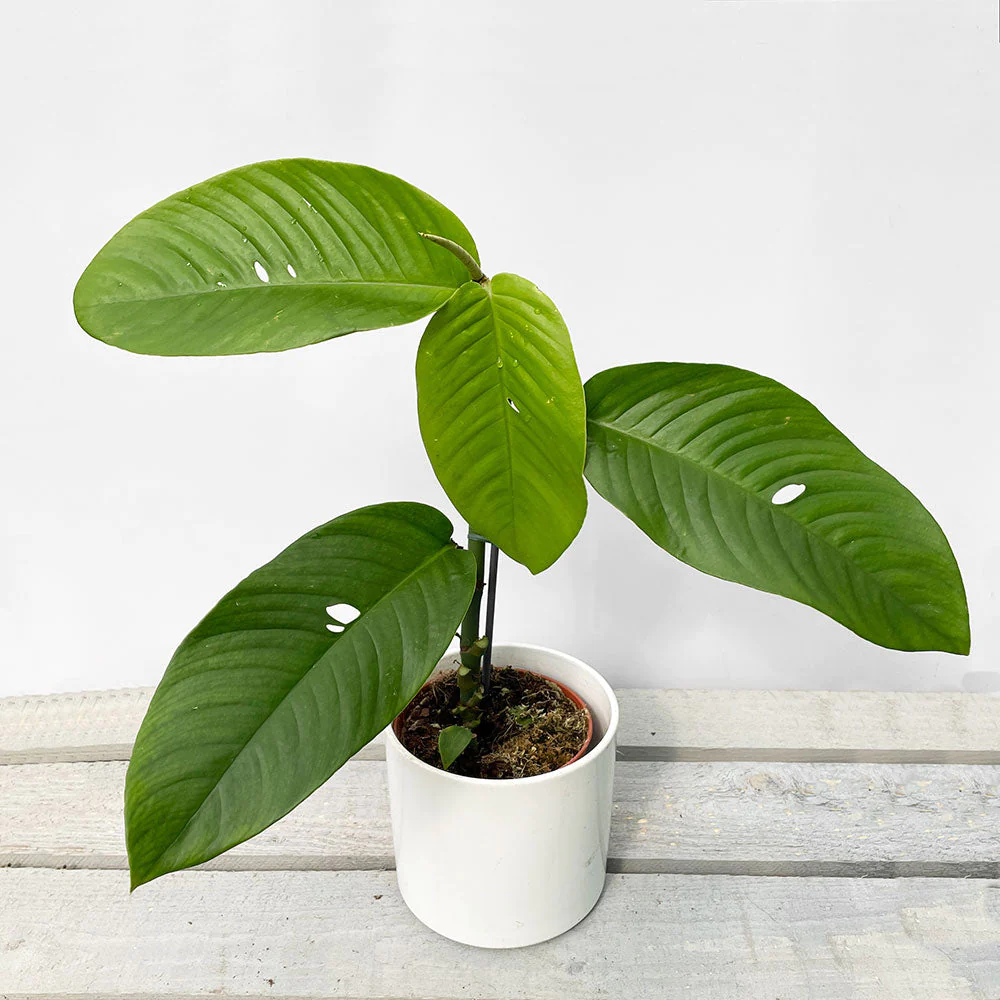
Kew accepts Rhaphidophora foraminifera (Engl.) Engl. as a species native to western Malesia. The botanical description treats it as a moderate-to-large robust vine in wet tropical forest, with clasping and feeding roots and densely leafy climbing stems.
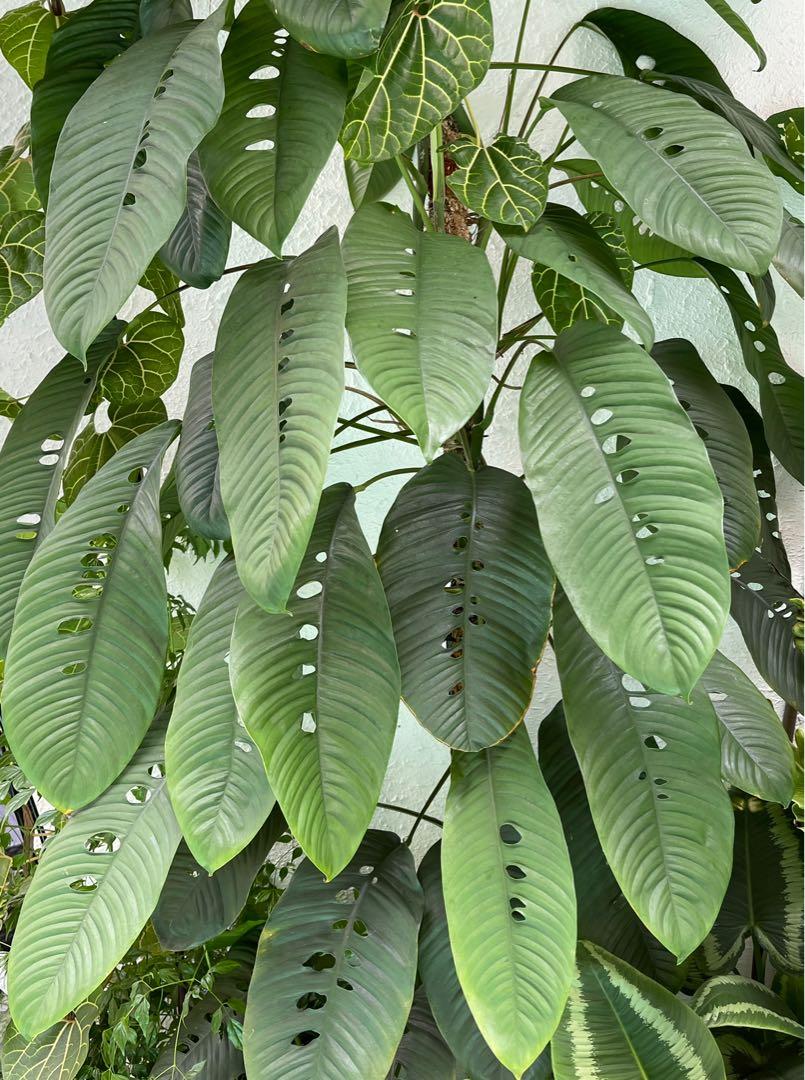
Mature blades can be entire, slightly perforated or more extensively perforated. The diagnostic openings are round to rhombic and extend only partway from the midrib; younger veins can be visibly hairy on the lower surface. That is a more useful frame than expecting deep edge splits or identifying the plant from a trade nickname.
One photo is not enough to authenticate a plant. Keep its source label, photograph the stem and several leaves, and compare mature characters over time. If the plant is patterned cream or white, use the separate variegated R. foraminifera owner for reversion and node-selection decisions.
Care at a glance: observe, then adjust
Use plant response and root-zone evidence instead of copying a schedule from a different room.
| Factor | Useful target | Watch for | First adjustment |
|---|---|---|---|
| Light | Bright, filtered exposure | Stretching or exposure-side bleaching | Move gradually; compare new growth |
| Water | Partial drying, then full soak and drain | Persistently wet mix or severe wilt | Check roots, mix and drainage |
| Support | Stem attached with room above the tip | Sideways search growth or long gaps | Extend and reattach the route |
| Humidity | Stable room conditions with air movement | Repeated unfurling damage or wet foliage | Measure before adding a humidifier |
| Nutrition | Label-rate feeding during active growth | Salt crust, burnt tips or stalled roots | Pause, flush and inspect conditions |
Light: judge the vine, not the compass
Place the plant where it receives bright light softened by distance, glazing, a sheer curtain or the angle of the sun. “East window” and “five feet back” are not universal measurements: outdoor obstructions, season and glass change the usable light dramatically.
Low usable light often shows as a long distance between leaves, a stem that searches away from support and progressively smaller blades. Excess direct exposure can create pale, dry patches on the window-facing side. Change exposure gradually and judge the next two or three leaves rather than expecting an old mark to heal.
Support: give the stem a continuous route
A board, trellis or pole should begin close to the root ball and extend beyond the active tip. Attach the main stem loosely between nodes. Do not tie a petiole or trap an emerging leaf; petioles need to reposition the blade toward light.
A dry board provides mechanical support and stays easy to inspect. A moist pole may invite roots into its surface, but it also creates another moisture zone to maintain. Choose the system you can extend and monitor. Contact supports orderly climbing and maturity; it does not guarantee that the next leaf will perforate.
Water and roots: replace the weekly rule
Water demand changes with light, temperature, humidity, pot material, root volume and substrate. Push a finger or wooden probe below the decorative surface and compare the pot’s weight. When the upper portion has partly dried while the root zone still feels lightly moist, water thoroughly and let the excess escape.
Never leave the nursery pot standing in a filled cachepot. If the mix remains wet for many days, first inspect the drainage path and roots; adding another ingredient without finding the bottleneck can hide the problem. The Rhaphidophora soil owner covers particle-size and water-holding trade-offs.
Repot for root evidence, not simply because the calendar changed. Roots circling densely, escaping the drainage holes or using water unusually fast can justify a modest size increase. A much larger pot holds a larger reservoir that an impaired root system may not use safely.
Humidity, leaves and pests
Stable moderate humidity can help a new blade expand, but daily misting changes the air only briefly and repeated wetting may increase disease risk. If leaves repeatedly stick or tear, measure the room, confirm root hydration and rule out pests before adding a clean humidifier with gentle air movement.
Support each blade and wipe dust with water and a soft cloth; skip oils and leaf-shine products. Inspect the underside, petiole junctions and newest folded growth for webbing, stippling, scale-like bumps or cottony residue. Isolate a suspicious plant before treatment and follow the product label for indoor use.
Feed only when the plant can use it
Fertilizer supplements active growth; it does not repair weak light or failing roots. Use a complete houseplant fertilizer at the label rate while the vine is producing healthy new leaves. Reduce or pause when growth slows, after root damage or while the medium stays wet unusually long.
White crust on the pot or mix, root-tip damage and repeating brown margins can accompany excess soluble salts. Pause feeding, confirm that the pot drains and flush with plain water when appropriate. If a whole leaf turns yellow, use the Rhaphidophora yellow-leaf diagnostic rather than assuming the plant needs more food.
When growth looks wrong
| Observation | Likely group | Check first | Avoid |
|---|---|---|---|
| Small solid leaves | Youth, weak light or lost support | Attachment, node spacing, newest trend | Forcing maturity with heavy feeding |
| Whole-leaf yellowing | Root-zone, light or nutrient issue | Mix depth, roots and sequence | Treating color alone |
| Dry exposure-side patch | Light or heat injury | Sun path and window proximity | Expecting old tissue to recover |
| Black soft patch | Moisture, cold or infection risk | Wetness, airflow and spread | Misting the symptom |
| New leaf sticks | Root hydration, dry air or pests | Roots, measured humidity, folded growth | Pulling the leaf open |
A five-minute weekly check
- Look at the newest leaf, node spacing and attachment before changing care.
- Check below the surface and lift the pot before deciding to water.
- Confirm the support continues beyond the active tip.
- Inspect the newest folded growth and leaf undersides for pests.
- Record one change at a time so the next leaf provides useful evidence.
Frequently asked questions
Is Rhaphidophora foraminifera an accepted species?
Yes. Kew accepts the name and places the species in western Malesia, where it grows as a wet-tropical climber.
Where should its leaf perforations appear?
Mature blades may be entire or perforated. When present, the round-to-rhombic openings typically run close to the midrib rather than forming a promise of deep edge splits.
Why does my young plant have no holes?
A solid blade can reflect a younger stage, a recent transition, weak usable light or lost climbing contact. Compare several new leaves and the attached stem before questioning identity.
How often should I water it?
Do not use a fixed weekday. Check moisture below the surface and pot weight, then soak and drain after the upper mix has partly dried.
Does it need a moss pole?
It needs a stable route upward, but that can be a board, trellis or pole. A moist pole is optional and adds another moisture zone to manage.
Can I propagate a leaf without a node?
A leaf alone does not contain the growth point needed to build a new vine. Use the Rhaphidophora propagation owner for node and rooting mechanics.