Greenboog collector guide
Variegated Rhaphidophora foraminifera is best managed as a climbing species with an extra constraint: every pale sector reduces the green area available to support the next leaf. Read the stem, active bud and several consecutive nodes—not a single show leaf.
Start with the species, not the seller nickname
Kew accepts Rhaphidophora foraminifera as a species native to western Malesia and describes it as a wet-tropical climber. A botanical revision from Singapore Botanic Gardens describes a robust vine whose mature blades may be entire or perforated, with rounded to rhombic openings near the midrib.
That matters because the legacy article called this plant “Dragon Tail” and promised dramatic splits. “Dragon Tail” is commonly applied elsewhere in the trade and is not a reliable identity for this species. Mature R. foraminifera is better read by its climbing habit and internal perforations than by a Monstera-like split-leaf promise.
“Albo,” “marble,” “yellow variegated” and “variegata” appear as commercial labels. They may help a seller distinguish stock, but the official botanical sources reviewed do not establish them as separate accepted taxa. Ask what the label means for the exact plant, and keep provenance separate from appearance.
Light supports the pattern; it cannot manufacture it
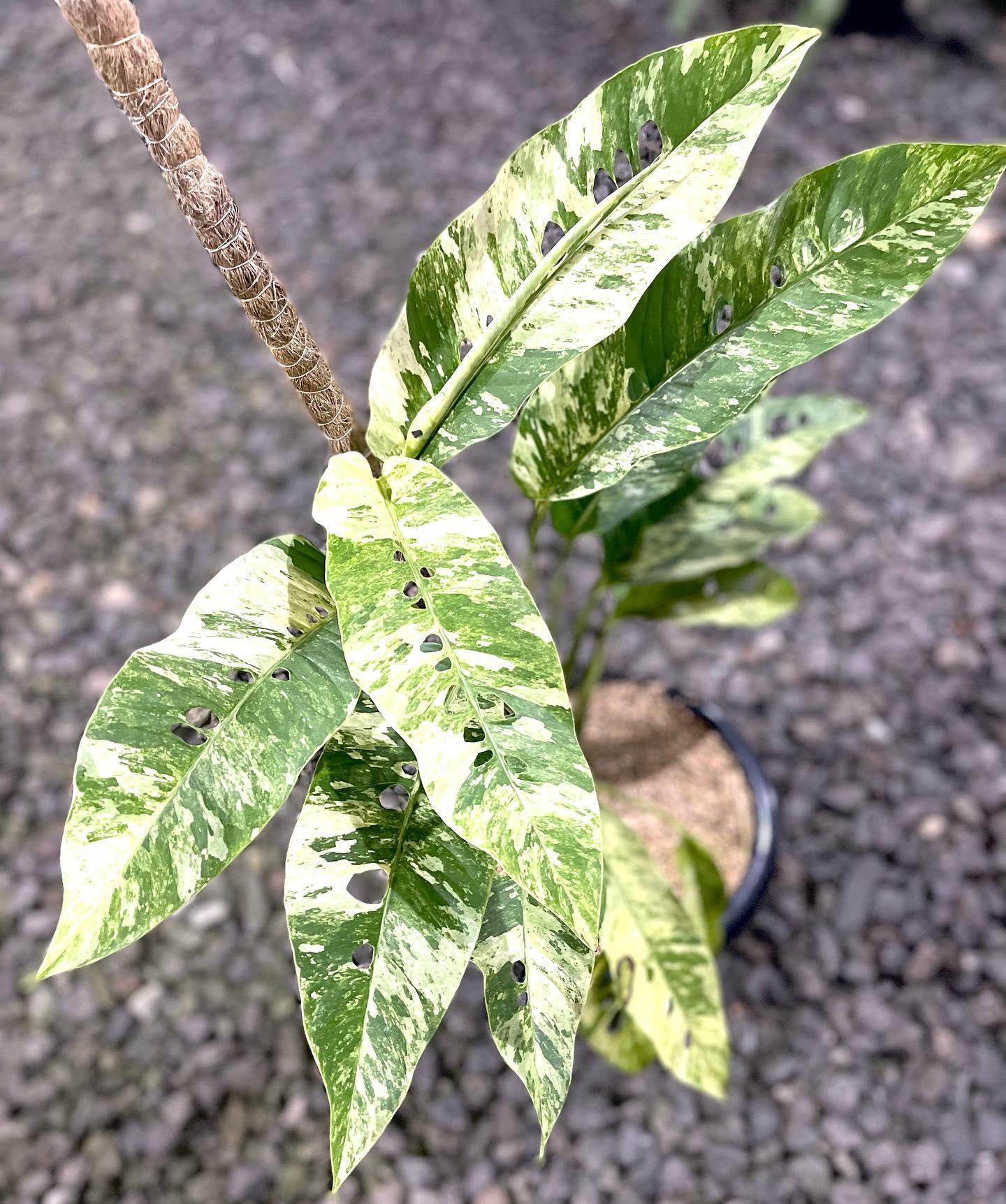
Pale leaf sectors contain little or no chlorophyll, so the remaining green tissue carries more of the photosynthetic workload. Place the vine where it receives bright, filtered light for much of the day, then acclimate it gradually. Watch the plant’s response rather than relying on window direction alone.
Too little usable light can produce weak growth and make a low-green vine harder to sustain. Too much direct exposure can bleach or scorch pale sectors first. Neither outcome proves that the genetic pattern has changed. Compare the exposure side, the stem beside the newest bud and several leaves before diagnosing reversion.
Read three nodes before making a cut
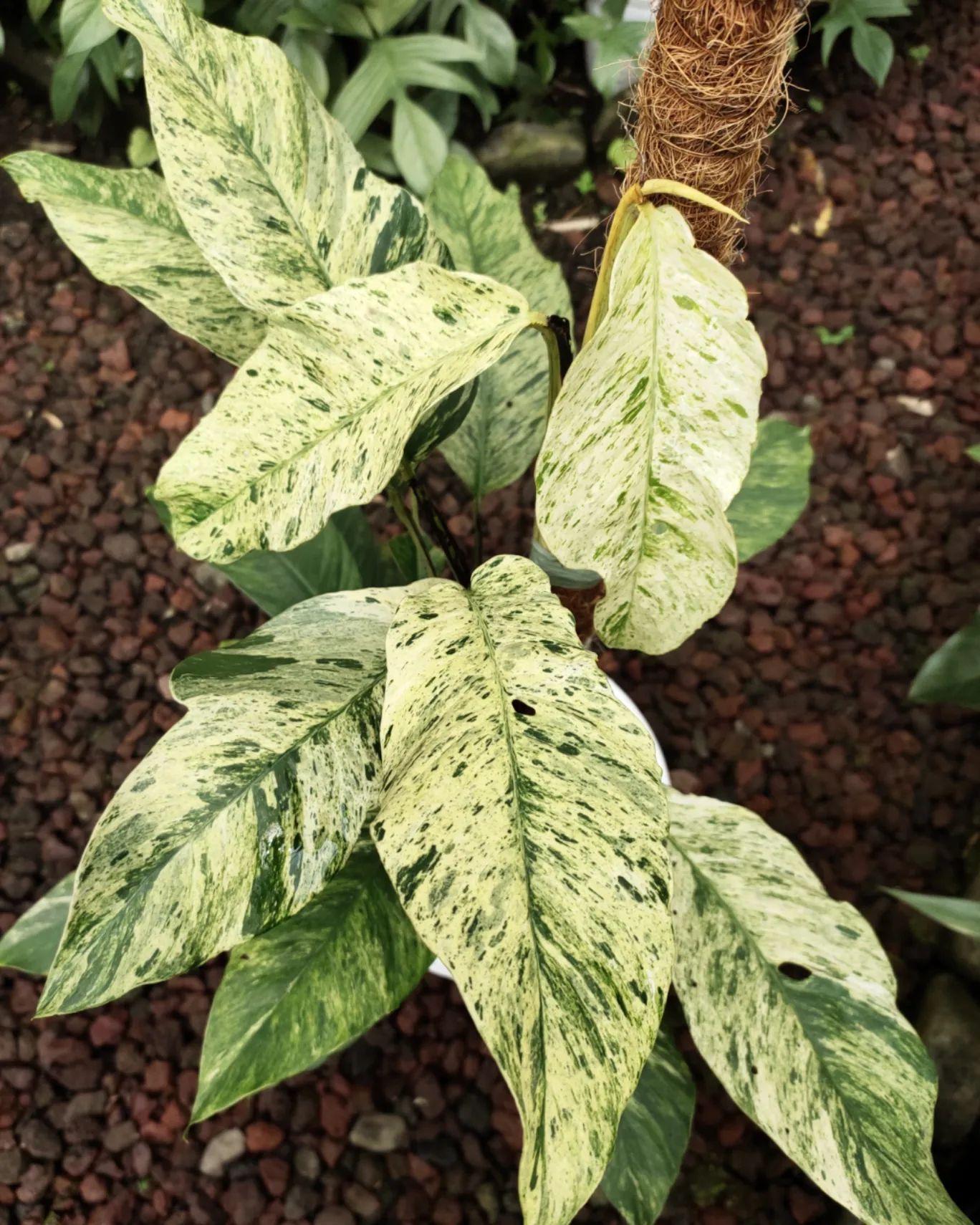
One greener leaf is not enough to declare reversion. Photograph the newest three nodes in neutral light and inspect the main stem, the axillary bud and the newest unfurled leaf together. Variegation can fluctuate from leaf to leaf even while a patterned stem continues.
Use this as a decision sequence, not a promise about what the next bud will produce.
| Observation | Possible meaning | Check next | Safest first action |
|---|---|---|---|
| One greener leaf | Normal variation within a patterned run | Stem pattern and next active bud | Wait; keep the useful green leaf |
| Several plain-green nodes | A green reversion may be established | Last balanced node with a viable bud | Plan one conservative cut only after confirming the growth point |
| Several almost-pale leaves | Too little green area to sustain vigorous growth | Roots, stem stripe and a bud with mixed tissue | Protect from scorch; consider returning to a balanced node |
| Tan edge on pale sector | Light, heat, water/root or physical damage | Exposure pattern, pot moisture and roots | Correct the confirmed stressor; do not chase old damage |
| Small leaves, long gaps | Usable light or climbing contact may be inadequate | Light duration, stem attachment and root health | Improve conditions gradually before pruning |
When reversion deserves pruning
University extension guidance notes that vigorous green reversions can overtake slower variegated tissue. On a climbing aroid, translate that principle node by node: find the last section showing a useful green–pale balance, confirm a viable axillary bud, and make a clean cut with sterile tools above the tissue you intend to keep.
Do not cut to the “prettiest leaf” without checking its bud. The next shoot comes from the growth point, not from the display blade. A beautiful leaf can sit beside a plain-green bud, an almost-pale bud or no usable bud at all.
Protect the roots behind the variegation
Variegation does not create a special watering calendar. Check below the decorative surface and compare pot weight. Water thoroughly after the upper portion has partly dried, then let excess drain. A low-green plant has less margin for chronic root stress, so permanent wetness is not a shortcut to faster growth.
Use a structured medium with durable air space and a pot sized to the roots. Particle size, indoor temperature and watering habits matter more than a universal recipe. The Rhaphidophora soil owner covers substrate choices; the genus care owner covers the broader seasonal routine.
If a whole leaf yellows rather than a pale patch browning, work through the Rhaphidophora yellow-leaf diagnostic. Do not assume every color change is reversion.
Give a robust climber a real route upward
The botanical description treats *R. foraminifera* as a substantial climber with clasping and feeding roots. Indoors, give the main stem a board, trellis or pole and attach it loosely between nodes. Never tie the petiole or trap an emerging leaf.
A dry board provides mechanical support. A moist pole can offer a rootable surface but also adds watering complexity. Choose the system you can inspect and maintain consistently. Extend it before the active stem hardens sideways; support encourages orderly climbing but cannot guarantee a perforation on the next leaf.
For baseline green-species light, water and support decisions, use the green R. foraminifera care owner. Its legacy URL contains a spelling error, but it remains the assigned species-care destination until a separately approved slug decision.
Humidity, leaf care and damage triage
Stable moderate humidity can help a new leaf expand, but daily misting does not create a controlled humidity system and may keep crowded foliage wet. Use a clean humidifier only when measured conditions and repeated unfurling problems justify it, with gentle air movement around the plant.
Skip leaf-shine products, oils and home mixtures. Support the blade and wipe dust gently with water and a soft cloth. Photograph a new mark before treating; observe whether it expands, repeats on new growth or tracks the window-facing side.
Propagation: inspect the bud, not only the mother leaf
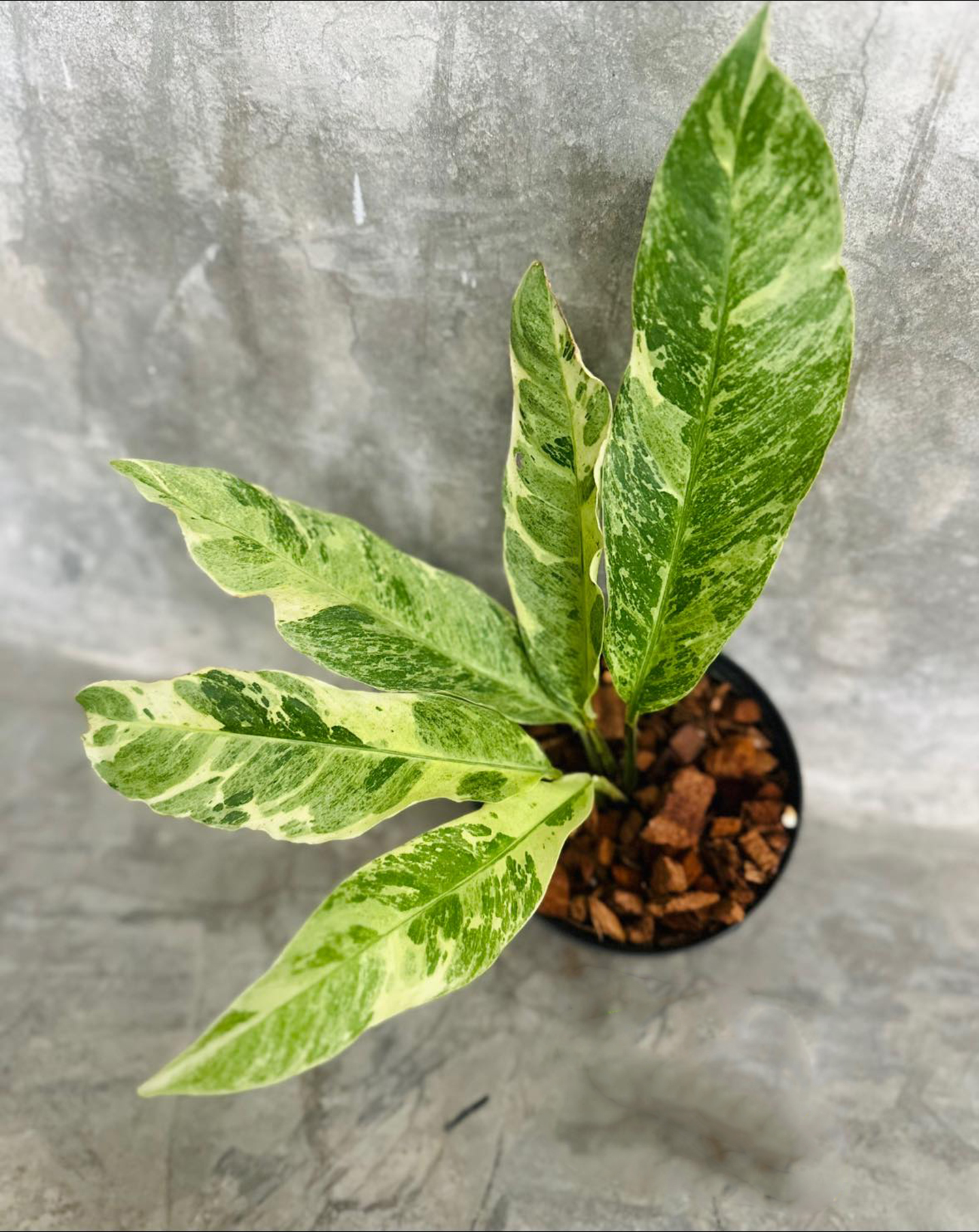
A cutting needs a viable node. For a variegated line, also inspect the stem and axillary bud that will form the next shoot. A strongly marbled mother leaf cannot guarantee that the new vine will repeat its pattern.
Keep rooting mechanics and transition care with the Rhaphidophora propagation owner. This guide owns only the extra pattern-selection boundary: preserve a functional growth point and enough green tissue, and avoid promises about rooting time or future color.
Before paying a variegation premium
The useful question is not “Which nickname sounds rarest?” It is “What evidence connects this listing to the growth point I will receive?”
Request current, exact-plant evidence whenever the price depends on variegation.
| Evidence | Why it matters | Useful proof | Weak substitute |
|---|---|---|---|
| Image basis | Shows whether the pictured plant is the plant sold | Exact-plant label and current dated images | Representative mother-plant photo |
| Stem and bud | Future growth comes from the bud | Close view of node, stem pattern and growth point | Leaf close-up without stem |
| Recent sequence | Shows the direction of the active line | Newest two or three leaves on one vine | One historic high-pale leaf |
| Root and medium | A stressed cutting has less margin for error | Rooted status, current medium and transition notes | “Easy to root” promise |
| Lineage/name | Trade labels vary between sellers | Documented source and a clear label definition | A premium nickname without provenance |
A five-minute weekly check
- Photograph the newest node, bud and leaf in neutral light from the same angle.
- Compare the newest three nodes before calling a shoot reverted or too pale.
- Check below the mix surface and lift the pot before deciding to water.
- Confirm the stem is supported and no petiole or unfurling blade is tied.
- Record scorch, pest or yellowing patterns before changing several conditions at once.
Frequently asked questions
Is variegated Rhaphidophora foraminifera a separate species?
No separate species was found in the official botanical sources reviewed. Kew accepts R. foraminifera; “variegated,” “albo” and “marble” describe cultivated appearance or seller lines unless documented otherwise.
Does more light create more variegation?
No. Bright filtered light supports growth with reduced green tissue, but it cannot reliably change the pattern encoded in an active growth point. Increase exposure gradually and watch for scorch.
Should I remove one all-green leaf?
Not automatically. It still feeds the plant and may be followed by patterned growth. Inspect several nodes and the stem beside the active bud before deciding that the shoot has reverted.
Can I save an almost-white run?
Protect it from direct scorch and confirm root health, but recognize that very little green tissue limits the energy available for continued growth. If a healthier balanced bud exists below, a conservative cut may be safer; the result is not guaranteed.
Why are the newest leaves not perforated?
Perforations are a maturity trait, not a test of variegation. The botanical description allows entire through perforated blades. Stable climbing contact and overall vigor matter more than forcing a fixed timetable.
Is “Dragon Tail” the right common name?
It is not a reliable identity label for this species. Use the botanical name *Rhaphidophora foraminifera* and verify the plant through provenance and multiple structural features rather than one trade nickname.
Sources and further reading
- Kew Plants of the World Online: accepted species, native range, habit and diagnostic description
- Singapore Botanic Gardens: taxonomic revision of Rhaphidophora in Peninsular Malaysia and Singapore
- UF/IFAS Extension: chlorophyll, variegation and green reversion principles
- University of Connecticut Extension: causes and management boundaries for plant reversion
- University of Florida propagation program: chimeral reversion and pruning principle