Root-zone decision guide
Water Epipremnum when the rooted zone has dried enough to regain air—not because a weekday, one-inch rule or drooping leaf says so. Combine pot weight, moisture depth, drainage behavior and root condition, then water the whole root ball and let runoff leave.
Why Epipremnum needs a decision, not a schedule
Dry-down changes with light, temperature, airflow, pot material, root mass, mix structure and the number of cuttings in a container. A small rooted cutting in coarse mix can dry quickly; a large decorative cachepot around dense mix can remain saturated. The same plant can also use water at different rates after a move or seasonal light change.
NC State advises allowing well-drained potting medium to dry between waterings and notes root rot and blackened leaf margins with overwatering. That describes a root-zone direction, not an exact number of days. A calendar is useful for checking; it should not decide automatically.
The four-signal watering check
| Signal | How to check | What can mislead you |
|---|---|---|
| Pot weight | Lift after a full watering, then compare as the mix dries. | Heavy ceramic/cachepots and newly upsized containers. |
| Moisture depth | Probe into the actual rooted zone with a finger or clean wooden skewer. | A dry surface above a wet lower pot; meters in chunky mix. |
| Drainage | Confirm open holes, free runoff and an empty saucer/cachepot. | A decorative pot hiding standing water. |
| Plant/root condition | Compare newest growth, stem firmness, root color/odor and recent change. | Treating every droop or yellow leaf as thirst. |
- After a thorough watering and full drain, lift the pot and note its weight.
- Check again over several days without watering automatically.
- Record light or temperature changes that alter drying time.
- Probe deeper than the decorative top layer.
- Use the pattern to choose the next check date—not a permanent watering day.
How to water the whole root ball
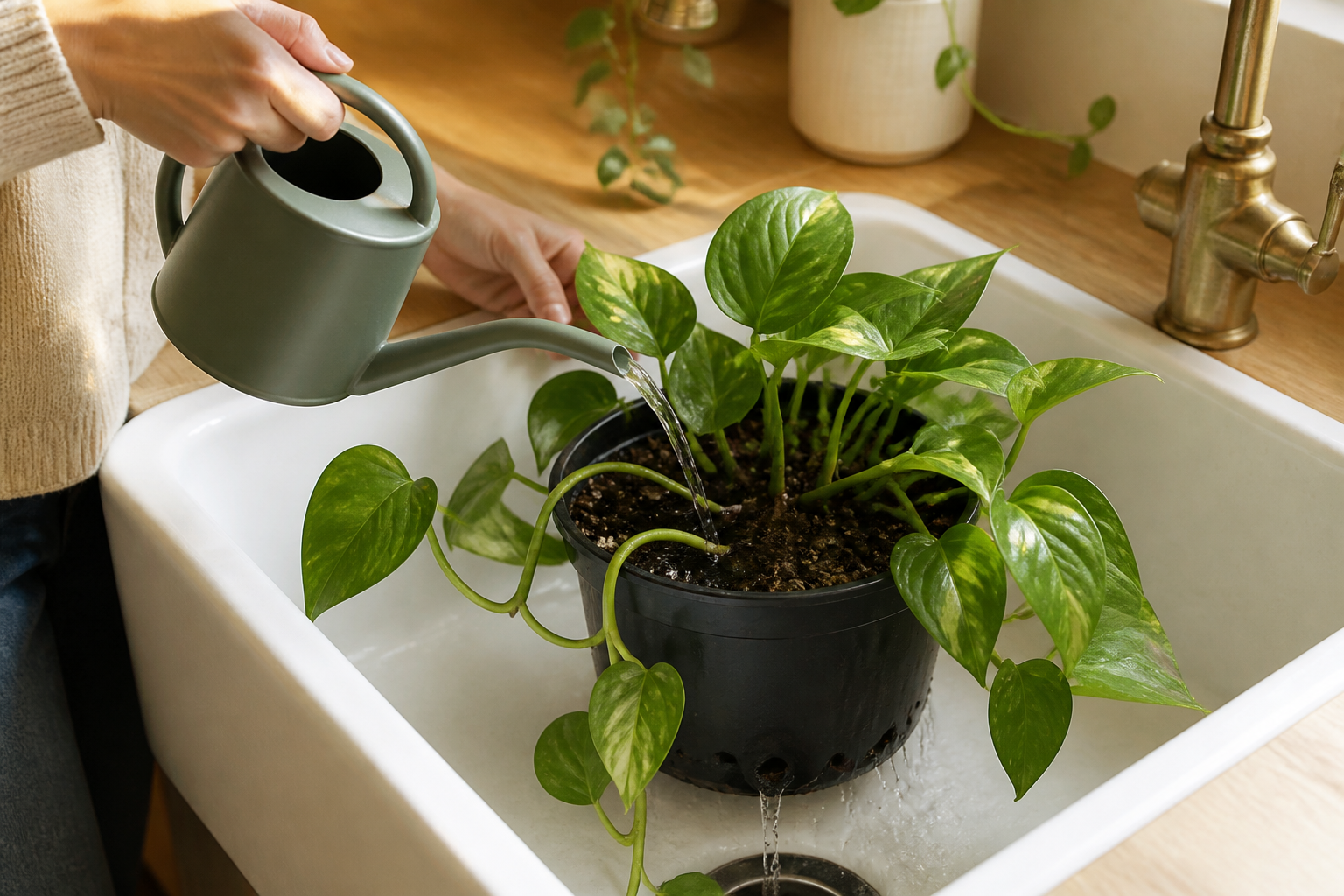
Move the nursery pot to a sink or use a tray that can be emptied. Pour slowly across several points on the mix until the root ball is evenly wet and modest runoff exits. Let the container drain, then remove standing water from the saucer or cachepot. Penn State Extension emphasizes drainage holes and removing excess water from an outer pot to avoid waterlogging.
If water races down one channel while the root ball stays light, the mix may have become hydrophobic or pulled from the pot wall. Apply water in two or three slow passes, pausing briefly between them, then verify that the center has rehydrated. Do not leave the pot submerged for hours as a routine.
If a container has no drainage hole, keep the plant in a draining nursery pot placed inside it. A gravel layer does not create an outlet and can leave the rooted zone saturated. Use the decorative container as a cachepot, not as a sealed root chamber.
Overwatered, underwatered or simply stressed?
| Observation | More consistent with | Next action |
|---|---|---|
| Droop + very light pot | Dry root zone, especially if stems and roots remain firm. | Water thoroughly, drain and watch recovery. |
| Droop + heavy wet pot | Low root oxygen, root loss, cold or disease. | Do not add water; inspect drainage and roots. |
| Yellowing + musty mix | Prolonged saturation and possible decay. | Unpot if needed; look for brown, soft or foul roots. |
| Crisp edges + light pot | Dry episode, heat/sun or concentrated salts. | Check exposure and root-zone moisture before assuming humidity. |
| Dark lesions spreading | Injury, pest, edema or disease—not a diagnosis from water alone. | Isolate if progressing and inspect both surfaces, stems and roots. |
UF/IFAS warns that cultural damage is frequently mistaken for disease in pothos production and that water can spread some pathogens. A leaf-spot photo is not enough to prescribe copper or another pesticide. Diagnose the progression and root zone, then follow a product label or professional recommendation appropriate to the confirmed problem.
Adjust for pot format and growth stage
A multi-cutting hanging basket may use water quickly but also hide a wet center. A newly rooted cutting has fewer active roots and should not sit in a large wet volume. A climbing mature plant may dry faster after stronger growth. Tissue-culture plantlets need a separate acclimation workflow because humidity, tiny roots and substrate volume change the decision.
When roots fill the container so densely that water runs around the edge or the mix dries unusually fast, inspect before upsizing. Penn State recommends a container only slightly larger than the root ball and a draining potting mix; excess volume can stay wet longer than the roots can use it.
Water quality without the overnight myth
Ordinary potable tap water is often workable. If white crust accumulates on the pot or mix, track fertilizer rate and dissolved minerals, then flush the root ball with suitable water while allowing complete drainage. Leaving tap water overnight may reduce some free chlorine, but it does not remove mineral salts and may not remove chloramine. Do not present it as purification.
Change one variable at a time. If a suspected water-quality problem persists across new growth, compare the source, fertilizer, pH/alkalinity where relevant and root health before buying distilled water indefinitely.
Continue by intent
Use the propagation guide for water-rooted cuttings and the transition to potting mix. Use the types hub to separate species and cultivar identity from watering symptoms.
Sources and limits
- NC State Extension: Epipremnum aureum — dry-down, drainage, root-rot and plant context.
- Penn State Extension: Repotting houseplants — drainage holes, cachepots, mix and container-size guidance.
- Penn State Extension: Container gardening — root-zone drainage boundary.
- UF/IFAS: Pothos diseases — cultural-damage and waterborne-disease diagnostic boundaries.
Evidence limit: No single depth, day count or leaf symptom works for every pot. Recalibrate after changes in light, container, mix, root mass or season.