Accepted species, changing leaf shape and support-led care
Philodendron hastatum, commonly sold as Silver Sword, is an accepted climbing species from southeastern Brazil. Its metallic blue-green appearance is memorable, but Kew’s taxonomic evidence shows wide leaf-shape variation; identify it from connected leaves, stem and provenance rather than silver colour alone.
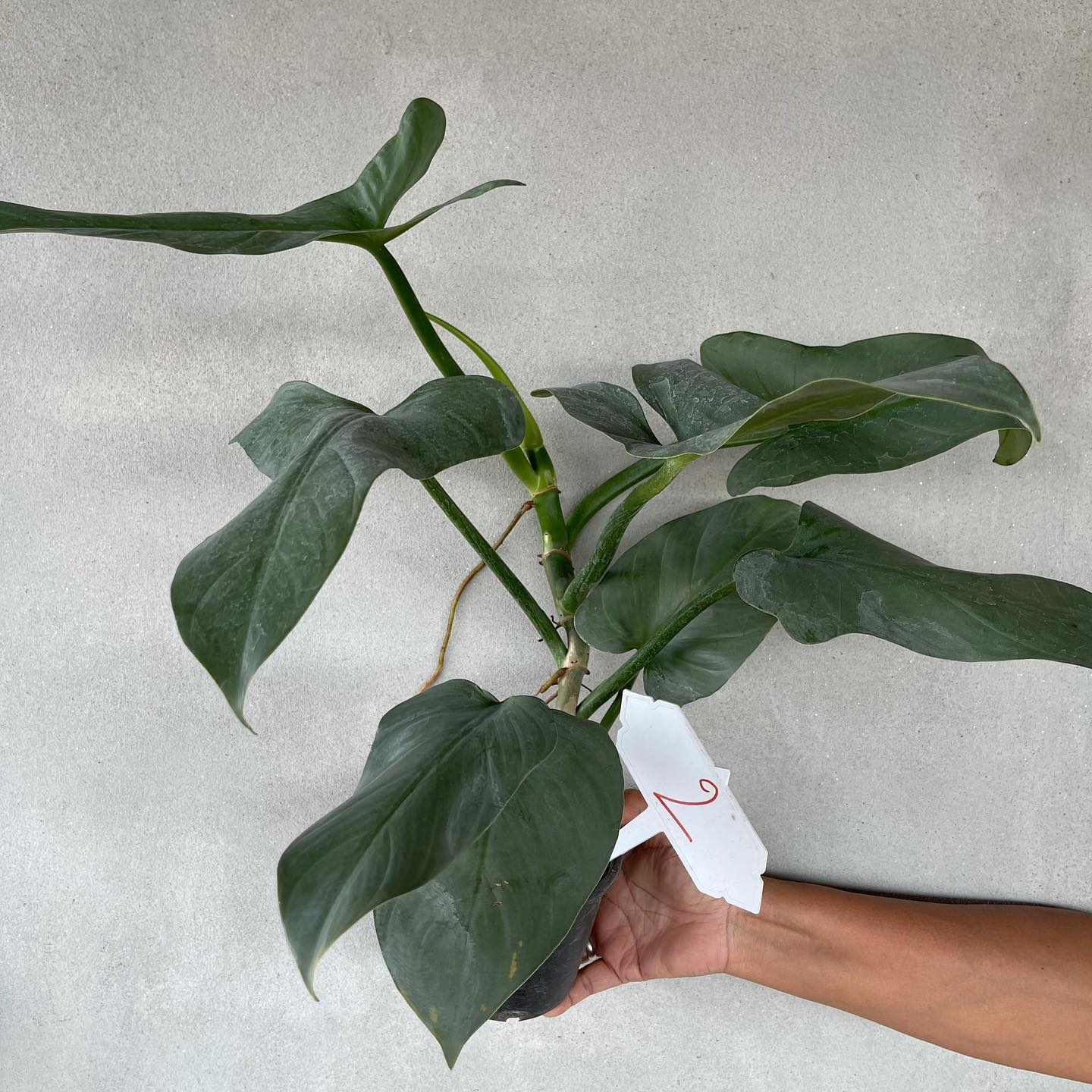
Published in 1855, not discovered in the 1960s
Kew accepts Philodendron hastatum K.Koch & Sello and records its first publication in 1855. Kew records it from southeastern Brazil, specifically Minas Gerais and Rio de Janeiro. It grows as a wet-tropical climber or hemiepiphyte.
The Kew-backed Brazilian revision describes wide morphological variation, especially in leaf shape. Blades can be narrowly ovate to ovate-triangular with a sagittate base and posterior lobes. “Silver Sword” is a horticultural common name for the cool metallic appearance; it is not a separate botanical variety.
That distinction matters when comparing listings. Camera white balance, leaf age, surface residue and viewing angle can all shift a blue-green leaf toward gray or green. Stronger evidence includes a connected series of leaves with developing posterior lobes, a climbing stem with nodes and aerial roots, and a source record that consistently carries the Hastatum name.
Leaf shape changes across connected growth
| Stage or trait | What to observe | What not to assume |
|---|---|---|
| Juvenile leaf | Shorter, less distinctly sagittate blade. | That the plant is misidentified from one young leaf. |
| Established leaf | Longer anterior division and clearer basal lobes. | That every leaf must form an identical sword. |
| Colour | Blue-green to silver-green appearance shifts with angle and hardening. | That low light alone controls the silver effect. |
| Connected stem | Nodes, aerial roots and successive petioles. | Authenticating from a detached leaf. |
Leaf shape is not fixed at one “sword” outline. Evaluate several connected leaves and the original source history, especially when juvenile specimens resemble other blue-green Philodendron.

Support the active climbing axis
Place a board or pole beside the newest flexible stem, secure stem tissue loosely and leave petioles free. Guide new growth before it bends away and allow aerial roots to contact the support where practical. A pole is not a substitute for healthy roots or usable light.
If internodes lengthen while later leaves shrink, check root function, light, warmth and attachment before increasing fertilizer. Use the general Philodendron guide for broader room-level care.
Water from root evidence
Check pot weight and moisture below the surface, then water across the rooted volume when it has partly dried. Let excess drain. A heavy wet pot with limp growth needs a root inspection, not more water; a dry lightweight root ball may need a thorough, even rewet.
Humidity can reduce rapid edge drying, but brown tips can also come from dry–wet swings, salts, heat, damaged roots or spray injury. Weekly watering, a fixed 50–60% target and a pebble tray do not diagnose the cause. Use the watering guide for deeper root-zone decisions.
After delivery or repotting, hold light, warmth and moisture reasonably steady while roots resume function. Avoid immediate fertilizing, repeated location changes and routine pruning of still-green leaves. Existing damage will not reverse, so judge recovery from a firm active point, stable roots and the condition of the next leaf.
Diagnose changes before treating
| Signal | Check first | Measured response |
|---|---|---|
| Droop | Pot weight, root firmness, heat and recent watering. | Correct the verified dry or wet-root cause. |
| Crisp brown tip | Moisture swings, salts, hot glass and roots. | Stabilise the matched factor. |
| Tan exposed patch | A recent light move, heat or spray residue. | Reduce the matched exposure; acclimate gradually. |
| Fine stippling or webbing | Leaf undersides for spider mites. | Isolate and use an indoor-labelled control if confirmed. |
| Distorted new growth | Growth point for thrips, mites or physical injury. | Identify before spraying. |
| Soft dark stem | Crown depth, roots and wet duration. | Remove failed tissue and preserve a viable node if needed. |
Propagate a node, not a detached leaf
A viable cutting needs stem tissue with a node and bud or active growth point. Photograph the connected plant and label before cutting, use clean tools, and keep the base warm, airy and moist rather than saturated.
- Choose a healthy node with useful leaf area.
- Retain an aerial root where practical.
- Keep the petiole and growth point above the medium.
- Transfer after functional roots can support new growth.
- Preserve the Hastatum / Silver Sword source label.
Use the Philodendron propagation guide for node and transfer decisions.
Safety, buyer checks and live routes
Philodendron hastatum is not pet-safe. Its tissue contains calcium-oxalate crystals that can irritate the mouth and digestive tract when chewed, and the sap can irritate skin. Keep plants and cut material away from children and pets.
- Confirm exact-plant versus representative-gallery scope.
- Compare several connected leaves, stem, nodes and active point.
- Ask about rootedness, format, support and shipment terms.
- Do not buy on an “air-purifying” or “pet-friendly” promise.
- Verify current stock and option on the live listing.