Accepted species, seller-line boundary and self-heading care
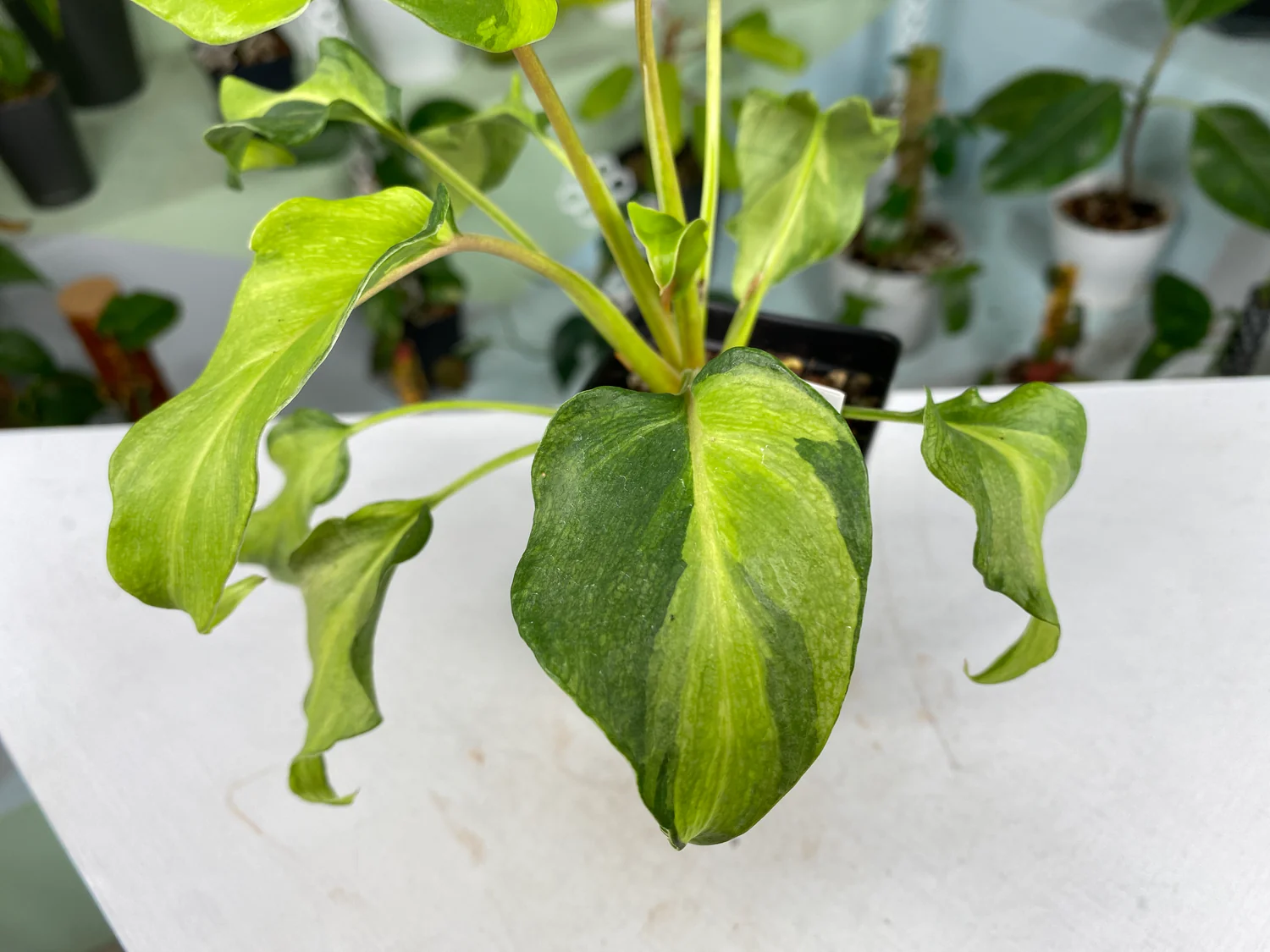
Philodendron Xanadu Dwarf Variegated is a compact seller-line name used for plants with green, chartreuse and yellow patterning around a self-heading crown. The accepted species and the current variegated seller line are related labels, not interchangeable evidence.
Start with the accepted species, then narrow the label
Kew accepts Philodendron xanadu Croat, Mayo & J.Boos, with a native range from southern Brazil to Paraguay. The 2002 species description was based on a cultivated Florida plant whose original collection locality was unknown. It describes a terrestrial plant with short internodes, persistent cataphylls and glossy, deeply divided blades arranged on a compact stem.
That record supports the Xanadu identity and self-heading architecture. It does not establish “Dwarf Variegated” as a botanical variety, cultivar registration or wild population. In current commerce, the added words describe a compact patterned seller line. Preserve that label and the supplier’s photos, but keep the evidence boundary visible.
| Name or record | What it supports | What it does not prove |
|---|---|---|
| Philodendron xanadu | Accepted species, compact terrestrial habit and deeply divided foliage. | The origin or stability of a current variegated line. |
| ‘Winterbourn’ / USPP7030 | Historical compact, many-leaved patented material introduced to the US market. | A variegated dwarf clone. |
| ‘Xanadu-II’ / USPP12506 | A distinct taller, more upright mutation of Winterbourn found in tissue culture. | Identity with Dwarf Variegated. |
| Xanadu Dwarf Variegated | Greenboog’s connected-crown seller line and its displayed pattern. | Formal registration, patent lineage or identical pattern on every leaf. |
Why the Winterbourn history needs a boundary
The original species paper records that horticultural Xanadu entered the American market through Australian nurserymen Barry and Veronica Winterbourn and received US Plant Patent 7,030 in 1989. That patent treated the plant as a compact form related to the old name Philodendron selloum; the later species authors found that it did not match P. bipinnatifidum and left the original seed history unresolved.
The 1989 Winterbourn patent does not document a variegated dwarf clone. A separate patent, USPP12506, covers ‘Xanadu-II’, a taller, more upright, larger-leaved whole-plant mutation discovered in tissue culture. Neither record should be transferred to Greenboog’s patterned line without clone-level provenance.
Read a compact crown, not a climbing vine
Xanadu develops closely spaced leaves around a short stem. It can broaden into a dense clump and may show aerial roots, but it is not a long-internode climber that needs a moss pole. Leave room around the crown, keep the growth point above the medium and rotate the container gradually if light arrives mainly from one side.
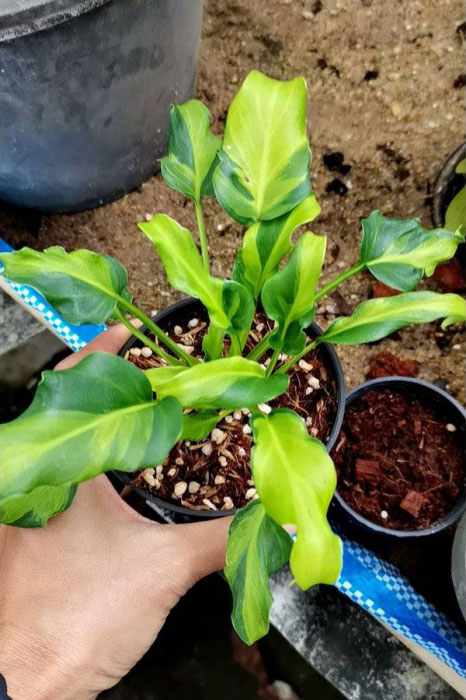
A juvenile leaf can be less deeply divided than a mature green species description. For the Dwarf Variegated line, compare the crown, internode spacing and multiple connected leaves. A single unlobed or unusually bright display leaf is weak identification evidence.
Light supports the plant; it does not paint the next leaf
Place the plant in bright diffused light and acclimate any increase gradually. Light supports the green tissue that powers growth; it cannot manufacture variegation. Harsh direct exposure can bleach or scorch pale areas, while very low usable light can slow growth and root-zone drying.
Judge the same crown over several leaves. One greener leaf is not automatic reversion, and one nearly yellow leaf is not proof of a “better” plant. Useful green tissue, a healthy growth point and functional roots matter more than the palest photograph. The general Philodendron care guide owns the broader room-level light and temperature framework.
Water from the rooted volume
Use a coarse, well-drained medium that still holds useful moisture, and a container only modestly larger than the root mass. Water across the rooted volume, let excess leave, then check pot weight and moisture below the surface before repeating. A fixed top-inch or weekly rule ignores root density, medium, temperature, light and airflow.
Keep the crown at its existing depth; burying the active point invites trouble. Feed modestly only during active rooted growth. Routine misting and pebble trays do not replace root watering or room-level humidity, and fertilizer cannot repair root loss or force stronger variegation. Use the Philodendron watering guide for the deeper wet-versus-dry diagnosis.
Diagnose the pattern and the root zone separately
| Signal | Check first | Measured response |
|---|---|---|
| One greener leaf | Previous and next leaves on the same crown; growth-point health. | Observe the sequence before removing tissue. |
| Large pale area turns tan | Recent sun, heat, spray and hydration change. | Filter exposure and stabilize watering. |
| Whole leaf yellows | Leaf age, root texture, pot weight and crown depth. | Separate normal turnover from root stress. |
| New leaves stay small | Roots, usable light, temperature and active point. | Correct the verified bottleneck, not every variable. |
| Distorted newest leaf | Growth point, thrips, mites and mechanical damage. | Isolate and identify before stacking treatments. |
Propagate a growth point, not a leaf
For a self-heading plant, a rooted offset or documented division is safer than treating a leaf and petiole as a cutting. Wait until an offset has its own viable point and useful roots, keep the crown intact, use clean tools and avoid splitting a stressed or recently shipped plant.
- Photograph the mother crown, label and connected leaf sequence first.
- Confirm the division includes a growth point, not only a petiole.
- Retain roots where practical and keep the base airy, warm and evenly moist.
- Preserve enough green tissue to support recovery.
- Judge later pattern across new leaves after establishment.
The Philodendron propagation guide provides the broader hygiene and transfer framework. A fixed four-to-six-week promise is unsafe because recovery changes with root mass, season and environment.
Buyer checklist and live routes
- Ask whether the photo is the exact plant or a representative of the line.
- Compare several connected leaves, the short stem, crown and active point.
- Confirm rootedness, pot size, recent division and shipment format.
- Do not pay a provenance premium for an undocumented patent or registration claim.
- Prefer balanced green tissue and healthy roots over one nearly yellow leaf.
Safety and sources
Philodendron tissue contains insoluble calcium-oxalate crystals that can irritate the mouth and digestive tract when chewed. Keep plants and divided material away from children and pets, and seek appropriate medical or veterinary guidance after significant exposure.