Greenboog cultivar-first care guide
Ring of Fire care is a balance problem: enough usable light for steady growth, enough air around the roots, and enough green tissue to support the changing color collectors value.
Start here before moving, watering, pruning or buying.
| Trait or need | Practical interpretation |
|---|---|
| Name | Philodendron ‘Ring of Fire’; RHS lists ‘Henderson’s Pride’ as a synonym |
| Plant type | Cultivated Philodendron with compact, short-internode growth—not a separate species |
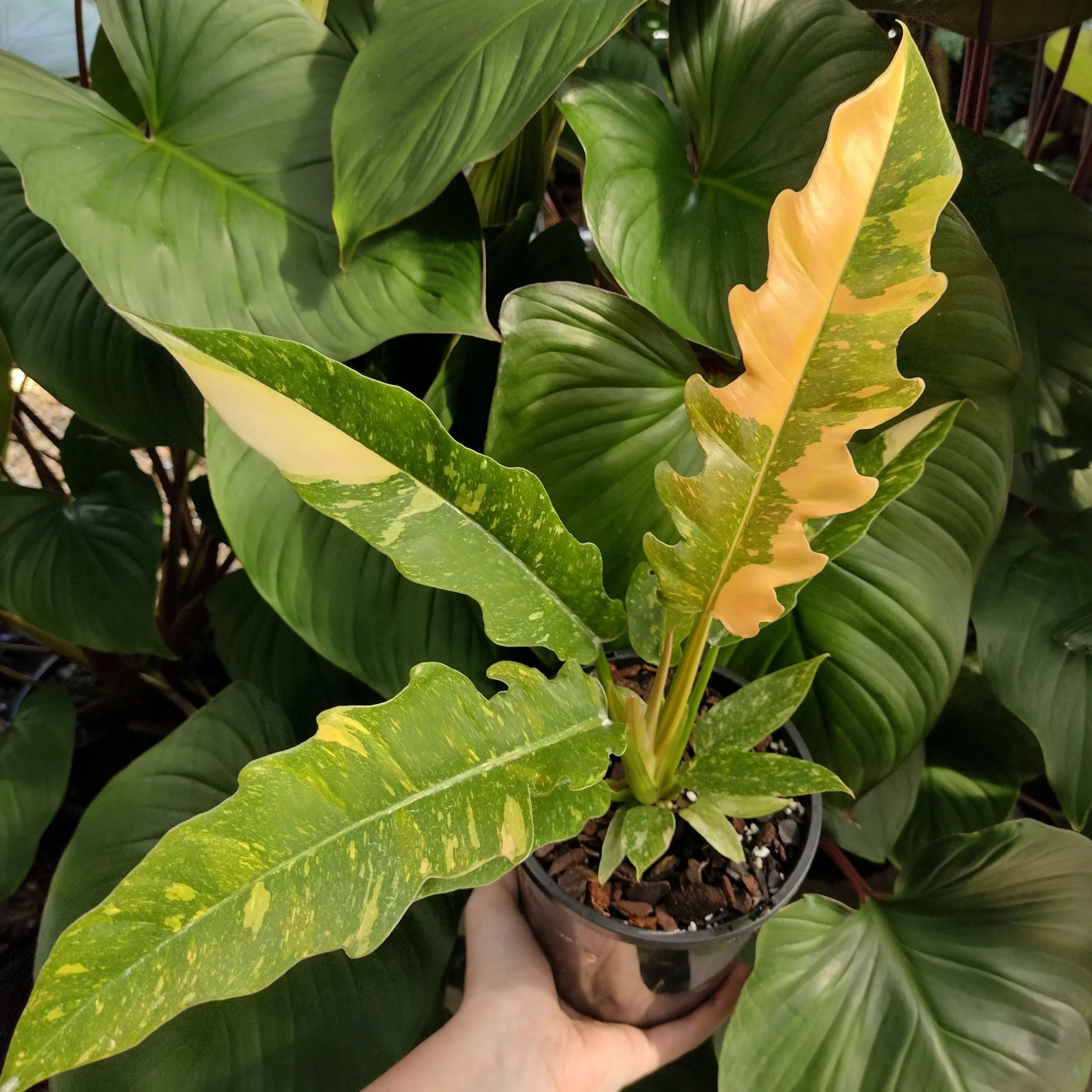
| Foliage | Long, increasingly lobed leaves with variable green, cream, yellow, copper and orange sectors |
| Light | Bright indirect or filtered light; acclimate before stronger exposure |
| Water | Water thoroughly after the upper root zone dries somewhat, then drain |
| Warning system | Roots and the pattern across several leaves—not a fixed weekly schedule |
Is Ring of Fire a species or a cultivar?
The evidence supports writing the name as Philodendron ‘Ring of Fire’. The Royal Horticultural Society record marks that cultivar name as accepted and lists Philodendron ‘Henderson’s Pride’ as a synonym.
A cultivar does not have a natural range in the same way a botanical species does. It is therefore misleading to say Ring of Fire itself is “native to the rainforests of Central and South America.” The genus Philodendron is tropical American; this particular named plant exists in cultivation.
Several parentage stories and introduction dates circulate in plant listings, but the RHS record does not verify them. Unless a seller can provide a breeder or registration source, treat a precise hybrid formula or discovery story as unconfirmed trade history—not as an identification feature.
How to identify Philodendron Ring of Fire
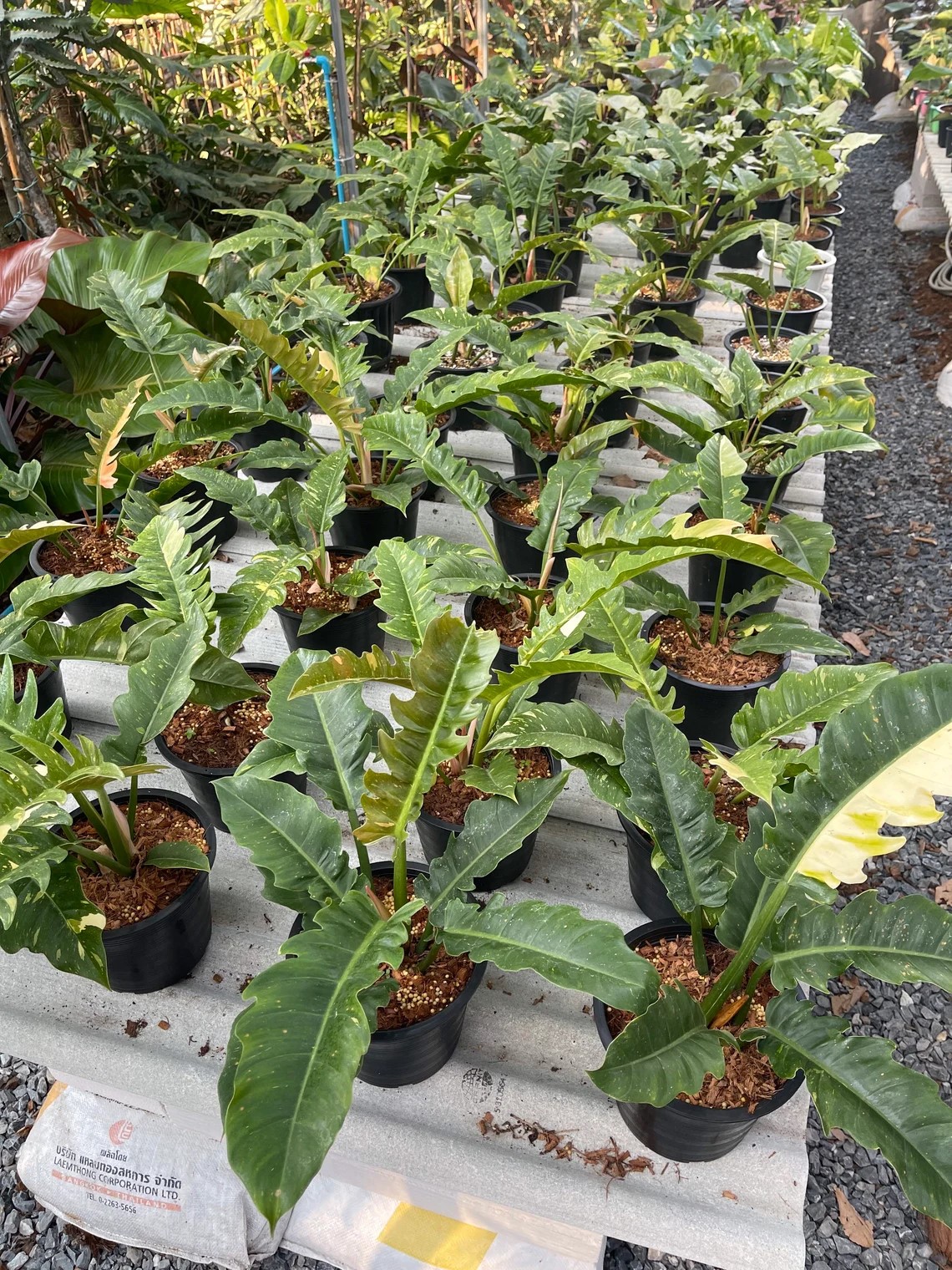
Look for a pattern across mature and developing leaves. Greenboog’s established plants show elongated blades whose margins become irregularly and deeply lobed. Variegation is sectoral or marbled rather than a uniform edge, and a new leaf may open copper, orange, yellow or cream before its color changes while hardening.
Color is variable from leaf to leaf. An orange emergent does not stay exactly the same shade, and a greener leaf does not automatically mean the entire plant has reverted. Juveniles and tissue-culture plantlets may not yet show the mature lobing, so source and batch identity matter when buying a small specimen.

Names that should not be merged automatically
“Golden Marble,” “Mint” and other seller labels may describe a selected look, a separate commercial line or simply marketing. The accepted RHS synonym does not make every similar lobed variegated Philodendron the same cultivar. Ask for the exact plant and its source instead of paying for typography on a label.
Light: support growth without bleaching the leaves
Start with bright indirect light or filtered window light. NC State Extension recommends bright indirect light for Philodendron generally and warns that direct sun can scorch leaves. A plant coming from a nursery, shipping box or dim room needs gradual acclimation before it receives stronger light.
Light helps the existing mix of green and pale tissue function; it does not paint genetic variegation onto green cells. Too little usable light can produce weak, stretched growth and poorer color expression, while excessive light can bleach or burn the pale sectors first. Judge placement by several weeks of new growth, internode spacing and scorch—not by one afternoon.
- Likely too little: long weak petioles, growth leaning strongly toward the source, smaller new leaves or prolonged lack of growth after roots are confirmed healthy.
- Likely too much/too fast: pale tan patches on the window-facing surface, crisp margins on light sectors or damage after a sudden move.
- Useful adjustment: move the plant in small steps, rotate for balanced exposure and measure duration/distance if using a grow light.
Water the root zone, not the calendar
Check below the surface and lift the pot before watering. When the upper mix has dried somewhat and the pot is noticeably lighter, water the entire root ball until excess exits the drainage holes; empty the saucer. A small root system in a large, dense pot can stay wet long after the top appears dry.
The goal is moist, oxygenated roots—not permanent saturation and not a scheduled drought. University of Minnesota Extension likewise advises using the plant and soil rather than the calendar and avoiding roots sitting in drainage water.
Build an airy, moisture-balanced root zone
Use a clean mix that holds some moisture but does not collapse around the roots. A practical blend can combine quality potting mix or coco/peat with coarse bark and mineral aeration such as perlite or pumice. Adjust the ratio to your room: warm, bright, ventilated conditions dry faster than a cool, dim shelf.
Choose a container only modestly larger than the healthy root mass, with unobstructed drainage. Repot when roots crowd the pot, the mix has broken down or water no longer moves through evenly—not because a fixed number of months has passed.
Temperature, humidity and airflow
Keep conditions warm and stable. NC State gives 65–85°F (about 18–29°C) as the general Philodendron range and warns about cold drafts. Avoid placing the foliage against cold glass or directly in heating/air-conditioning airflow.
Average household humidity can work when roots, light and airflow are balanced. A pebble tray cannot correct an undersized root system or a cold wet mix, and routine misting gives only a short humidity change while leaving leaf surfaces wet. Use a hygrometer and a room humidifier if the air is genuinely dry; maintain circulation around crowded plants.
Feeding and maintaining variegation
Feed only while the plant is actively growing and follow the product label at a conservative rate. Do not fertilize a dry, rotting, newly shipped or recently repotted root system to force color. Illinois Extension cautions that overfertilizing can burn roots, especially when growth is slowed by dim light.
Variegated tissue contains less chlorophyll, so the plant needs a workable balance of green and pale tissue. Keep a healthy green leaf simply because a new leaf is greener than expected. Consider pruning only after repeated all-green growth from the same active point and after confirming that light and root health are adequate. Cut back to a node/stem section that visibly carries variegated tissue; a random tip pinch does not guarantee a better pattern.

Growth habit and support
Ring of Fire usually presents as an upright, compact plant with short spaces between leaves. It should not be sold as a trailing basket vine. As the stem lengthens and the top becomes heavy, a stake or board can stabilize it, but the support does not turn it into a fast climber.
Do not remove healthy leaves merely to make the plant bushier; each leaf supplies energy. Prune damaged tissue when it no longer contributes, or shorten a leggy stem only when you have identified the nodes and have a propagation/rollback plan.
How to propagate Ring of Fire
A new shoot requires viable stem tissue with a node and axillary bud. A detached leaf and petiole may stay alive or form roots in some aroids but cannot reliably rebuild a complete Philodendron without a growth point.
- Start with a hydrated, pest-free plant that is actively growing.
- Locate the node and bud before cutting; short internodes can hide them beneath old cataphylls.
- Use a clean sharp blade and let the cut surface stop weeping.
- Root in clean, airy, lightly moist medium with bright indirect light and warmth.
- Keep humidity high enough to limit water loss but provide airflow; do not seal a wet cutting against stagnant media.
- Pot up when roots are branching and new growth is stable, not at an arbitrary week count.
Penn State Extension recommends healthy unstressed stock, clean tools, pathogen-free media and moist—not saturated—conditions. Vegetative propagation can preserve the cultivar, but the color balance of each new growth point can still vary.
Troubleshooting by pattern
Confirm the root zone and recent environmental change before treating a leaf symptom.
| Pattern | Check first | Do next |
|---|---|---|
| Yellow lower leaves; wet mix | Root color and smell, drainage, pot size and cold | Restore oxygen and remove confirmed rot; do not add fertilizer |
| Crisp pale sectors | Light increase, dry root ball and hot glass or vent | Stabilize water and move gradually out of harsh exposure |
| Curling new leaf | Roots, humidity swing, mites, thrips and physical trapping | Use the leaf-curling diagnostic before spraying |
| Repeated green growth | Light and the active stem or growth point | Observe more than one leaf; prune only with visible variegated-stem evidence |
| No growth after shipping | Root viability and acclimation stage | Hold conditions steady; avoid repotting, feeding and pruning together |
Inspect leaf backs, petiole bases and new growth for thrips, mites, scale and mealybugs. Isolate a new arrival before placing it in a valuable collection. Treat an identified pest with a product legally labeled for that use, following the label exactly.
Safety around pets and children
Philodendrons contain insoluble calcium oxalate crystals. ASPCA Animal Poison Control lists oral irritation, swelling, drooling, vomiting and difficulty swallowing after chewing related Philodendron material. Keep leaves, cuttings, sap and pot debris out of reach; contact a veterinarian or local poison-control service for an exposure rather than inducing vomiting or improvising treatment.
What to check before buying
- Is the photo the exact plant, a batch example or only a mature mother plant?
- Does the listing show the active growth point, current roots and both sides of the leaves?
- Is the plant a rooted specimen, cutting or tissue-culture plantlet, and is it already acclimated?
- Is the variegation distributed through several leaves/stem sections rather than one damaged or fading area?
- Are pests, cold-weather shipping, phytosanitary documents and arrival terms addressed in writing?
Greenboog currently separates a potted Philodendron Ring of Fire listing from a Ring of Fire tissue-culture listing. Check the current page for the exact format, stock and photographs; this care guide does not promise availability or price.
FAQ
Is Philodendron Ring of Fire a natural species?
No. It is a named cultivar. Write the name Philodendron ‘Ring of Fire’ rather than inventing a species-level native range.
Why does a new Ring of Fire leaf change color?
Emergent foliage can open copper, orange, yellow or cream and change as the leaf hardens. Judge identity and health across several leaves, not one temporary shade.
Will more light make a green leaf variegated?
No. Light supports the plant and may affect how strongly existing patterning is expressed, but it cannot create the underlying mutation in tissue that lacks it. Increase light gradually to avoid scorch.
How often should I water Ring of Fire?
There is no safe universal interval. Check moisture below the surface, pot weight, root mass, light and temperature; water thoroughly once the upper root zone has dried somewhat, then drain.
Can I propagate it from a leaf?
A reliable new plant needs viable stem with a node and growth point. A leaf-only piece is not a dependable propagation unit.
Is Philodendron Ring of Fire pet-safe?
No. Treat it as toxic if chewed because Philodendron tissue contains insoluble calcium oxalate crystals.
Sources and evidence boundaries
- Royal Horticultural Society: accepted cultivar name and Henderson’s Pride synonym
- NC State Extension: genus-level light, temperature, drainage, habit and calcium-oxalate safety
- Penn State Extension: humidity has no single indoor target; misting and pebble-tray limits
- Penn State Extension: clean tools, healthy stock and moist—not saturated—propagation media
- ASPCA Animal Poison Control: calcium-oxalate oral signs in related Philodendron material