Greenboog leaf-sequence field guide
This guide is for collectors and owners who need to verify the plant behind the trade name, distinguish developmental color from persistent variegation, grow a supported vine, propagate a viable node and compare established versus tissue-culture formats.
Use the sequence and structure first; adjust care from the actual plant and room.
| Factor | Start here | Adjust from evidence |
|---|---|---|
| Identity | Pale newest leaf, greener mature leaves and climbing Florida architecture | Verify several nodes, stem and provenance—not one photo |
| Color | White/cream to lime/mint to greener hardening sequence | Protect functioning green leaves; do not chase maximum white |
| Support | Stable plank, trellis or pole attached to the stem | Increase stability as internodes and leaf mass grow |
| Water | Thorough watering after suitable partial root-zone dry-down | Use deeper moisture, pot weight and root condition |
| Safety | Calcium-oxalate risk typical of Philodendron | Keep plant and cuttings inaccessible |
The documented Florida hybrid—and the Ghost boundary
The underlying Philodendron `Florida` is not a wild species from Florida. In 1956 proceedings of the Florida State Horticultural Society, West and Miller discussed a vining hybrid introduced by Robert McColley of Bamboo Nursery in Orlando. A later New Zealand environmental-regulatory application compiles the cross as Philodendron pedatum × P. squamiferum and cites that 1956 record.
The older literature can use P. laciniatum or P. quercifolium for one parent. Kew currently accepts those names under Philodendron pedatum. The other parent, Philodendron squamiferum, is an accepted climbing species with conspicuously textured/scaly petioles.
RHS describes `Florida Ghost` as a choice hybrid of those two species and documents its climbing habit and white-to-lime-to-dark-green leaf sequence. RHS also marks the cultivar name status unresolved. The careful conclusion is therefore: the Florida hybrid and its parentage have strong horticultural documentation, while this page does not invent a recorded selector, patent or registration for the later Ghost form.
How to identify Florida Ghost through development
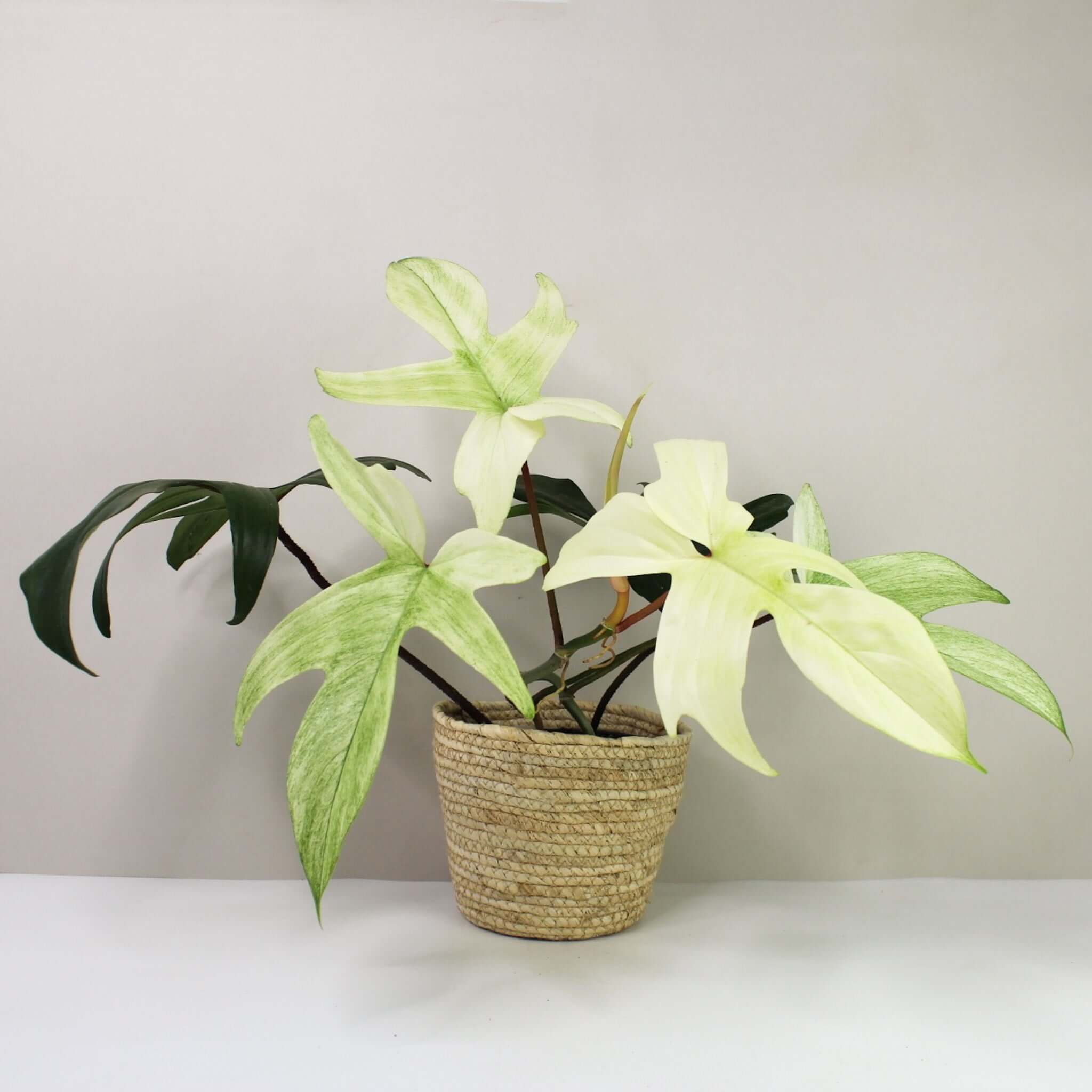
Read the youngest and oldest leaves together
- Emergent color: the newest leaf may be ivory, cream, yellow-green or pale mint. It should not be judged before it has expanded and hardened.
- Hardening sequence: chlorophyll develops as the leaf ages, so lime, mint and green leaves can coexist on one plant.
- Juvenile shape: early leaves can be spear- or arrow-like with limited lobing.
- Mature shape: supported growth produces increasingly lobed blades with deep indentations on both sides of the central vein.
- Stem: this is a vine with nodes, internodes, aerial roots and cataphylls. It is not a compact rosette growing only outward.
- Petiole: some Florida plants carry red tones and texture inherited from the squamiferum side, but petiole color alone does not establish a cultivar.
One white leaf is not enough
A newly unfurled leaf can look greener or yellower under different light and camera settings. Shipping stress, root damage and chlorosis can also make a leaf pale. Verify the sequence across several nodes, check whether older leaves green normally and compare the plant’s architecture with the seller’s label.
Florida Ghost vs Beauty, Green and Ghost Mint
Compare the color pattern across age and the whole climbing stem.
| Trade name | Useful working distinction | Do not assume |
|---|---|---|
| Florida Ghost | New leaves open pale and green progressively with age | Permanent random white splashes on every mature leaf |
| Florida Beauty | Persistent cream/yellow sectoral or marbled pattern; use the Florida Beauty guide | A Ghost becomes Beauty when a leaf starts greening |
| Florida Green | Green Florida expression without the signature pale new-leaf sequence | One mature green Ghost leaf renames the plant |
| Florida Ghost Mint | Trade label for a longer-lasting mint/silver cast or fine green speckling | A universally resolved cultivar or permanent shade |
These names describe useful commercial distinctions, but listings are not botanical vouchers. Ask to see the actual plant, its newest leaf, two older leaves and the active stem. When buying online, also ask whether the photo is the exact plant or only representative stock.
Why Ghost leaves change from white to green
A near-white new leaf starts with limited visible chlorophyll. As it hardens, chlorophyll and structural tissue develop, so the surface becomes lime, mint and eventually greener. This is the normal appeal of the cultivar—not a failure that should be corrected by cutting mature leaves off.
Light changes how much energy the plant can make and how compactly it grows, but it does not offer a simple `more light = whiter Ghost` switch. A plant in inadequate light may stretch and produce weak growth. A suddenly overexposed pale leaf may bleach, scorch or dry before it contributes much energy.
Why fixed Florida Ghost recipes can mislead
Translate popular shorthand into a decision the plant can test.
| Common advice | What it leaves out | Use it this way |
|---|---|---|
| More light keeps leaves brilliantly pale | Development, genetics, roots and acclimation | Increase usable light gradually; judge vigor and several leaves |
| Water after the top 1–2 inches dry completely | A dry surface can hide a wet or hydrophobic core | Probe deeper, learn pot weight and inspect roots |
| Use bark, perlite and charcoal | Particle size and product composition vary | Build for air and useful moisture in the actual room |
| Maintain 50–80% humidity | Sensor accuracy, airflow, roots and mold risk | Measure trends and correct a repeated, supported problem |
| A moss pole yields larger split leaves | Light, roots, attachment, maturity and time | Provide a runway; treat mature form as response, not guarantee |
| Feed half-strength monthly in spring/summer | Dose, label, roots, substrate charge and indoor growth | Feed only a functioning plant at/below its product label |
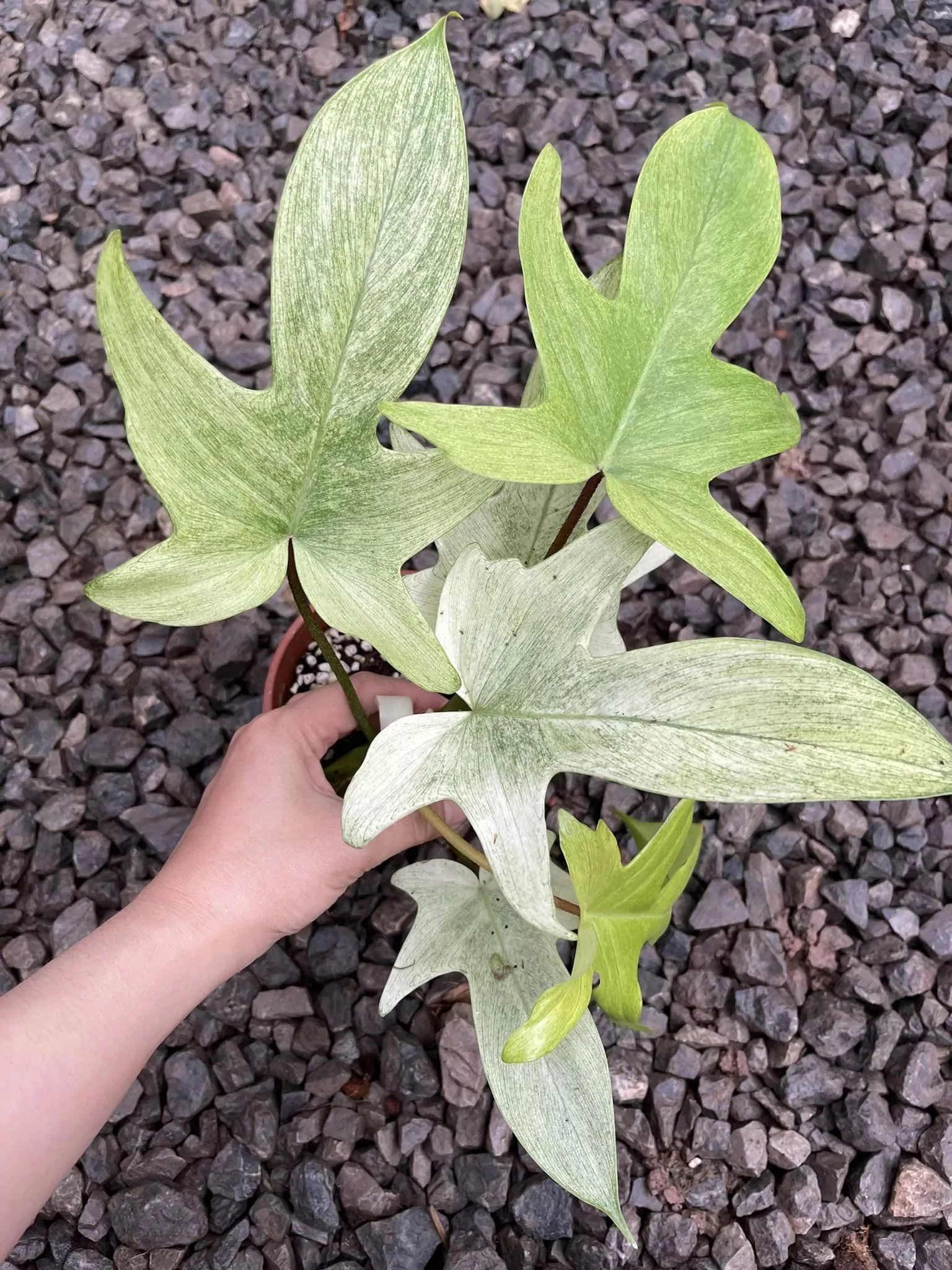
Healthy roots and a stable climb matter more than one photogenic leaf.
| Factor | Useful direction | Change when |
|---|---|---|
| Light | Bright filtered exposure introduced gradually | Internodes stretch or pale tissue scorches |
| Root zone | Airy particles, useful moisture and free drainage | The core stays wet or roots cannot hydrate the leaf |
| Support | Guide the stem and aerial roots to a stable surface | The vine leans, detaches or outgrows the support |
| Warmth/air | Stable warmth away from cold glass and HVAC blast | Measured conditions or repeated unfurling damage show stress |
| Feeding | Complete fertilizer at/below label rate in active growth | Roots are damaged, growth stalls or salts accumulate |
Give the vine a support before judging leaf shape
Attach the stem—not the petiole—to a plank, trellis or moss-style pole. Keep the active tip facing upward and place aerial roots against the support or guide them toward the potting mix. Loose ties should hold the stem without crushing it.
Without a vertical runway, the plant can sprawl, lean and produce smaller or less-developed leaves. Pruning can create a new growth point, but it does not replace support and it does not make a naturally climbing stem `bushy` on command.
Light: useful brightness without a shock
Choose bright, diffused light with a clear view of the sky. University of Minnesota Extension recommends moving philodendrons toward stronger seasonal light gradually because a sudden change can scorch foliage.
- Start a shipped or newly repotted plant in stable indirect light.
- Increase exposure in small steps over one to two weeks.
- Use the stem as a low-light signal: longer internodes and smaller new blades indicate the plant is reaching.
- Use the pale new leaf as a high-light signal: tan or translucent patches on the exposed side indicate the transition was too fast.
- If using a grow light, measure placement at the leaf level and provide a dark period rather than leaving it on continuously.
Water from root-zone evidence
Iowa State Extension recommends moderate-to-indirect light, evenly moist but not wet substrate, and no standing water in the saucer. Convert that into a repeatable decision rather than `every seven days`:
- Probe below the decorative surface; the top can be dry while the root ball is wet.
- Lift the pot and learn its wet and ready-to-water weights.
- When the upper zone is drying and the pot is lighter, water the whole root ball until runoff appears.
- Empty the cachepot or saucer.
- If a wet plant wilts, inspect roots and stem before adding more water.
Water use increases with leaf area, light, warmth and active roots; it falls after root loss, repotting shock or seasonal slowdown. The interval should change with the plant.
Substrate, pot and root checks
Use an airy, moisture-retentive mix with stable coarse particles and finer material that wets evenly. The goal is a root ball that becomes fully moist but drains and regains oxygen. A pot with drainage holes and only modest room beyond the root mass is easier to manage than a large decorative container full of slowly drying mix.
- Repot when roots are crowded, the mix has collapsed, drainage has slowed or the pot dries too fast to manage—not on a fixed two-year date.
- Keep the climbing stem at its existing depth. Do not bury long internodes to compensate for a weak support.
- Firm the support before filling the pot so new roots are not repeatedly disturbed.
- Healthy roots should be firm. Brown, hollow or mushy roots plus a sour, wet mix require correction before fertilizer.
Temperature, humidity, airflow and feeding
Keep Florida Ghost warm and away from cold glass, air-conditioner discharge and hot vents. Stable room humidity is more useful than occasional misting. If dry air makes a new leaf stick, increase ambient humidity with a humidifier or controlled cabinet while preserving air exchange; wet leaves are not a substitute for humid air.
Feed lightly only while the plant is producing roots and leaves. Use a complete houseplant fertilizer at a conservative label rate, then watch leaf size, root health and salt accumulation. Pause after severe root damage or while a tissue-culture plantlet is still acclimating.
Diagnose the signal before changing care
Separate normal greening from stress before changing several variables.
| Signal | Check first | Safer response |
|---|---|---|
| Newest leaf is green | Leaf age, earlier nodes, identity, light and roots | Stabilize care and observe another growth cycle |
| Pale leaf develops tan patches | Recent light/heat, dry episode, shipping or salts | Correct measured stress; dead tissue will not refill |
| Long gaps between leaves | Usable light, support and roots | Increase light gradually and secure the stem |
| Leaf curls inward | Water balance, heat, pests or root injury | Use the leaf-curl diagnostic |
| Fine stippling/webbing | Spider mites on undersides and lobes | Isolate, identify and use a labeled control |
How to propagate Florida Ghost
Every cutting needs a viable node: the stem point that can carry an axillary bud and produce new growth. A leaf and petiole may stay green or form limited roots, but without the correct stem tissue it cannot rebuild this climbing Philodendron.
Node cutting
- Choose an actively growing stem with a visible node, healthy aerial root or root nub and enough stem on both sides to cut safely.
- Use a clean blade. Keep one leaf when practical, but reduce excess leaf area if the cutting has almost no roots and cannot support it.
- Root in a clean, airy, evenly moist medium or in water that is changed before it becomes stagnant.
- Provide warmth, gentle light and humidity with airflow. Do not bury the petiole or active bud.
- Pot only after the cutting has a functional root system; then acclimate to stronger light gradually.
The detailed Philodendron propagation guide owns the genus-wide workflow. On this cultivar, mark which leaf is newest so you do not confuse normal greening during rooting with loss of identity.
Air layering
Wrap a node and aerial root in lightly moist medium while it remains attached to the parent. Once roots are visible and branching, cut below the rooted node. This keeps the cutting connected to the parent during root formation and is useful when the top growth is valuable or very pale.
Tissue-culture Ghost Mint needs a separate transition
A sealed plantlet is not a miniature established vine. UF/IFAS describes Stage-IV acclimation as a transition from laboratory conditions in which plantlets have weak water regulation and reduced photosynthetic competence. Micropropagation also does not, by itself, guarantee pathogen-free or perfectly uniform plants.
- Confirm whether the product is sealed in vitro, freshly deflasked or already hardened.
- If deflasking, remove gel gently and discard tissue with obvious rot.
- Use a small, clean container and pre-moistened airy medium.
- Start with protected humidity, warmth, modest light and some gas exchange.
- Increase ventilation and light in steps only when the plantlet remains firm and roots are active.
- Delay fertilizer, a large pot and repeated handling until growth is stable.
The current tissue-culture Florida Ghost Mint listing owns pack and availability details. Plantlet color can change with age and acclimation, so a single in-vitro leaf cannot guarantee the mature Mint expression.
Buyer checks for Ghost and Ghost Mint
- Ask for a leaf sequence: newest, hardening and mature—not one filtered pale leaf.
- Verify the stem: nodes, internodes and climbing architecture should be visible.
- Check the active point: avoid a top cutting with no viable bud or a leaf-only sale presented as propagatable.
- Check roots: ask whether the plant is rooted, recently imported, freshly potted or still acclimating.
- Separate the labels: `Ghost`, `Ghost Mint` and `Florida Beauty` are not interchangeable promises.
- Separate the formats: compare the current established Florida Ghost and established Ghost Mint listings on their own terms.
Pet and handling safety
Philodendron is not pet-friendly. The ASPCA identifies insoluble calcium oxalates in Philodendron stems, petioles and leaves. Chewing can cause oral irritation, drooling, retching, vomiting and, in more serious cases, swelling that interferes with swallowing or breathing. Keep the plant out of reach, wear gloves if sap irritates your skin and contact a veterinarian or animal poison service after a concerning exposure.
The collector’s decision rule
Judge a Florida Ghost as a time series. A pale new leaf should harden, a supported vine should progress toward more deeply lobed blades, and the roots should remain firm in an airy, evenly watered pot. Preserve mature green leaves because they fund the next pale one. If a seller offers only a name and one white photo, the evidence is incomplete.
Sources and evidence boundary
- West & Miller, Florida State Horticultural Society proceedings (1956) — documented early Florida Philodendron hybrids and McColley’s introduction.
- New Zealand EPA APP204308 — regulatory evidence compilation for Philodendron `Florida` parentage and history.
- RHS: Philodendron `Florida Ghost` — parentage, climbing habit, leaf-color sequence, care and unresolved name status.
- Kew POWO: Philodendron pedatum and P. squamiferum — accepted parents and taxonomy.
- Iowa State Extension: Philodendron care.
- University of Minnesota Extension: gradual light acclimation.
- Penn State Extension: vegetative propagation and nodes.
- UF/IFAS: tropical foliage micropropagation and acclimation.
- ASPCA: Philodendron calcium-oxalate exposure.
Evidence note: the underlying Florida hybrid and its parentage are documented, and RHS describes the Ghost color cycle. RHS still marks the `Florida Ghost` cultivar name unresolved; `Ghost Mint` is treated here as a current trade label rather than a guaranteed or formally resolved cultivar.