Greenboog Florida Beauty identity and care field guide
Give it bright, filtered light, an airy mix that drains fully, and a pole or plank to climb. Water from the condition of the root zone—not a fixed calendar—and keep enough green tissue to power new growth.
Match each care decision to plant evidence rather than a fixed number.
| Decision | What to check | Practical target |
|---|---|---|
| Identity | Lobed leaves plus persistent cream/yellow-and-green sectors | Check several leaves and the active stem, not one photo |
| Light | Internode length, leaf size, scorch or fading | Bright indirect light; acclimate before stronger exposure |
| Water | Moisture below the surface, pot weight and root condition | Water thoroughly after the upper mix has dried slightly |
| Potting mix | Drainage speed and air around roots | Moisture-retentive but open; never leave the pot standing in water |
| Support | Whether aerial roots can contact a pole or plank | Attach the stem loosely and guide new growth upward |
| Variegation | Green tissue, stem pattern and successive leaves | A balanced plant is safer than an almost-white specimen |
What is Philodendron Florida Beauty?
Florida Beauty is a horticultural name used in the houseplant trade, not an accepted wild species name. The Florida line is commonly described by growers as involving Philodendron pedatum and Philodendron squamiferum. Kew recognizes both as separate climbing species: P. pedatum has deeply divided mature leaves, while P. squamiferum is known for its textured petioles.
Because the cultivar name and pedigree are not a formal species treatment, retail labels are not always consistent. Treat “Florida Beauty” as a useful trade identity and verify the plant in front of you. Do not pay a collector price solely because a seller has placed that name on a juvenile cutting.
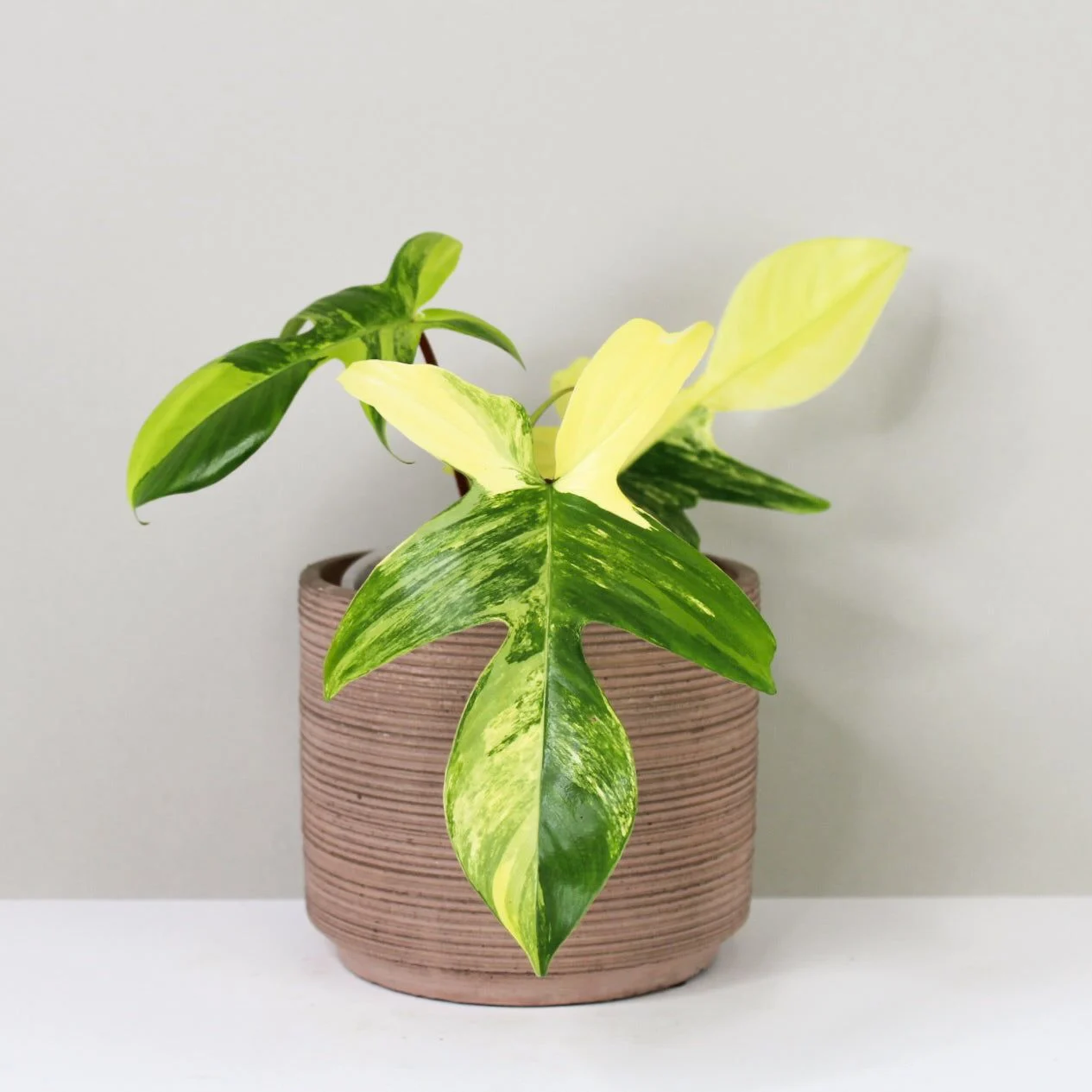
How to identify Florida Beauty
Look at more than one leaf
A typical established plant produces increasingly lobed leaves as it climbs. Florida Beauty adds irregular cream, pale yellow or mint-toned areas to the green blade. The pattern may be marbled, speckled or sectoral, and it can change from leaf to leaf. A juvenile leaf may be less divided, so leaf shape alone is not enough.
Inspect the petiole and stem
Look for a climbing stem with distinct nodes and aerial-root points. Petiole texture can help connect a plant to the Florida group, but texture varies with age and photographs often hide it. For a variegated cutting, inspect the stem around the active bud. A colorful leaf attached to a fully green stem does not guarantee similarly variegated future growth.
Florida Beauty vs Florida Green vs Florida Ghost
Compare a sequence of hardened leaves and the active stem—not seller color words alone.
| Trade name | Typical foliage behavior | Best identification clue |
|---|---|---|
| Florida Green | Green leaves without persistent cream sectors | Several mature and new leaves remain green |
| Florida Beauty | Irregular cream/yellow-and-green variegation persists on mature leaves | Pattern appears across leaves and into viable stem tissue |
| Florida Ghost | New leaves may emerge very pale, then harden toward greener tones | Color changes with leaf age rather than fixed patchwork sectors |
These are trade-level distinctions, not a substitute for provenance. Tissue-culture batches, lighting, leaf age and seller naming can blur the appearance. Ask for current photographs if the distinction affects the price.
What to check before buying
- Request the actual plant. Representative photos can show the cultivar, but they do not show the specimen’s current variegation, roots or pest condition.
- Find the active growth point. On a cutting, confirm that a viable bud and at least one node are present. A leaf with a piece of petiole but no node will not make a climbing vine.
- Check the green-to-cream balance. Large pale sectors are attractive, but a nearly chlorophyll-free plant has little productive leaf area and a smaller margin for shipping or root stress.
- Ask how it was rooted. Clear photographs of pale, firm roots and the rooting medium are more useful than a promise that it is “established.” Brown staining is not automatically rot; hollow, mushy or foul-smelling roots are more concerning.
- Inspect for pests. Look at leaf backs, petiole bases and the newest rolled leaf for webbing, stippling, sticky residue, cottony clusters or distorted growth.
- Plan for acclimation. An imported, recently deflasked or freshly transferred plant should not be treated like a long-established specimen.
For a currently listed specimen, compare the photographs and terms on the Philodendron Florida Beauty product page. To compare it with other plants rather than hybrids that merely contain “Florida Beauty” in their names, browse the Philodendron collection.
Light for growth and variegation
Use bright, indirect light as the starting point. The RHS Philodendron guide recommends bright filtered light and warns that strong direct summer sun can scorch leaves. Introduce any brighter window or grow light gradually, especially after shipping or a season in lower light.
Light supports compact growth and the green tissue’s photosynthesis; it does not manufacture genetic variegation. Long internodes, smaller leaves and a stem leaning strongly toward the window point to insufficient usable light. Bleached tan patches on the window-facing side point to excess exposure or an abrupt change.
How and when to water
Check below the decorative surface layer. When the upper few centimeters of mix have dried slightly and the pot feels lighter, water the entire root ball until excess drains. Empty the saucer or cachepot. Check again later rather than adding small daily sips.
The interval will change with light, temperature, pot size, root mass and substrate. A plant in coarse bark may dry much faster than one in fine peat. A calendar such as “once a week” cannot describe both. If leaves yellow while the mix stays wet for many days, inspect drainage and roots before adding fertilizer.
Potting mix, pot size and repotting
Use a clean mix that holds some moisture but retains air after watering. A practical blend can combine quality peat-free houseplant mix or coir with fine orchid bark and perlite or pumice. Adjust particle size to your climate and watering habits rather than following an exact equal-parts formula.
Choose a pot with drainage holes and only a modest amount of space beyond the root ball. An oversized pot leaves a large volume of uncolonized mix wet for longer. Repot when roots crowd the container, the mix has collapsed, or water can no longer move through it evenly—not because a fixed number of years has passed.
Support and mature leaf development
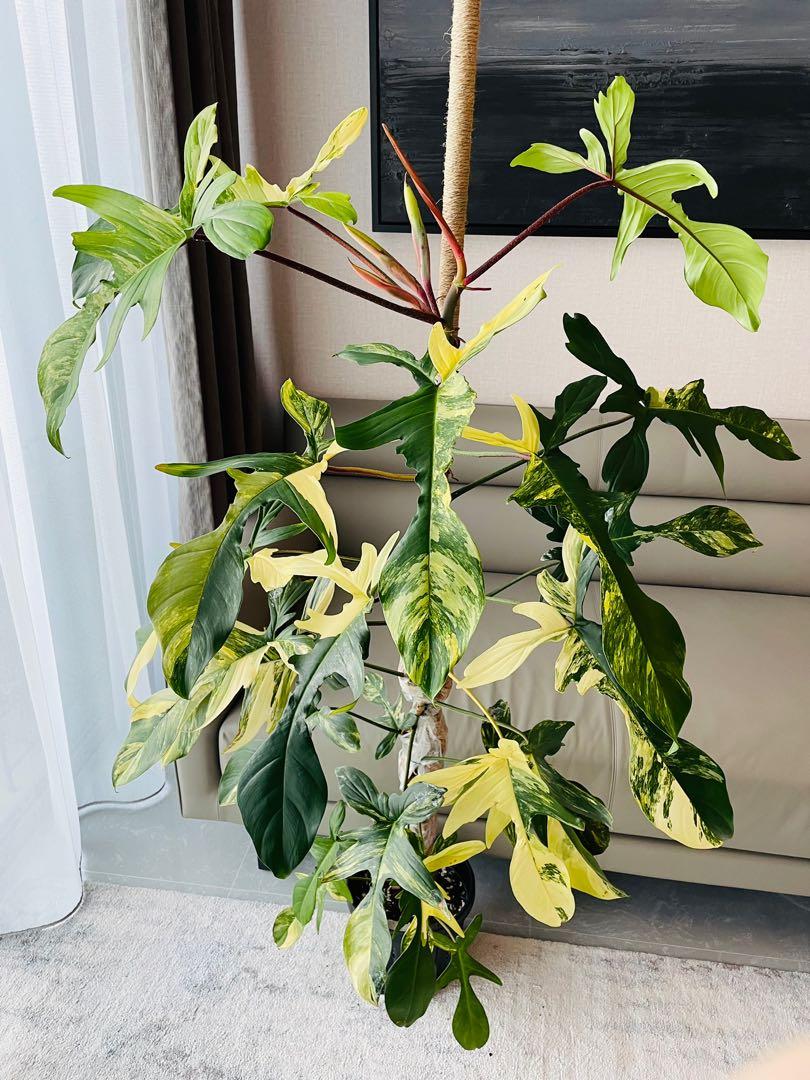
Florida Beauty is a climber, so a stable pole, plank or trellis is functional rather than decorative. Place the support close to the stem, orient aerial roots toward it and use soft ties that do not constrict the plant. Keep the top moving upward instead of repeatedly cutting it back if larger, more divided leaves are the goal.
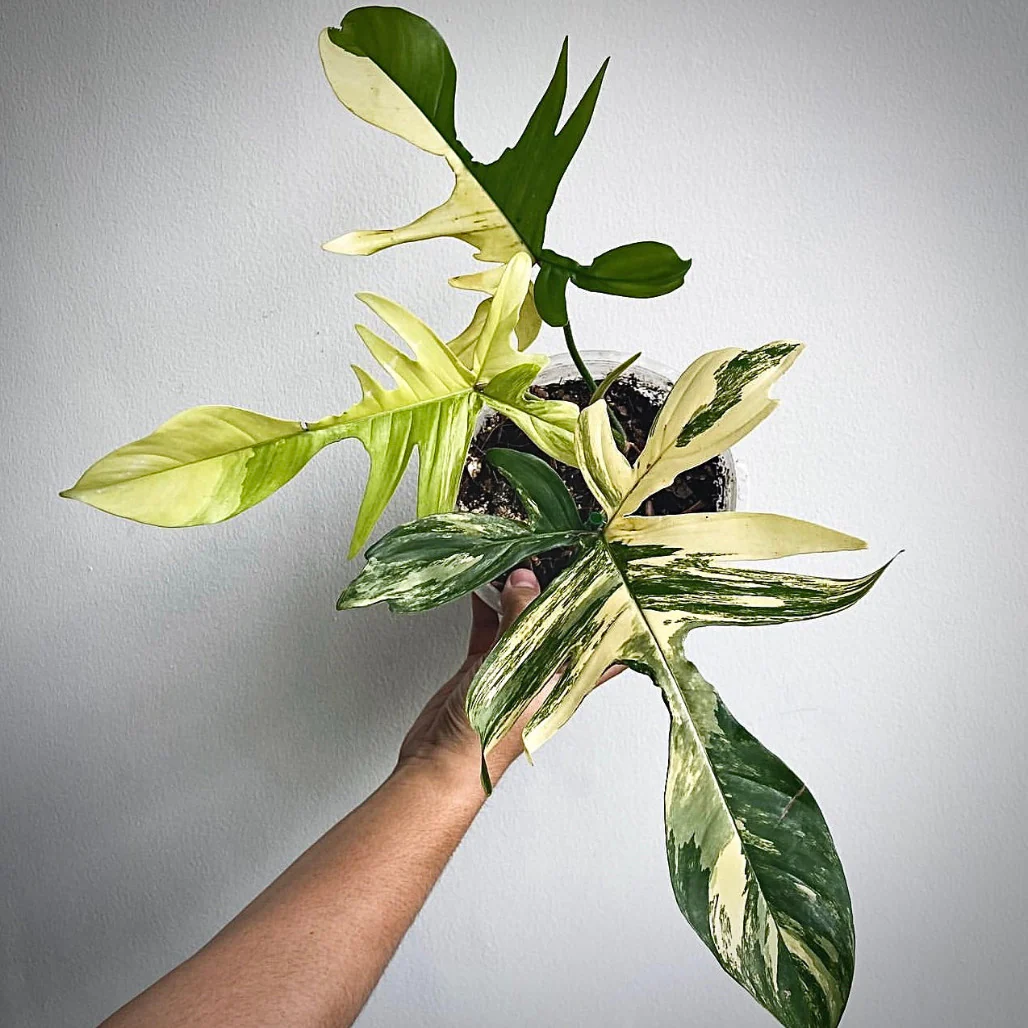
Leaf size and division depend on plant maturity, light, roots and support. Avoid fixed promises such as a guaranteed 12-inch leaf indoors. A healthy new leaf that is slightly larger than the last is more useful evidence than a size claim from another grower’s conditions.
Temperature, humidity and feeding
Keep the plant warm and away from cold drafts or sudden heat. General Philodendron guidance from NC State Extension places the preferred range around 65–85°F (18–29°C). The RHS advises keeping Philodendrons above 59°F (15°C).
Moderate household humidity can work if watering and roots are sound. A humidifier may help in very dry air, but a pebble tray does not correct root damage and crowded, stagnant air can increase disease risk. Feed only during active growth, following the product label. Flush the mix if salts accumulate, and do not fertilize a plant with damaged roots in an attempt to force recovery.
How to propagate Florida Beauty
Propagation needs a stem node with a viable bud; a detached leaf cannot continue the vine. Use a clean, sharp tool and take a section with at least one healthy node. Root it in water or a clean, airy medium kept evenly moist rather than saturated. Bright filtered light and warmth support rooting.
For a valuable top cutting, air layering is the lower-risk option: encourage roots at a node while it remains attached, then cut only after a usable root system develops. Penn State’s houseplant propagation guidance emphasizes healthy stock, clean tools, sterile media and node-based stem sections. Our broader Philodendron propagation guide covers setup choices in more detail.
What changing variegation means
Several greener leaves in a row
First confirm that the plant has adequate light and is still actively growing. Then inspect the stem and active bud. Chimeral variegation can produce all-green shoots, and those shoots may outgrow the slower variegated portion. UF/IFAS explains that chimeral plants can revert to all-green or all-non-pigmented growth.
If a branch is consistently green and the plant is healthy enough to prune, trace it back to a node where desirable stem pattern and a viable bud remain. Light cannot turn an already green genetic sector into a cream one, so do not respond by putting the plant into harsh sun.
Almost-white new growth
Do not remove a single pale leaf automatically; it can still be part of a balanced vine. Watch the next growth and the amount of green tissue on the plant as a whole. Repeated all-cream leaves provide little photosynthetic capacity. If the active stem can be cut back to a balanced node without sacrificing the plant’s only viable bud, that may produce a more sustainable direction—but no node can guarantee the exact pattern of the next leaf.
Common problems
Diagnose the pattern and root zone before changing several care variables at once.
| What you see | Most useful check | First response |
|---|---|---|
| Yellow lower leaves; mix stays wet | Drainage, root firmness and recent watering | Pause watering and inspect the root zone |
| Crisp tan patch on the bright side | Recent move or direct-sun exposure | Move back to filtered light and acclimate gradually |
| Long internodes and smaller leaves | Usable light and support contact | Improve light gradually and secure the climber |
| Brown tips or margins | Dry-down swings, root health and salt buildup | Correct the confirmed cause; do not assume humidity alone |
| Stippling, webbing or distorted new leaf | Leaf backs, petiole bases and nearby plants | Isolate, identify the pest, then use a labeled treatment |
| Black, soft stem or foul roots | Extent of firm tissue above the damage | Remove rot with a sterile tool and salvage a healthy node |
For watering, pest and root-zone fundamentals that apply across the genus, use the general Philodendron care guide.
Is Florida Beauty toxic to pets?
Yes. Philodendrons contain calcium oxalate crystals. Chewing can cause mouth pain, swelling, drooling, vomiting or difficulty swallowing in people and pets; sap can also irritate skin. Keep the plant out of reach, wear gloves when making multiple cuts, and contact a medical professional or veterinarian if ingestion causes symptoms.
Frequently asked questions
Is Florida Beauty rare?
Availability and price change with propagation supply, region, plant size, root quality and variegation. “Rare” is not a condition grade. Judge the actual plant, seller evidence and aftercare needs before paying a premium.
Can I make Florida Beauty more variegated?
No care trick can guarantee the next pattern. Adequate filtered light supports the green tissue and compact growth, while pruning a confirmed all-green shoot can preserve the remaining variegated line. Neither action can manufacture a specific sector.
Why are new leaves less divided?
Juvenile growth, insufficient light, weak roots or a stem that has lost climbing contact can all reduce size and division. Stabilize roots and light, then give the active stem consistent support. Judge progress across several leaves.
Can Florida Beauty grow outdoors?
Only where temperatures remain warm and the plant can be protected from harsh sun. In cooler climates, use a container and bring it indoors before temperatures approach 59°F (15°C). Acclimate in both directions; a plant moved straight from indoor light to outdoor sun can scorch quickly.
Sources and Florida Beauty reference boundaries
- Kew Plants of the World Online: accepted record for Philodendron pedatum
- Kew Plants of the World Online: accepted record for Philodendron squamiferum
- Royal Horticultural Society: Philodendron light, water, mix, support and temperature
- NC State Extension: Philodendron habit, drainage, propagation, pests and toxicity
- UF/IFAS: chimeral variegation and reversion
- Penn State Extension: node-based houseplant propagation