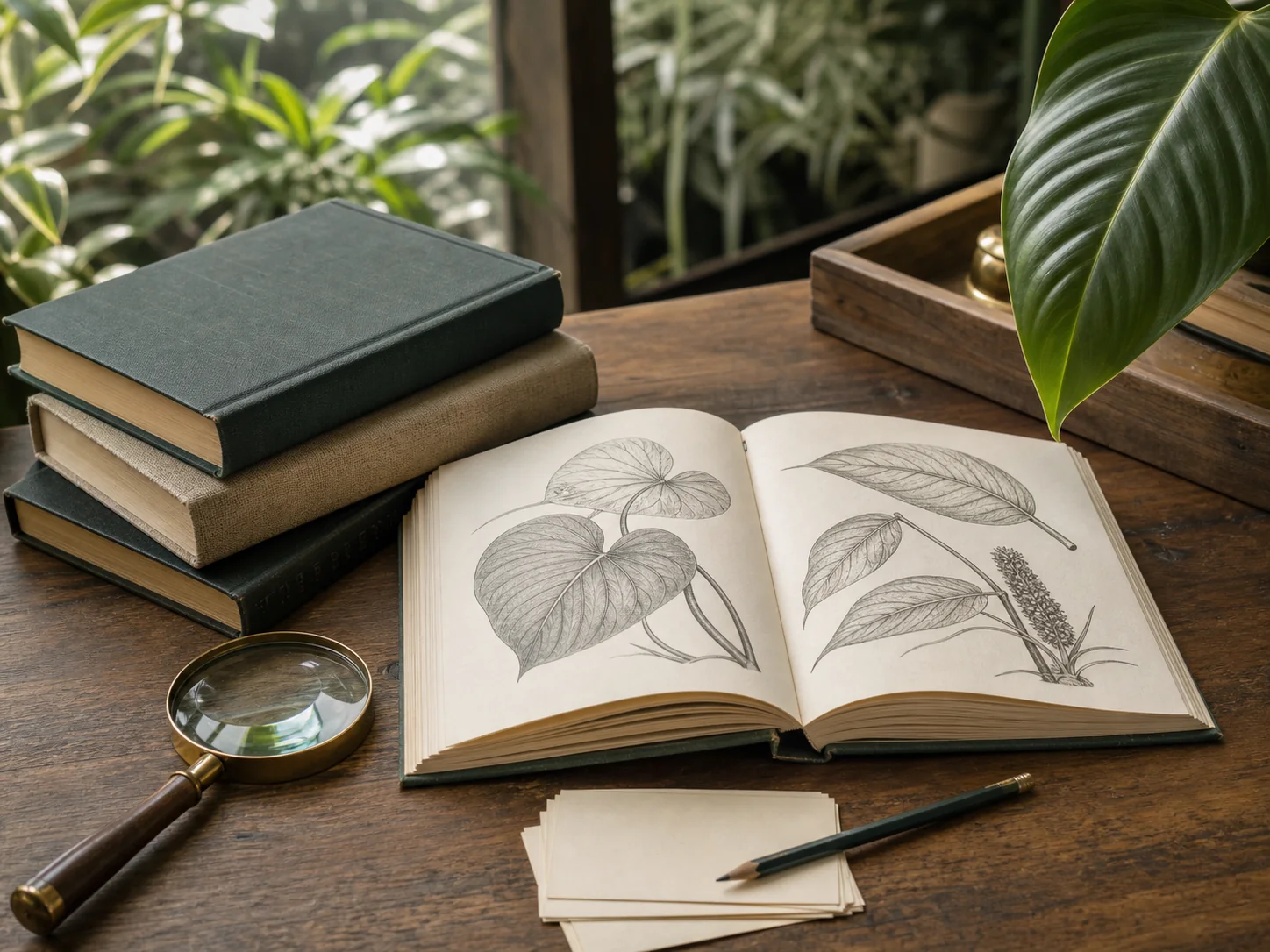
A reference shelf for growers, collectors and aroid readers
The best Philodendron book depends on the decision in front of you. A care manual can improve your indoor environment; an Araceae reference can improve morphology and naming; neither can guarantee a seller-line identity from one photograph.
Choose a book by the job it can do
Grow better
Use an indoor-growing reference for usable light, root-zone moisture, containers, nutrients and diagnosis.
Collect better
Use a collection guide for acquisition choices, environmental capacity, propagation and record keeping.
Name better
Use an Araceae reference plus current databases for morphology, genera, accepted names and publication history.
This distinction prevents a common mistake in legacy “top ten” lists: a beautiful styling book may be useful without being an identification authority, and an important taxonomic book may be the wrong first purchase for someone troubleshooting a wet pot.
Six verified Philodendron and aroid book choices
| Book | Best use | Boundary |
|---|---|---|
| Aroids: Plants of the Arum Family Deni Bown, 3rd ed., Kew |
Family-level botany, cultivation context and collector reference; 456 pages with 450 colour plates. | Broad Araceae scope, not a live cultivar catalogue; check current names. |
| The Genera of Araceae Mayo, Bogner & Boyce, Kew, 1997 |
Genus descriptions, morphology, line drawings, distributions and higher-level identification. | Foundational but older; later taxonomic changes require current databases and papers. |
| The New Plant Collector Darryl Cheng, Abrams, 2024 |
Building a collection that fits available light, moisture and maintenance capacity. | Covers 22 plant groups; not a Philodendron monograph or botanical key. |
| The New Plant Parent Darryl Cheng, Abrams, 2019 |
Reasoning from light, water, nutrients and the plant’s response instead of memorising a calendar. | General indoor growing; not species identification or seller-line provenance. |
| RHS Practical House Plant Book RHS, Zia Allaway & Fran Bailey, DK, 2018 |
Accessible care, propagation, pests, pruning, projects and broad plant profiles. | Beginner-to-intermediate breadth; edition and ISBN vary by market/format. |
| Leaf Supply Lauren Camilleri & Sophia Kaplan, Smith Street Books, 2018 |
Broad plant profiles, pots, display and fitting indoor greenery to a room. | Styling and general care are not evidence for rarity, accepted names or cultivar identity. |
What to check before buying an edition
Search by more than the title. Record the author, publisher, edition, publication year and ISBN. A paperback, ebook and regional edition may have different identifiers; a newer edition can change page count, taxonomy and illustrations. Compare the publisher description with the question you actually need answered.
- Does the contents page cover care, morphology, taxonomy or design?
- Is the edition current enough for the claim you want to verify?
- Are photographs or drawings connected to named specimens and captions?
- Does the book cite sources or explain how names were chosen?
- Can you borrow it first through a library or interlibrary loan?
Use printed books with live botanical sources
A printed reference freezes knowledge at an edition date. That is useful: it preserves descriptions, drawings and the taxonomic framework used by its authors. It is not proof that every accepted name remains unchanged. Kew’s Plants of the World Online provides current accepted-name and distribution records, while IPNI records the publication details behind botanical names.
For an unidentified or seller-labelled plant, build an evidence chain:
- Photograph the whole plant, connected leaf sequence, stem or crown, petiole and newest growth.
- Use the book’s glossary and drawings to describe morphology without forcing a name.
- Check the candidate name and synonyms in POWO/IPNI.
- Look for a primary revision or cultivar record when the seller-line history matters.
- Preserve uncertainty when the evidence stops.
This approach is especially important for variegated plants. Colour can change with leaf age, tissue pattern, exposure and photography; a vivid sector does not replace provenance or connected morphology. Greenboog’s rare Philodendron varieties guide owns collection-level comparison.
A three-step reading path
1. New grower
Begin with The New Plant Parent or the RHS Practical House Plant Book. Apply one idea at a time to light, pot weight, drainage and growth. Use Greenboog’s Philodendron care guide to connect those principles to the site’s care cluster.
2. Active collector
Add The New Plant Collector and Bown’s Aroids. Keep acquisition records, exact-versus-representative photo scope, rooted format, arrival notes and later leaf development together. A collection becomes easier to diagnose when its source history is preserved.
3. Botanical reader
Use The Genera of Araceae for structure and terminology, then verify names in POWO/IPNI and follow the cited taxonomic literature. Older works can remain indispensable without being the final word on every name.
Book selection FAQ
Is there one definitive Philodendron care book?
No single title owns current taxonomy, indoor growing, cultivar provenance and troubleshooting. Use a houseplant reference for environment and an aroid/taxonomic source for names and morphology.
Is an older botanical book still useful?
Yes, for descriptions, illustrations and historical frameworks. Verify accepted names and distributions against current databases and later revisions.
Can a book identify my variegated Philodendron from one leaf?
No. Compare connected growth, stem or crown, petiole, source history and several hardened leaves. Preserve the seller-line label when primary cultivar evidence is unavailable.
Why are the legacy ten book covers gone?
The redesigned page compares verified scopes rather than reproducing a visual shopping list. Publisher records remain linked so readers can confirm the correct title and edition.
Publisher and botanical sources
- Royal Botanic Gardens, Kew / University of Chicago Press: Aroids, third edition
- Bibliographic record: The Genera of Araceae
- Abrams: The New Plant Collector
- Abrams: The New Plant Parent
- DK/RHS: RHS Practical House Plant Book
- Smith Street Books: Leaf Supply
- Kew Plants of the World Online and International Plant Names Index