Monstera collector guide
“Monstera laniata variegated” combines an accepted subspecies route with a commercial appearance claim. Kew accepts Monstera adansonii subsp. laniata; “variegated” or “albo” describes the offered plant, not a botanical rank on that record.
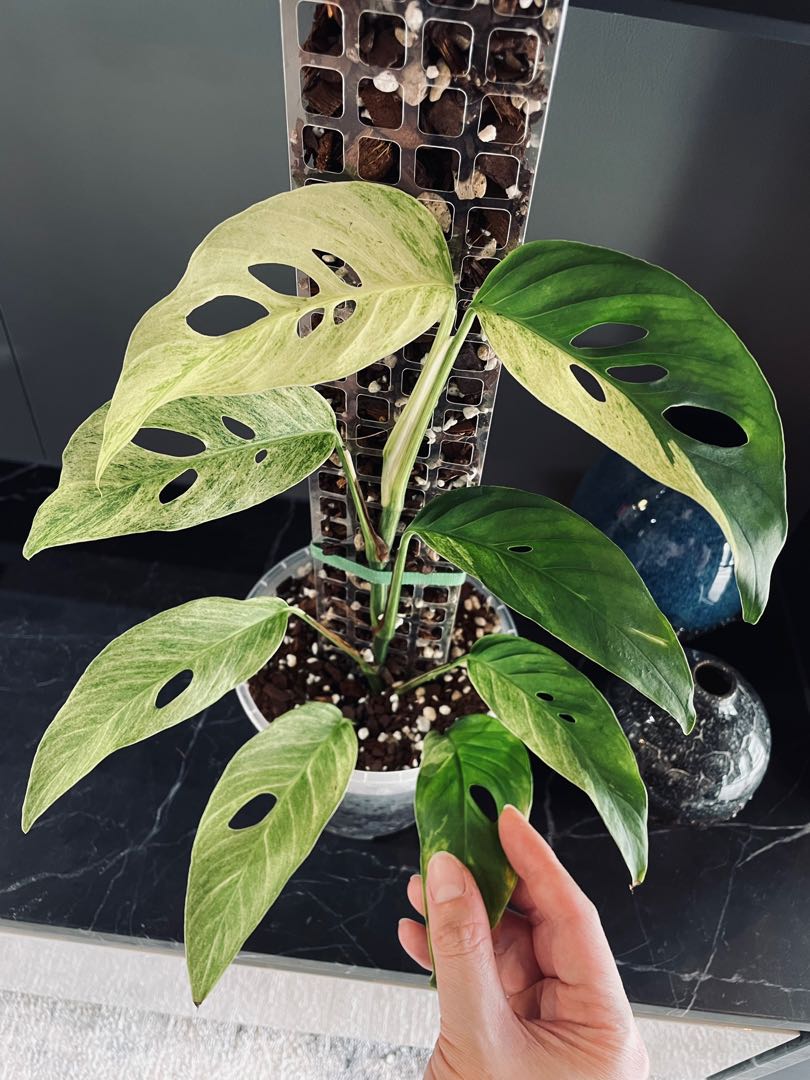
Use the accepted name before reading the sales label
Kew’s Plants of the World Online accepts Monstera adansonii subsp. laniata (Schott) Mayo & I.M.Andrade. It records a native range from Nicaragua to southern Tropical America and a wet-tropical climbing habit. Kew treats M. adansonii var. laniata, the name used in Madison’s 1977 revision, as a synonym of that accepted subspecies.
The common shop spelling “Lanianta” adds an extra “n” and is not the accepted epithet. More importantly, neither “variegated” nor “albo” appears as part of Kew’s botanical name. Those words can still help describe a listing, but they need image-scope and provenance evidence.
| Label part | Evidence available | Do not infer |
|---|---|---|
| Monstera adansonii | Accepted species containing recognized infraspecific taxa. | A perforated leaf alone does not establish this species. |
| subsp. laniata | Accepted Kew subspecies; var. laniata is a synonym route. | A seller title alone does not prove provenance. |
| variegated / albo | Commercial description of pale and green foliage in the shown plant or line. | Not a Kew taxonomic rank or a promise of identical future leaves. |
| Lanianta | Legacy commercial misspelling retained in the old URL only. | Not an alternative accepted scientific spelling. |
Read a sequence, not the palest leaf
Plant-variegation research shows that green and pale sectors can differ in plastid and photosynthetic-protein development. That general evidence does not identify the mechanism or inheritance of this exact commercial line. Appearance alone cannot tell a buyer whether a plant is a stable chimera, another genetic form, a temporary response or a mislabeled specimen.
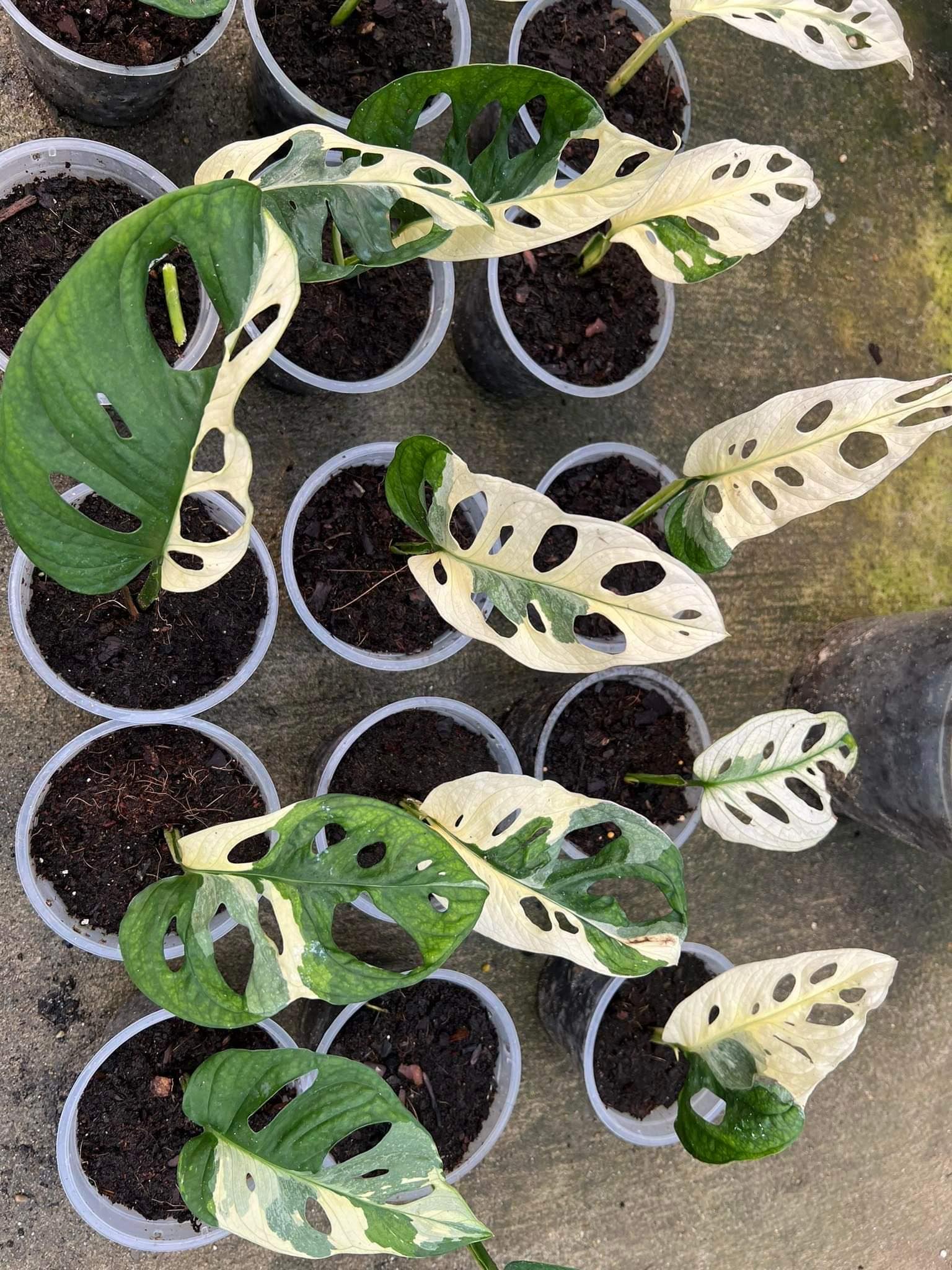
Use the whole vine instead: follow successive leaves back to their nodes, inspect the corresponding stem sector and locate the axillary bud. Green tissue matters to the plant’s carbon balance, while an almost-white leaf should not be treated as a collectible score independent of the rest of the plant.
| Check | Strong evidence | Risk signal |
|---|---|---|
| Image scope | Seller states exact plant, representative batch or parent reference. | One mature reference photo with no shipped-stage disclosure. |
| Leaf sequence | Several connected leaves shown in chronological order. | Only the palest leaf is framed. |
| Stem and bud | Node, axillary bud and sector relationship are visible. | A leaf-only cutting or hidden growth point. |
| Roots and format | Rooted plant, cutting or tissue-culture status and quantity are explicit. | Gallery scale is used to imply shipped size. |
| Provenance | Source line and naming basis are documented. | “Rare” substitutes for an identification trail. |
Care for the plant, not a target percentage of white
Use the completed green Monstera adansonii care guide for the shared climbing, light, watering and root-zone system. A variegated plant still needs a close support, bright filtered exposure adjusted gradually, an airy draining substrate and observation before watering.
Do not push harsh light to “make more white,” add fertilizer to force fenestration or prune every green leaf. Light can change how a leaf performs and appears, but it cannot turn a weakly documented plant into a verified line. Fertilizer cannot rewrite a stem’s sector pattern.
- Photograph the current leaf sequence, stem sectors, nodes and roots before changing care.
- Choose a node only after locating its axillary bud and noting the surrounding stem tissue.
- Preserve productive green tissue while monitoring fully pale growth for decline.
- Change one major condition at a time and evaluate the next hardened leaf.
- Keep labels and dates so a future buyer can separate observation from memory.
The white-variegated Adansonii guide owns the fuller pale-tissue care workflow. The Monstera fenestration guide explains leaf openings, and the propagation owner covers method and aftercare.
Sources
- Kew POWO: accepted Monstera adansonii subsp. laniata name, range, habit and synonyms
- Kew POWO: Monstera adansonii var. laniata synonym record
- Madison, A Revision of Monstera: historical taxonomic treatment
- Plant Physiology: green/white sector plastid and photosynthetic-protein evidence in a variegation model