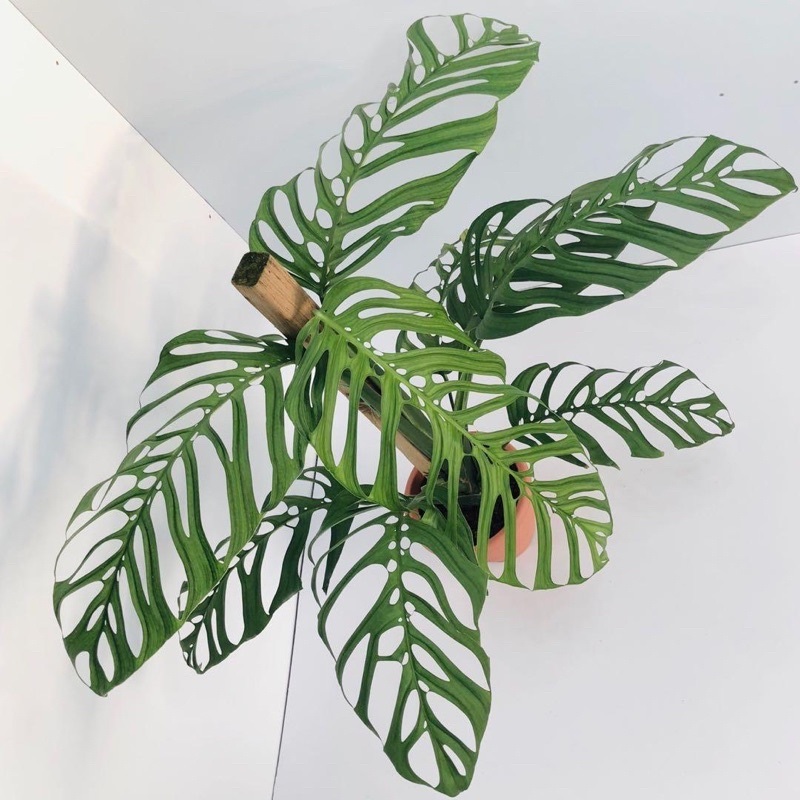
Monstera Esqueleto is a cultivated trade name for a robust climbing Monstera with unusually large, rib-like leaf perforations. It should not automatically be called Monstera epipremnoides. The current Aroid Cultivars record lists the base species as unknown, while Kew treats M. epipremnoides as a separate accepted species.
That uncertainty does not make the name useless. It changes how you identify and buy the plant: examine mature architecture, several hardened leaves, the petiolar sheath and provenance instead of trusting one spectacular photo or a copied species label.
Monstera Esqueleto identification at a glance
| Feature | Useful evidence | Limit |
|---|---|---|
| Growth habit | A robust climber that benefits from firm vertical support | A climbing habit is common across many Monsteras |
| Mature blade | Dark green, often slightly drooping, with a reported maximum around 78 x 43 cm in the cultivar record | Indoor size depends on maturity and conditions; size alone is not an ID |
| Perforations | Small holes close to the midrib plus much larger openings extending toward, but often not breaking, the margin | Young leaves may not yet show the mature pattern |
| Mature stem | Short, stacked internodes can make established leaves fan from the climbing axis | Juvenile cuttings may have longer, less diagnostic spacing |
| Petiolar sheath | Persistent sheath reported to extend to about one fifth of the petiole below the geniculum | Photographs often hide this feature; inspect the actual plant |
| Provenance | A traceable mother plant or supplier record that consistently uses the Esqueleto name | A tag cannot replace morphology, but it can explain the plant’s history |
These characters come from the Aroid Cultivars record for Monstera sp. ‘Esqueleto’. Use them as a field checklist, not a promise that every young plant can be identified from foliage alone.
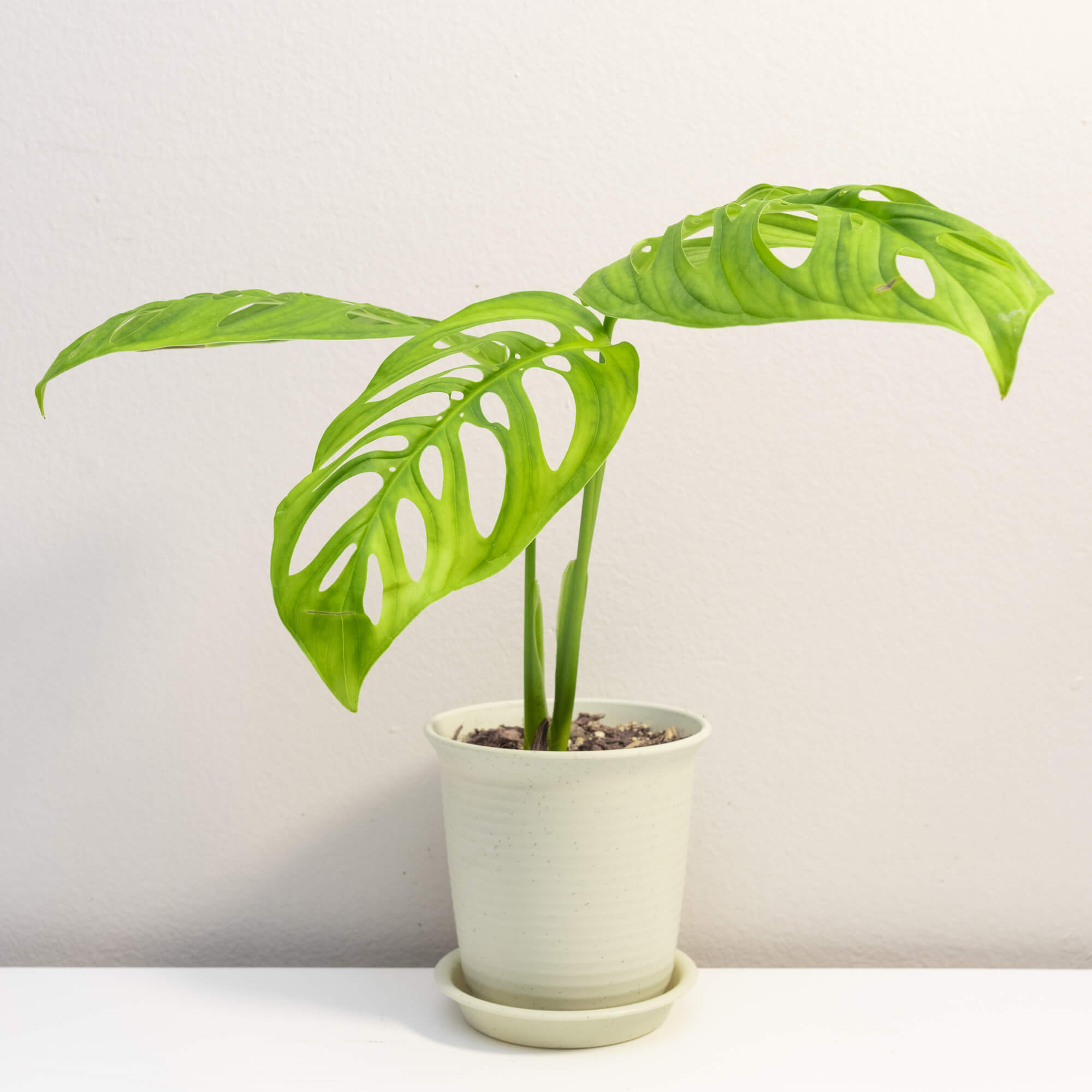
Is Monstera Esqueleto the same as Monstera epipremnoides?
No—not on the evidence available today. The Esqueleto record marks the name as not accepted and not established, gives the base species as unknown, and describes it as a historical cultivar until the plant is formally described. It names Jody Benicek as the person who supplied the name, not as the originator of the plant.
By contrast, Kew accepts Monstera epipremnoides Engl. as a species from Costa Rica to Panama. A separately accepted botanical record cannot be assigned to an unidentified cultivated clone merely because the trade once used that label.
| Name on a label | What the record supports | What it does not prove |
|---|---|---|
| Monstera Esqueleto | A recognizable cultivated name tied to a documented foliage and growth pattern | A formally accepted species or known wild origin |
| Monstera sp. ‘Esqueleto’ | A careful way to show that the base species remains unresolved | That cultivar acceptance has been completed |
| Monstera epipremnoides | A separately accepted species name in Kew’s taxonomy | That a commercial Esqueleto plant belongs to that species |
| Monstera aff. lechleriana | A comparison indicating resemblance to the lechleriana group | A published species assignment |
This is why the article uses Monstera Esqueleto as the searchable cultivated name while keeping the identity caveat visible. It is more accurate than repeating an obsolete equivalence in a title, product tag or care card.
Esqueleto vs adansonii, lechleriana and obliqua
Look-alike comparisons work best on an established climbing plant. Juvenile leaves can be small, minimally perforated and altered by growing conditions, so a single cutting is a weak basis for a confident name.
Esqueleto vs Monstera adansonii
RHS describes M. adansonii as the smaller-statured common houseplant relative of M. deliciosa. Esqueleto is selected for a more robust mature habit and an extreme pattern of small inner perforations plus large outer openings. If the plant is young, keep the original provenance and wait for mature climbing growth instead of renaming it from one leaf. Our Monstera adansonii guide owns the care and identity intent for that species.
Esqueleto vs Monstera lechleriana
The Aroid Cultivars record explicitly compares Esqueleto with M. lechleriana in growth habit, leaf size and tightly stacked mature internodes. It distinguishes Esqueleto by the combination of small holes along the midrib, larger openings toward the margin and generally drooping blades. Kew accepts M. lechleriana as a separate species, so resemblance is not synonymy. See the Monstera lechleriana guide for that plant’s dedicated page.
Esqueleto vs Monstera obliqua
Kew accepts Monstera obliqua as a distinct, geographically broad species. A heavily perforated leaf is not enough to convert an Esqueleto into obliqua. Keep photographs of the mother plant, examine mature stems and treat a high-value identification without provenance as provisional. The separate Monstera obliqua Peru guide retains that topic’s informational ownership.
How to verify a plant before buying
- Ask for the exact plant. Request a current whole-plant image or video showing the newest leaf, lower stem, petioles and pot—not only a close-up.
- Check more than one leaf. Compare the perforation pattern across several hardened leaves and note whether the plant is beginning to size up on support.
- Inspect the sheath and internodes. These less glamorous features can be more useful than the largest hole in one blade.
- Ask for provenance. Find out whether the name follows a known mother plant, supplier invoice or only visual resemblance.
- Confirm the growth stage. A fresh cutting, newly rooted plant and established potted vine carry different acclimation risks.
- Separate identity from the offer. Verify today’s size, quantity, stock, shipping and replacement terms on the product page.
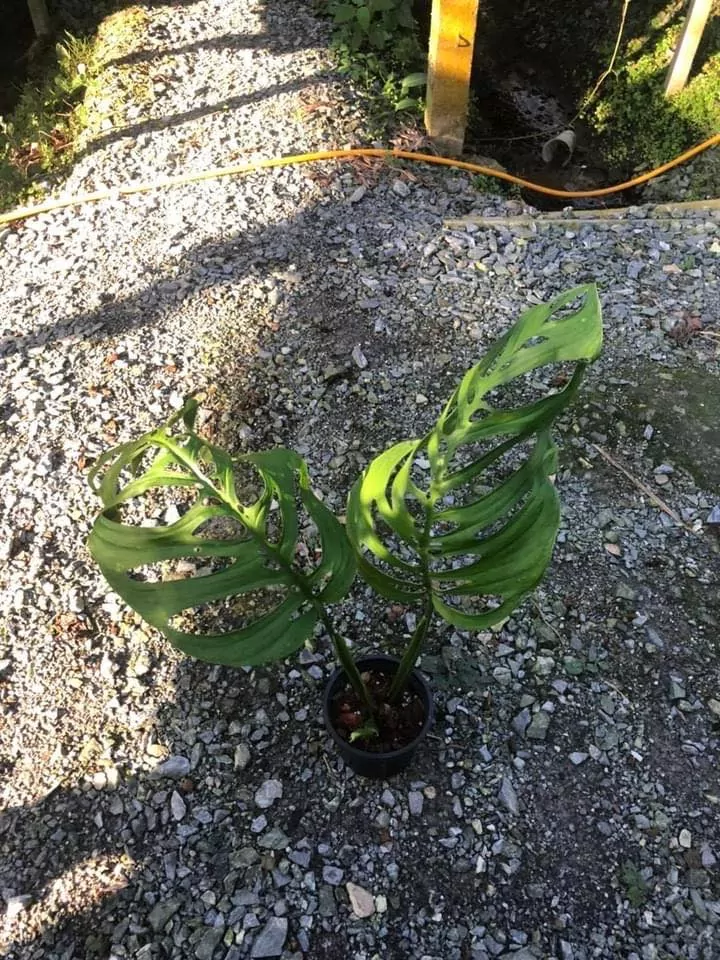
Greenboog’s Monstera Esqueleto product page is the owner for the current commercial offer. This guide does not freeze a price, pot size or stock claim that can change.
Monstera Esqueleto care: the practical baseline
No controlled Esqueleto-specific care trial was found in the sources reviewed. The following starting points combine its documented climbing habit with authoritative general Monstera guidance. Adjust them to the root zone and the plant’s trend rather than following a calendar.
| Factor | Useful starting point | Read the plant |
|---|---|---|
| Light | Bright filtered or indirect light; introduce stronger exposure gradually | Smaller new leaves and long spacing can indicate insufficient usable light, root stress or lack of support |
| Water | Water thoroughly after the mix has substantially dried, then drain completely | Use pot weight and moisture below the surface; do not water because a weekday arrived |
| Substrate | Open, well-drained, slightly acidic houseplant mix in a pot with working drainage | The root zone should re-aerate without becoming bone-dry for long periods |
| Temperature | Warm indoor conditions; RHS gives 18–25°C (65–77°F) for Swiss cheese plants | Avoid cold drafts, hot glass and abrupt changes after shipping |
| Humidity | Moderate, stable room humidity with air movement | Dry edges are a prompt to check roots, watering, salts and heat—not proof of one cause |
| Support | A firm board, pole or trellis positioned behind the climbing stem | Tie the stem between nodes; never strap an emerging leaf or petiole |
| Feeding | A complete houseplant fertilizer at label rate during active growth | Do not fertilize a saturated, cold or failing root system to force a new leaf |
The RHS Monstera growing guide recommends filtered light, warmth, free drainage and thorough watering after an appropriate dry-down. For the broader routine, use Greenboog’s Monstera care guide; the sections below focus on Esqueleto’s collector-specific decisions.
Light and support: the two maturity levers
Place the plant where it receives enough diffuse light to sustain larger growth without abruptly exposing an acclimated indoor leaf to hot direct sun. Window direction is only a clue; curtains, season, distance and nearby buildings all change the light that reaches the blade.
At the same time, give the active stem a stable vertical route. RHS notes that climbing Monstera often produce larger, more mature and more perforated foliage once trained on support. Attach only the stem. Guide aerial roots toward the support or substrate when practical and leave the growth point free.
Support and light do not manufacture the Esqueleto identity. They help a correctly named, healthy plant express more mature growth. Genetics, maturity and root function still set the limits.
Water and mix as one root-zone system
Water until the entire root ball is evenly wet and excess leaves the drainage holes. Then wait until the mix has substantially dried before repeating. Test below the decorative top layer and learn the difference between the pot’s just-watered and ready-to-water weight.
A workable mix contains water-holding material plus coarse structure that restores air after irrigation. Bark, coir or peat-based material and mineral aeration can all work in different ratios. Judge the result:
- If the center remains wet for many days while growth slows, check pot size, light, temperature and root condition.
- If water immediately escapes a gap around a shrunken root ball, re-wet the center instead of assuming the plant was watered.
- If roots are firm and filling the pot but the mix dries within a day, a modestly larger container may improve control.
- If roots are brown, soft or foul-smelling, remove failed tissue with a clean tool and correct the saturated conditions before feeding.
How to encourage larger, more perforated leaves
- Confirm active roots. A plant cannot size up while repeatedly losing roots to saturation or drought.
- Increase usable light gradually. Track the next two or three leaves, not one sudden move.
- Keep the stem climbing. Use a stable support and avoid letting the active tip repeatedly fall and restart.
- Maintain the growth sequence. Unnecessary pruning resets the shoot to a smaller stage.
- Feed only during real growth. Correct light, roots and temperature before increasing fertilizer.
A fresh juvenile cutting may need several leaves before its architecture becomes useful for identification. Do not reject a healthy plant solely because the first post-propagation leaf is small or lightly perforated.
Propagate Monstera Esqueleto from a node
A viable cutting needs a section of stem containing a node and an axillary bud or growth point. A detached leaf and petiole do not contain the structures required for continued shoot growth. The University of Minnesota’s Monstera propagation guide illustrates this node-first principle.
- Identify the active growth point, node, axillary bud and any aerial root before making a cut.
- Photograph the mother plant and the exact node so the clone’s provenance stays with the cutting.
- Use a clean, sharp tool and cut through healthy internodal stem without crushing the node.
- Root in clean water or an airy, evenly moist medium; keep the growth point above stagnant water.
- Pot after a functional root system forms. Use a small draining container instead of surrounding a new root with a large volume of wet mix.
- Expect the first leaf to be smaller. Rebuild light, roots and vertical support before judging mature identity.
See Greenboog’s Monstera propagation guide for the broader workflow. For a valuable Esqueleto, preserving a documented node and mother-plant record matters as much as producing roots.
Troubleshooting by evidence
| Observation | Check next | Avoid |
|---|---|---|
| New leaves are smaller and less perforated | Root health, recent cutting history, total light and whether the stem is climbing | Adding fertilizer before checking roots and support |
| Several leaves yellow while the mix stays wet | Drainage, pot size, stem base, root firmness and odor | Watering again because only the surface looks dry |
| One side develops a crisp pale patch | Recent move, hot window glass or grow-light distance | Treating stable scorch as a spreading infection |
| Fine stippling, webbing or distorted growth | Leaf undersides, petiole junctions and nearby plants under magnification | Assuming every mark is a watering problem |
| Leaf edges brown repeatedly | Root-zone swings, salt buildup, hot air and actual room humidity | Using misting as the only diagnosis or control |
| Cutting roots but never produces a shoot | Whether the piece includes stem, a node and a viable bud | Waiting indefinitely on a leaf-and-petiole cutting |
| Plant does not resemble the seller’s mature photo | Age, support, provenance and the sequence of new leaves | Renaming a juvenile plant from one stressed leaf |
Pet and child safety
Treat Monstera Esqueleto as a plant that should not be chewed or eaten. RHS warns that Monstera plants are poisonous. The ASPCA record for Monstera deliciosa identifies insoluble calcium oxalates and oral irritation in cats and dogs; that record is not an Esqueleto-specific taxonomic test, but it supports a conservative placement away from pets and children. Seek veterinary or medical advice after suspected ingestion rather than relying on an article diagnosis.
Frequently asked questions
What is the correct scientific name for Monstera Esqueleto?
The safest current label is Monstera sp. ‘Esqueleto’ or simply Monstera Esqueleto. The Aroid Cultivars record lists its base species as unknown and calls it a historical cultivar until described.
Is Monstera Esqueleto a Monstera epipremnoides?
Do not assume so. Kew accepts M. epipremnoides as a separate species, while the Esqueleto record does not assign that species as its base. The old trade equivalence should not be repeated as settled taxonomy.
How can I tell Esqueleto from adansonii?
Wait for established climbing growth and examine the combination of mature size, small holes near the midrib, much larger outer openings, drooping blades, stacked internodes and persistent petiolar sheath. A juvenile leaf by itself may remain ambiguous.
Why does my Monstera Esqueleto have few holes?
The plant may be juvenile, recently propagated, growing without support, receiving too little usable light or managing root stress. Correct the limiting condition and compare the next several leaves; do not cut off healthy juvenile growth to force fenestration.
Can Monstera Esqueleto grow from a leaf?
Not as a continuing plant if the piece is only a leaf and petiole. Propagation requires stem tissue with a node and viable growth point.
Does Monstera Esqueleto need a moss pole?
It needs stable vertical support, but that support does not have to be a moss pole. A board, trellis or pole can work if it holds the stem safely and gives aerial roots a useful direction.
Sources and evidence boundary
This guide prioritizes the Aroid Cultivars identity record, Kew’s taxonomic backbone, RHS cultivation guidance and university extension propagation information. Esqueleto’s base species remains unresolved, and general Monstera care is an evidence-led starting point rather than a species-specific controlled trial. Keep a plant record, photograph its mature growth and revise the identification if a future formal description provides stronger evidence.