
Monstera longevity guide
A Swiss cheese plant can be a long-term houseplant, but the internet’s neat 10-, 20-, 40- and 50-year claims are not a reliable biological clock. The useful question is what part of the plant you are measuring—and whether an apparent age problem is actually a root, light, support or space problem.
- Do not treat 10–15, 20, 30–40 or 50 years as a guaranteed average or maximum.
- One aging leaf is not evidence that the whole plant is old or dying.
- A node cutting becomes a new rooted plant while preserving the parent plant’s genotype.
- Diagnose a declining root or stem system before blaming age.
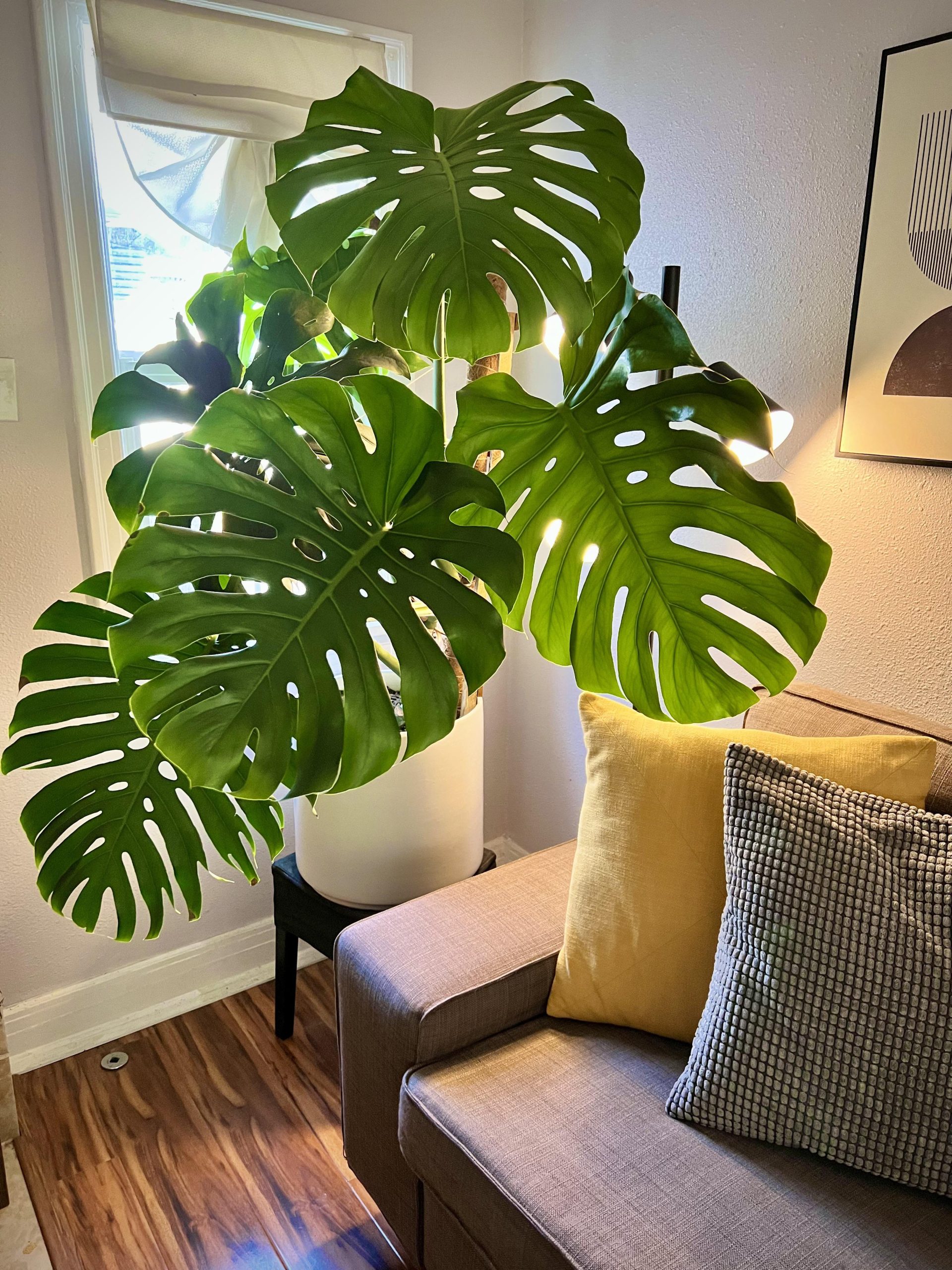
There is no trustworthy fixed age for an indoor Monstera
Monstera deliciosa is a perennial climber. The Royal Horticultural Society describes Swiss cheese plants as vigorous and long-lived, while NC State Extension classifies M. deliciosa as perennial. Those descriptions support a careful answer—this is not a short-season plant—but neither source assigns every indoor plant a fixed number of years.
That distinction matters because a houseplant’s history is shaped by the container and the grower. A specimen may be divided, cut back, rerooted, moved, repotted or rebuilt around one surviving stem. Two people can both say they have owned “the same Monstera” for 20 years while referring to very different biological units.
What exactly are you trying to age?
A lifespan claim changes meaning depending on which living unit the writer is counting.
| What is counted | What can end | What continues | Useful interpretation |
|---|---|---|---|
| One leaf | The oldest leaf can yellow and be shed. | The stem, node and growing point may remain healthy. | Leaf turnover is not whole-plant death. |
| Original root system | Roots can be lost to prolonged saturation, disease or severe damage. | A sound stem node may be capable of forming new roots. | The root system and the genotype do not have the same clock. |
| Connected plant | A whole rooted stem system can become nonviable. | A previously separated node cutting may survive independently. | Ask whether the original connected organism is still present. |
| Propagated line | Each individual cutting can fail or be discarded. | Successful descendants retain the parent plant’s genotype. | Continuity of a clone is not proof of an immortal individual plant. |
A Monstera may outgrow a room before it gets old
Monstera is a climbing plant, not a naturally compact floor rosette. With time, its stem extends, aerial roots explore, leaves can become larger and the mass above the pot becomes harder to support. In a home, ceiling height, safe anchoring and the ability to inspect or move the container often become more practical limits than chronological age.
That does not mean a large plant must be discarded. A healthy vine can be redirected, pruned or propagated when its form no longer suits the room. Structural work is easier before a stem becomes heavy and rigid, so use the Monstera support and training guide when the issue is leaning, sprawling or an unstable pole—not “old age.”
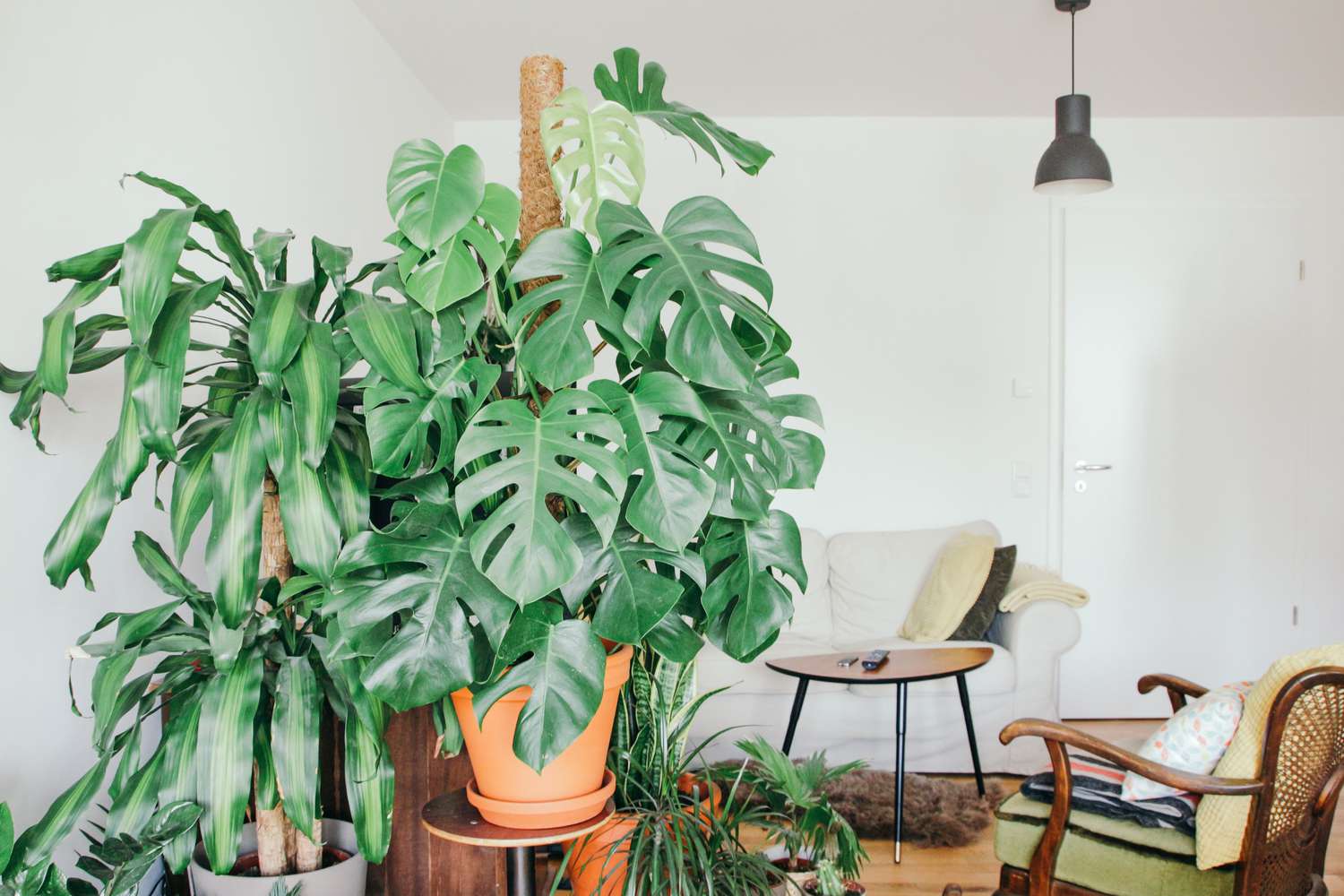
Normal turnover or a plant-wide decline?
Age should be the last explanation you reach, not the first. A single lower leaf can decline while the active tip, newer leaves and roots remain sound. Several symptoms appearing together—especially when the root zone stays wet or the stem loses firmness—deserve a broader inspection.
| What you see | What it may mean | Check next | Route |
|---|---|---|---|
| One oldest lower leaf yellows | Ordinary leaf turnover is possible if the rest of the plant is stable. | New growth, root-zone behavior and whether yellowing spreads. | Observe before correcting. |
| Several leaves change together | A shared root, light, temperature or pest stress is more likely than leaf age alone. | Roots, drainage, recent environmental changes and leaf undersides. | Assess whole-plant health. |
| Brown or crisp areas | Water stress, root damage, heat, salts or abrupt light can overlap. | Pattern, texture, pot condition and what changed first. | Use the brown-leaf diagnostic. |
| Soft roots, foul odor or collapsing stem | The plant may have a time-sensitive root or stem failure. | Firm surviving tissue and viable nodes. | Follow the Monstera recovery sequence. |
What most often shortens useful indoor life
A root zone that stays airless
Roots need moisture and oxygen. A container that remains saturated, has blocked drainage or holds a dense wet center can lose roots even when the surface looks normal. Conversely, repeated severe drying can also reduce functioning roots. The reliable response is to inspect the rooted zone and learn how the actual pot changes between waterings. The Monstera watering guide owns that decision process.
Too little usable light—or an abrupt increase
Long-term weak light can produce stretched, less resilient growth, while a sudden move into intense direct sun can damage leaves that developed in shade. Window direction, distance, glass, season and obstruction all change exposure. Use the Monstera light and placement guide to evaluate the site instead of relying on the label “indirect light.”
A stem system that becomes unmanageable
Heavy unsupported growth can bend, detach from a pole or become impossible to move safely. A crowded plant may also hide pests, dead material or a failing attachment. Support, pruning and space planning preserve usable form; they do not add a guaranteed number of years.
Untreated pests, disease or mechanical damage
Mealybugs, scale and mites can weaken a plant when they are missed, but treatment should follow the pest and product label. Routine dish-soap mixtures, neem schedules or indiscriminate sprays are not a longevity plan and may damage tissue. Inspect new growth, nodes, petiole junctions and leaf undersides, then respond to what is actually present.
A long-term review works better than a rigid calendar
- Compare the newest growth with the previous few leaves and internodes.
- Relearn pot weight and drying behavior after repotting, root loss, a seasonal light change or a major move.
- Make sure water can leave the container and that the base is not standing in runoff.
- Inspect ties and supports before stems become difficult to reposition.
- Look under leaves and around nodes for pests before applying a treatment.
- Review whether the plant still fits the room and whether a planned cutting would be safer than an emergency rescue.
Repot because the root system, medium or container behavior gives you a reason—not because an online schedule says every plant needs a larger pot after a fixed interval. A large pot around a small root system can be harder to manage than a snug but functional one.
Does propagation reset a Monstera’s age?
“Reset” is convenient grower shorthand, but it is not a measured biological rule. A stem cutting with a viable node and axillary bud can form an independent root system and new growth. That new plant carries the same genotype as the parent, but the original root system and the new rooted cutting are not the same connected individual.
This is why a family’s Monstera can have a decades-long story even if the current pot contains a descendant of the original vine. Both statements can be honest: the clone has a long history, and the current rooted plant began later. For node selection, cutting methods and transfer, use the Monstera propagation guide.
Keep, rejuvenate or restart?
| Decision | When it fits | First action | What not to assume |
|---|---|---|---|
| Keep as is | Roots, stem and active tip are sound; the plant fits its support and space. | Continue observation and condition-based care. | One old leaf means decline. |
| Rejuvenate | The plant is healthy but leggy, top-heavy or too large for its setting. | Plan support, pruning and viable-node propagation before cutting. | Bigger automatically means healthier or older. |
| Rescue sound tissue | Root or stem failure is advancing but firm nodes remain. | Separate diagnosis from propagation and preserve only viable material. | A fertilizer or spray can restore dead tissue. |
| Replace | No viable node or healthy rooted section remains, or the plant no longer suits the household. | Resolve the failed condition before introducing another plant. | The species has a short built-in lifespan. |
Frequently asked questions
Can a Monstera live for 40 or 50 years?
Individual plants and propagated family lines may be kept for decades, but the reviewed authoritative sources do not establish 40 or 50 years as a universal indoor average or maximum. Use “long-lived perennial” rather than promising a number.
Is my Monstera dying because it is old?
Age alone is a weak diagnosis. Inspect whether symptoms are limited to one oldest leaf or affect several leaves, the active tip, stem and roots. Whole-plant change is more useful evidence than the purchase date.
Does cutting an old Monstera make it young again?
A viable node cutting can form a new independent root system while retaining the parent’s genotype. That is a practical renewal method, but “young again” or “reset” should not be treated as a measured biological lifespan claim.
Do old Monstera leaves naturally yellow?
An oldest lower leaf can eventually be shed, but yellowing also occurs with root, moisture, light and pest problems. Observe the pattern and the rest of the plant before calling it natural aging.
How can I help a Monstera remain a long-term houseplant?
Protect the root zone from prolonged saturation, provide usable light, support the climbing stem, inspect for pests and adapt the setup as the plant grows. Use condition-led care rather than a fixed calendar.
Sources and evidence notes
- Royal Horticultural Society: Swiss cheese plants — vigorous, long-lived growth and indoor scale.
- Royal Horticultural Society: how to grow Swiss cheese plants — climbing habit, pruning, propagation and root-rot context.
- NC State Extension: Monstera deliciosa — perennial classification and species-level horticultural context.
- Kew Plants of the World Online: Monstera deliciosa — accepted name and climbing/sprawling growth habit; not an indoor lifespan source.
- University of Minnesota Extension: propagating Monstera deliciosa — node and axillary-bud requirements for new growth.

1 thought on “How Long Do Monstera Plants Live? What Limits Them”