Greenboog evidence-led cultivar guide
This guide is for collectors, owners and tissue-culture buyers who need to separate the modern tricolor trade plant from older or similar names, grow it on support, protect functional green tissue and diagnose changes without chasing color at the expense of roots.
Use a complete plant profile. Color alone overlaps with several red-stemmed Philodendron cultivars.
| Factor | What to verify | Practical meaning |
|---|---|---|
| Botanical status | Cultivated trade plant; no independent wild-species range | Keep reported parentage separate from documented fact |
| Growth habit | Climbing stem, lengthening internodes and aerial roots | Support the stem vertically and tie internodes, not petioles |
| Foliage | Several green/burgundy leaves with cream, white, mint or pink pattern | Allow new color to harden before judging the plant |
| Stem evidence | Repeated red/burgundy tone and pattern near a viable bud | One pink leaf cannot prove identity or future variegation |
| Safety | Insoluble calcium oxalates typical of Philodendron | Keep plants and cuttings inaccessible to pets and children |
What is Philodendron Red Anderson?
The modern plant sold as Philodendron ‘Red Anderson’ is a cultivated climbing aroid, not a wild species called Philodendron redandersonii. It therefore has no independent South American “native range.” A cultivar may descend from tropical species, but that is different from saying the cultivar grows naturally in rainforest.
Many shops describe Red Anderson as a Pink Princess × White Knight hybrid. That may be the prevailing trade account, but repetition is not breeder documentation. Until a primary record is found, the responsible wording is “commonly reported parentage,” not a settled cross.
Kew records Philodendron erubescens as an accepted Colombian climbing species with reddish-green stems and rooting internodes. Red Anderson is usually discussed within this red-stemmed cultivated group, but the species record does not prove the identity or parentage of a particular trade clone.
Red Anderson is not automatically Anderson’s Red
University of Connecticut Extension lists an older reddish selection called ‘Anderson’s Red’ and describes it as mostly green with red overtones. Modern sellers commonly use “Red Anderson” for a strongly cream/white/pink-variegated plant.
Those descriptions are different enough that the two names should not be treated as proven synonyms. If lineage matters to the purchase, ask for the exact source label, mother-plant history and current-plant photographs rather than accepting a swapped word order as evidence.
Separate what can be observed now from what still requires provenance.
| Claim | What supports it | Responsible conclusion |
|---|---|---|
| Modern tricolor trade plant | Several current leaves, burgundy stem/petioles, climbing nodes and source label | A useful working identification when the complete profile agrees |
| Pink Princess × White Knight | Widely repeated retailer and collector account | Commonly reported parentage, not a settled cross without primary documentation |
| Same as Anderson’s Red | Similar words but conflicting historical and modern descriptions | Do not merge the names automatically; request source history |
| Native tropical species | Cultivated plants may descend from tropical Philodendron species | The cultivar itself has no independent wild native range |
How to identify a modern tricolor Red Anderson
Read a sequence of leaves
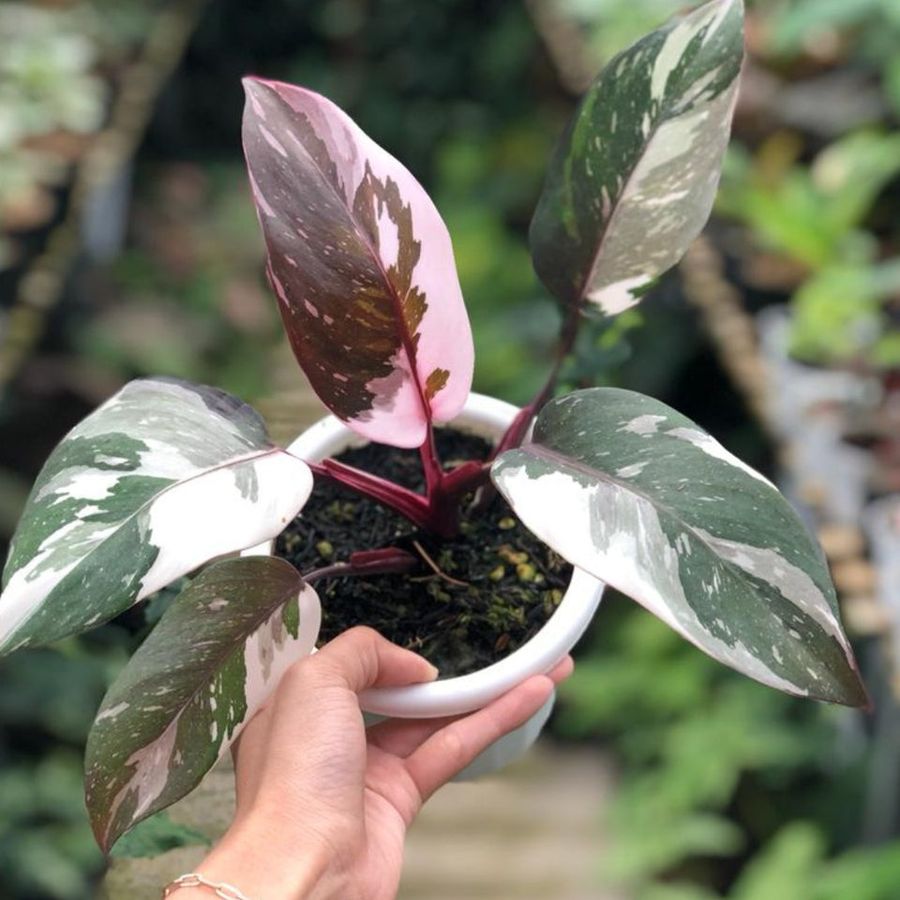
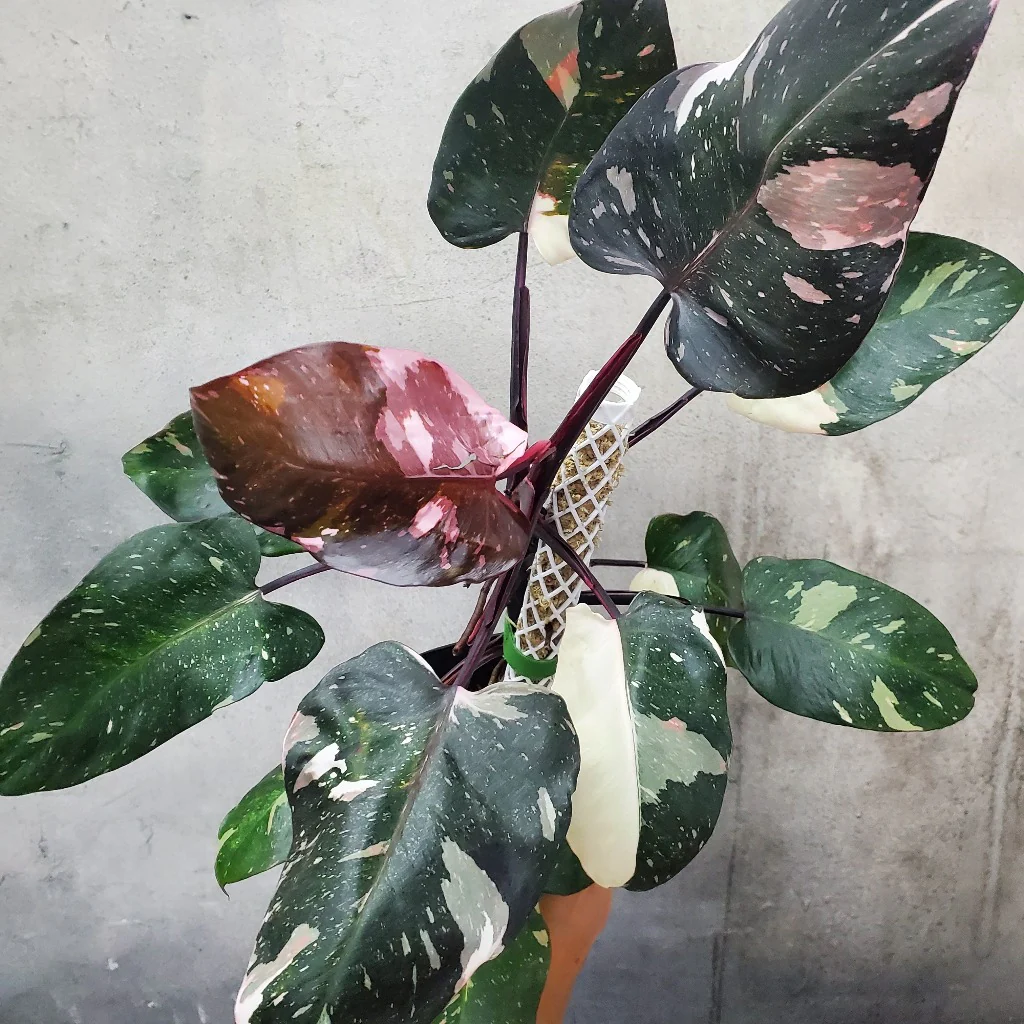
A plant sold under the modern name often carries dark green or burgundy blades with white, cream, mint and pink sectors, splashes or speckling. A new leaf may emerge bronze, burgundy or pinkish, then shift as it expands and hardens. The older green tissue does not “turn into” a different cultivar; leaf color is one observation in a growth sequence.
Inspect stems, petioles and cataphylls
Red to burgundy stems and petioles support the trade identification, especially when the color repeats across nodes. Look for where pale or pink striping travels through the stem near the active bud. Do not use petiole color alone: red-stemmed Philodendron cultivars overlap.
Confirm climbing architecture
The stem should lengthen between nodes and make aerial roots that can attach to a support. A compact juvenile can look self-heading before its internodes extend. Follow the stem rather than forcing a conclusion from the silhouette of a small pot.
Red Anderson versus similar cultivars
North Carolina Extension describes Pink Princess as an upright/vining plant with dark purplish-green leaves and pink variegation, White Princess as green with white variegation, and Red Emerald as a climber with deep red petioles. These traits explain why a young or low-pattern Red Anderson is easy to mislabel.
Use these traits to form questions for the seller, not to force a diagnosis from a single photograph.
| Comparison | Useful clue | Why it is not proof |
|---|---|---|
| Pink Princess | Often emphasizes pink against very dark leaves | Red Anderson can also produce pink and burgundy foliage |
| White Knight/White Princess trade | White sectors plus cultivar-associated stem/petiole patterns | Juvenile and tissue-culture plants overlap; labels are inconsistent |
| Red Congo Variegated | Usually sold as a more self-heading Congo-type plant | A juvenile climber can appear compact and photos can hide internodes |
| Strawberry Shake | Often shows cream, salmon or orange-pink on green | Leaf age and photography change color; provenance is still required |
The strongest purchase evidence is not a comparison chart. It is a consistent mother plant, several current leaves, visible stem and active point, accurate propagation method and a seller who distinguishes the plant shown from a representative photo.
Variegation: protect plant function before chasing color
Pale tissue contains less chlorophyll and therefore contributes less photosynthetic capacity. A high-white or high-pink leaf can be beautiful while increasing the plant’s dependence on its green tissue. More fertilizer cannot turn a chlorophyll-poor sector into a productive green one.
- If new growth is mostly green, verify light, roots and the pattern through the stem before cutting. One green leaf is not a reason to remove half the plant.
- If new growth is extremely pale, protect it from abrupt light, preserve functional green leaves and wait for the next node/leaf before making a risky cut.
- Pruning to a visibly patterned node can influence which bud continues, but it cannot guarantee the color of the next leaf.
- Do not buy a green wet stick, seed or unrooted leaf on a guaranteed-tricolor promise.
University of Minnesota Extension notes that low light stretches stems and can allow variegated plants to become greener, while excessive light can bleach or scorch. Use this as a diagnostic framework—not permission to sun-stress the plant for color.
Why fixed care recipes fail
Replace generic care shorthand with a decision you can verify.
| Common advice | What it leaves out | Use it this way |
|---|---|---|
| Bright indirect light preserves color | Identity, genetics, leaf age, roots and acclimation | Increase usable light gradually; never promise a color outcome |
| Water every 7–14 days | Pot, mix, root mass, light, temperature and leaf area | Probe the full root zone and learn watered-versus-ready pot weight |
| Keep soil constantly moist | Air-filled porosity and oxygen demand around the roots | Maintain usable moisture without leaving the core saturated |
| Maintain a precise humidity range | Sensor accuracy, airflow, roots and household mold risk | Measure trends and intervene only when repeated symptoms support it |
| A pole produces bigger, pinker leaves | Light, roots, maturity, nutrition and stem pattern | Use support for climbing architecture, not as a color guarantee |
Give the climbing stem a stable support
Install a plank, coir/moss-style pole or another vertical surface before the plant becomes top-heavy. Place the stem against it and use soft ties around internodes. Petioles and emerging leaves need room to move; a tight tie can scar or deform them.
Guide aerial roots toward the support or substrate. A support does not need to stay saturated at all times, and a wet pole must not keep the pot permanently soaked. Mechanical stability and repeatable care matter more than a decorative support material.
Use the plant’s response to tune care; a fixed range copied from a shop cannot describe every pot and room.
| Factor | Useful starting point | Adjust when |
|---|---|---|
| Light | Bright, filtered exposure introduced gradually | Internodes stretch, leaves shrink or pale sectors scorch |
| Water | Water thoroughly after appropriate partial root-zone dry-down | Pot weight, roots, light, leaf area or season changes |
| Substrate | Clean, airy and moisture-retentive mix in a draining pot | The core stays saturated or the mix collapses and dries unevenly |
| Warmth and air | Stable warmth, no cold/HVAC blast, gentle airflow | Measured conditions or repeated leaf damage identify a problem |
| Support | Stable vertical surface with soft ties around internodes | Stem weight, aerial roots or pot stability outgrow the setup |
| Fertilizer | Complete fertilizer at or below label rate in active growth | Growth slows, roots are damaged or salts accumulate |
Light: increase usable energy without bleaching leaves
Begin with bright, diffused light and a broad view of open sky. Window direction alone is not a measurement: glass, trees, roof overhangs, season and distance change intensity. A suitable grow light on a timer can make exposure more consistent.
Long internodes, smaller successive leaves and a pot that dries much more slowly can support a low-light diagnosis. Dry pale patches on the exposed side support a too-fast increase. Change position or lamp distance gradually, then judge leaves formed under the new condition.
Water the whole root zone, not a calendar
Probe below the surface and learn the difference between the pot’s watered and partly dried weight. When the upper zone has dried somewhat but the root ball remains receptive, water the full profile and let runoff leave the pot.
Iowa State University Extension recommends evenly moist but not wet conditions and warns against leaving Philodendron in soggy soil or standing water. A fixed one-to-two-week interval fails because light, warmth, pot size, root mass and leaf area change water use.
Build an airy root zone and proportionate pot
Use a clean medium that holds useful moisture while retaining air after watering. Fine bark or coco chips, coir or another water-holding component, perlite/pumice and a measured potting component can work. Adjust particle size and water retention to the actual room and owner rather than copying one recipe.
Choose a container only modestly larger than the working roots, with open drainage and enough weight to stabilize the support. Repot when the root system, collapsed mix or top-heavy structure requires it—not because a generic two-year date has arrived.
Temperature, humidity, airflow and feeding
Keep conditions warm and stable, away from cold glass, air-conditioning blasts and heating vents. Higher humidity can reduce moisture loss while a new leaf expands, but it cannot repair damaged roots. Measure the room with a hygrometer when symptoms recur, use a humidifier only when needed and pair higher humidity with air movement.
Skip routine misting and pebble-tray promises. Wet leaves in still air complicate pest/disease management, while a small tray cannot control a room. Apply a complete houseplant fertilizer at or below label rate during active growth; reduce or pause when the plant is cold, dark, newly repotted or root-damaged.
How to propagate Philodendron Red Anderson
Propagation requires a viable node. A detached leaf and petiole can stay attractive for a time but cannot reproduce the plant without stem tissue and an active or dormant bud.
- Choose healthy, pest-free stock with several leaves and a clearly visible stem.
- Trace the variegation through the stem and identify the node, bud and any aerial root before cutting.
- Air-layer the node while it remains attached when the plant or cutting is valuable; an established root system reduces the unrooted interval.
- Use a clean, sharp blade and place the cutting in water or a clean, airy medium kept moist but not saturated.
- Provide stable warmth and bright diffused light; pot after functional roots and active growth appear.
See the site’s Philodendron propagation guide for node and rooting pathways. Penn State Extension emphasizes healthy stock, clean tools, bright indirect light and moist-not-saturated propagation media. No method guarantees the next leaf’s color or a fixed rooting week.
Tissue-culture plantlets need a staged transition
An in-vitro plantlet has roots and leaves formed in sterile, high-humidity conditions. Do not give it established-plant light, fertilizer, pot volume or dry-down on day one.
- Work cleanly, remove culture gel carefully and use a small volume of fine, airy medium.
- Begin under protected humidity with gentle bright light and enough ventilation to limit stagnant condensation.
- Open the enclosure in measured steps as roots function and a new leaf forms.
- Change one major condition at a time; simultaneous lower humidity, stronger light and fertilizer compounds stress.
- Evaluate pattern only after several acclimated leaves; a tiny plantlet is weak identity evidence.
UF/IFAS describes Stage IV acclimation as a vulnerable transition in which humidity is reduced and light is increased gradually. Home timing must follow the plant’s response rather than a commercial greenhouse calendar.
Diagnose before treating
Change one major factor at a time and use subsequent growth to test the diagnosis.
| What you see | Check first | Safer next step |
|---|---|---|
| Mostly green new leaf | Light, roots, stem pattern, propagation history and several leaves | Stabilize care; do not make an immediate deep cut for color |
| Mostly white/pink new leaf | Remaining green area, active point and roots | Preserve functional green tissue and wait for the next signal |
| Yellow older leaf | Normal retirement versus slow-drying mix, low light or root loss | Inspect the full root zone before watering or feeding |
| Curling/stalled new leaf | Moisture swing, roots, temperature, unfurling conditions and pests | Use the leaf-curl diagnostic and isolate the cause |
| Crisp pale sector | Abrupt light, hard dry-down, root damage or salts | Correct the measured stress; damaged tissue will not refill |
| Fine stippling/distortion | Mites, thrips, scale or mealybugs on hidden surfaces | Isolate, identify and use a treatment labeled for the site |
Safety: Philodendron is not pet-safe
ASPCA Animal Poison Control includes Philodendron varieties among plants containing insoluble calcium-oxalate crystals. Chewing can cause oral pain, drooling, retching, vomiting and difficulty swallowing. Keep the plant, cuttings and dropped material inaccessible; contact a veterinarian or poison-control service after exposure, especially if swallowing or breathing is affected.
Buying: established plant or tissue culture?
Choose the format by evidence available now and the transition risk you can manage.
| Format | Best for | Verify before buying |
|---|---|---|
| Established plant | Buyer wanting several diagnostic leaves, visible stem and working roots | Actual plant, source label, active point, node pattern, roots, pests and shipping state |
| Tissue-culture plantlet | Experienced acclimator accepting weak juvenile identity signals | Plant count, in-vitro/ex-vitro state, roots, current pattern, responsibility and support |
Greenboog keeps the formats separate: see the established Philodendron Red Anderson listing or the Red Anderson tissue-culture listing. Availability, size, count and price belong on those current product pages. Browse the Philodendron collection for other options and use the Philodendron discovery guide for broader genus context.
FAQ
Is Red Anderson a Pink Princess × White Knight hybrid?
That parentage is widely repeated in the trade, but no authoritative breeder, registration or patent record currently establishes it. Treat it as reported lineage and buy from provenance plus current-plant evidence.
Are Red Anderson and Anderson’s Red the same plant?
Do not assume so. UConn describes the older ‘Anderson’s Red’ as mostly green with red overtones, while modern Red Anderson listings often show tricolor variegation. Ask the seller for source history.
Does Red Anderson climb?
The modern trade plant is grown as a climber. Give its stem vertical support, attach internodes loosely and let petioles and emerging leaves move freely.
How do I get more pink or white variegation?
No care change guarantees a color. Provide healthy roots, stable bright diffused light and support; observe several leaves and stem pattern before considering a node-based cut.
Can a Red Anderson leaf grow a new plant?
Not without viable stem tissue. A propagation requires a node and bud; a detached leaf and petiole alone cannot reproduce the cultivar.
How often should I water Philodendron Red Anderson?
There is no safe fixed interval. Check the whole root zone, pot weight, light, temperature and current growth; water thoroughly after partial dry-down and drain completely.
Is Philodendron Red Anderson safe for cats and dogs?
No. Philodendrons contain insoluble calcium oxalates and can cause painful oral and swallowing symptoms when chewed. Keep the plant inaccessible and contact a veterinarian after exposure.