
Velvet-leaf identity, normal colour and symptom-first care
Philodendron Micans is the familiar horticultural name for a velvet-leaved climbing form that Kew places within accepted Philodendron hederaceum var. hederaceum. Its bronze new leaves, copper underside and angle-dependent sheen are normal traits—not variegation or disease on their own.
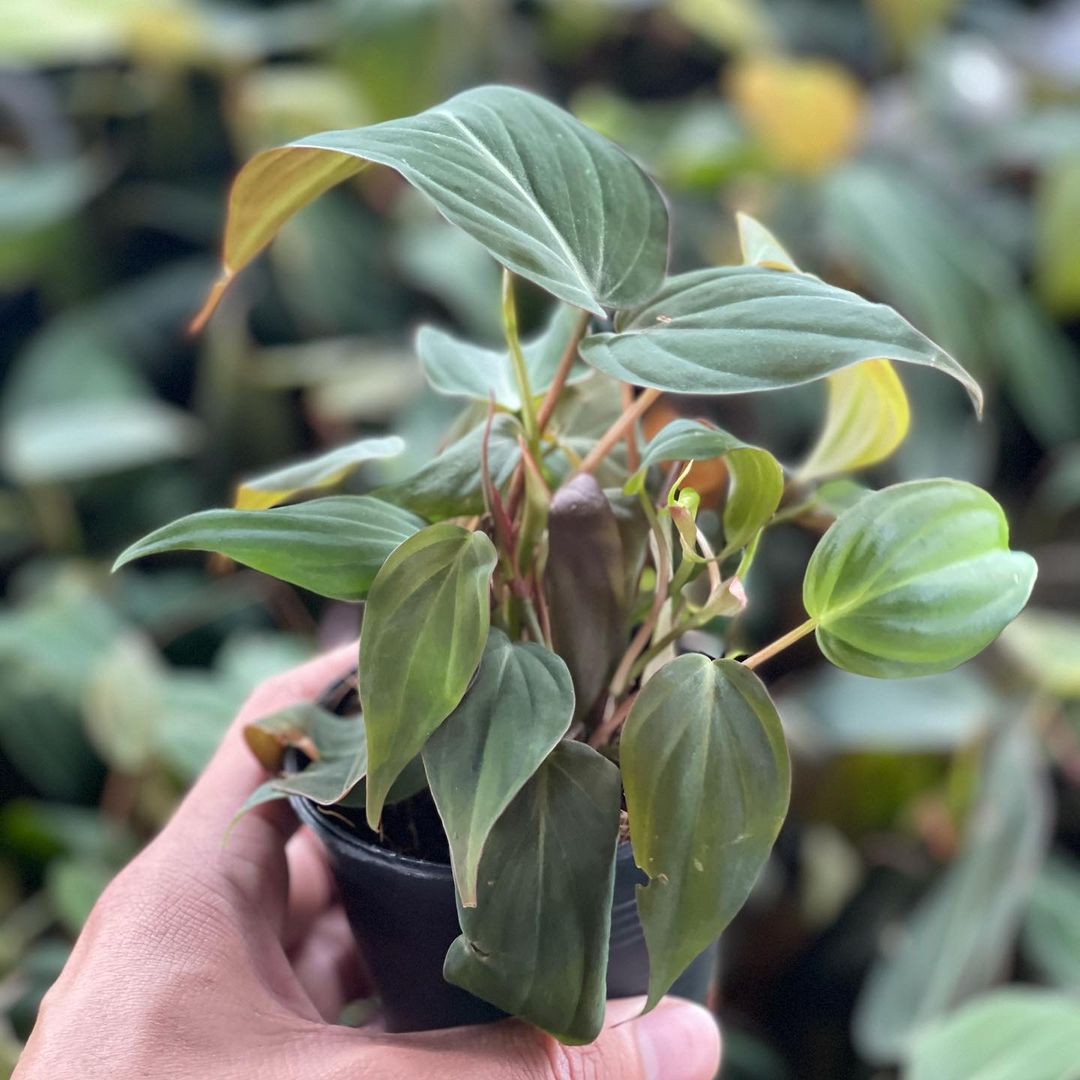
Micans is a familiar name, not the accepted taxon
Kew treats Philodendron micans Klotzsch ex K.Koch as a synonym of accepted Philodendron hederaceum var. hederaceum. The accepted variety ranges from Mexico through tropical America and is a wet-tropical climber. IPNI preserves the historical Micans name and publication record; it does not override Kew’s current acceptance.
Greenboog’s live product title uses the singular seller spelling “Philodendron Mican.” This article uses “Micans” for the widely searched horticultural name while preserving the exact product label on commercial routes. Neither spelling makes a plant variegated.
Know what healthy colour can look like
| Observation | Often normal | Investigate when |
|---|---|---|
| Bronze or copper fresh leaf | New growth commonly opens warmer before settling greener. | The leaf stays weak, deformed or the active point stalls. |
| Copper-toned underside | A recognised Micans trait in horticultural descriptions. | There are water-soaked patches, collapse or spreading lesions. |
| Surface looks different by angle | Velvet texture changes reflected colour with light and camera position. | Fine stippling, webbing, black specks or silvery scars appear. |
| One old leaf yellows | A single oldest leaf can senesce. | Yellowing advances through several leaves or follows wet-root stress. |
A copper underside is not proof of sunburn, and a bronze emerging leaf is not evidence of nutrient deficiency. Use the connected sequence and recent growing history before changing care.

Read the root zone before watering
Droop is not a watering instruction. A dry, lightweight root ball can need a thorough rewet; a heavy wet pot with limp growth can signal oxygen-starved or damaged roots. Check below the surface, water through the rooted volume when needed and let excess drain. Do not force the mix to become completely dry.
Use an airy medium and a container only modestly larger than the functioning roots. If water races down a gap around a shrunken root ball, rewet evenly rather than repeatedly wetting only the top. If roots are brown and soft, remove failed tissue with clean tools and correct the drainage or overpotting cause. The Philodendron watering guide owns the deeper root-zone method.
Use the vine to interpret light and support
Micans can trail, but it is botanically a climber. Long internodes and progressively smaller leaves can point to weak usable light, limited roots or a stem that never attaches. Give bright filtered light, guide the active stem onto a board or pole and secure stem tissue loosely while leaving petioles free.
Move plants into stronger light gradually. A fixed east- or west-window rule ignores glass, season, latitude and heat; the same window can be gentle at one time and scorching at another. A tan patch concentrated on the exposed surface after a move is better evidence of light or heat injury than a generic brown tip.
Diagnose common Micans symptoms in order
| Signal | Check first | Measured response |
|---|---|---|
| Several leaves yellow and pot stays wet | Drainage, root colour/firmness, pot size and crown depth. | Pause calendar watering; correct the verified root-zone problem. |
| Crisp brown edges | Dry–wet swings, salts, hot glass, roots and humidity together. | Stabilise the matched cause; do not assume dry air alone. |
| Pale stippling or webbing | Leaf undersides with magnification for mites. | Isolate, confirm and use an indoor-labelled control if needed. |
| Silvery scars, black specks or distorted new leaf | Tight new growth and undersides for thrips. | Identify the pest before selecting a label-compliant treatment. |
| Sticky residue or cottony clusters | Nodes and undersides for scale, mealybugs or aphids. | Isolate and remove/target the confirmed pest. |
| Dark, limp patches after a cold event | Timing, window contact, draft and shipment exposure. | Warm gradually and wait for the damage boundary before pruning. |
UC IPM notes that most houseplant symptoms have several possible causes. Routine misting, a pebble tray, automatic neem applications or a nearby space heater do not replace diagnosis and can introduce new leaf, moisture or safety problems.
Propagate the vine from a viable node
A detached Micans leaf cannot rebuild the vine. Take stem tissue containing a node and viable bud or active growth point. Keep the cutting warm, airy and evenly moist rather than saturated, then transfer it after functional roots can support growth.
- Photograph the connected plant and original label first.
- Choose a healthy node with useful leaf area and clean stem.
- Retain an aerial root where practical without crushing it.
- Use clean tools and keep the petiole above the propagation medium.
- Carry the exact non-variegated or variegated seller label forward.
Use the Philodendron propagation guide for node, medium and transfer decisions, and the general Philodendron guide for room-level care.
Buyer checklist and live routes
- Confirm whether the gallery is exact or representative.
- Compare connected upper surfaces, undersides, nodes and active growth.
- Keep ordinary Micans separate from Mican Variegated seller lines.
- Verify rootedness, format, stock and shipment terms on the live listing.
- Do not treat bronze colour or velvet sheen as guaranteed variegation.
Safety and sources
Philodendron tissue contains insoluble calcium-oxalate crystals that can irritate the mouth and digestive tract when chewed. Keep plants and cut material away from children and pets, and seek appropriate medical or veterinary guidance after significant exposure.
- Kew POWO: Philodendron micans synonym record
- Kew POWO: accepted Philodendron hederaceum var. hederaceum
- IPNI: historical Philodendron micans name record
- UF/IFAS: interiorscape Philodendron production guidance
- NC State Extension: heartleaf Philodendron habit and safety
- UC IPM: symptom diagnosis and houseplant pests

Hi there my philodendron micans has started to have pink leaves and they eventually fall off. Is this due to too much sun? I had it by the wall, climbing but the sun was indirect and in a west facing window. I did have a grow light right beside it so maybe that was the issue? I have moved it so that the grow light is now blocked so hopefully that works but what do you think?
It’s possible that the grow light was too intense for your Philodendron Micans and caused the pink leaves and leaf drop. While they enjoy bright, indirect light, they can be sensitive to excessive light, especially artificial light that’s too close.
Here’s why the grow light might be the culprit and what else to consider:
Light intensity: Grow lights often emit stronger light than a typical west-facing window, even if it seems indirect. This can stress the plant, leading to pink discoloration (similar to a sunburn) and eventual leaf drop.
Light duration: Was the grow light on for an extended period? Philodendron Micans, like most plants, need a period of darkness for optimal health. Too much light can disrupt their natural cycle.
Heat: Grow lights can generate heat, which can also contribute to leaf stress, especially if the light is very close to the plant.
What to do now:
Observe: Monitor your plant closely now that you’ve moved the grow light. New growth should be a healthy green. It might take a few weeks to see improvement.
Indirect light: Ensure the plant receives bright, indirect light. A west-facing window is generally good, but you might need to move it slightly further away if the sun is too intense.
Watering: Make sure the soil is well-draining and that you’re not overwatering. Allow the top inch or two of soil to dry out between waterings.
Humidity: Philodendron Micans prefer higher humidity. Consider a humidifier or a pebble tray to increase humidity around the plant.
If the problem persists:
Other causes: If moving the grow light doesn’t resolve the issue, consider other factors like temperature fluctuations, pests, or root problems.
Seek expert advice: If you’re still concerned, you can consult with a local plant shop or a gardening expert for a more personalized diagnosis and solutions.
It’s great that you’re taking steps to address the issue. With a little observation and adjustment, your Philodendron Micans should hopefully recover and thrive!