Greenboog evidence-led cultivar guide
This guide is for collectors and home growers who need to identify the real cultivar, grow it beyond the juvenile stage, diagnose greener leaves without damaging the plant and choose between an established plant and tissue culture.
Use several traits together; one unusually pale or green juvenile leaf is not enough for a reliable identification.
| Factor | What to look for | Practical meaning |
|---|---|---|
| Botanical status | Named cultivar of a currently unidentified Philodendron species | Do not present a trade story as a settled species name or pedigree |
| Growth habit | Climbing stem, lengthening internodes and aerial roots | Add a pole, plank or comparable stable vertical runway |
| Leaf identity | Elongated to arrow-shaped blade, often with undulating margins | Compare mature form, stem and provenance—not color alone |
| Pattern | Variable pale yellow-green field with irregular darker marks | Evaluate a sequence of new leaves; never buy on a recovery promise |
| Safety | Insoluble calcium oxalates typical of Philodendron | Keep the plant and cuttings inaccessible to pets and children |
What is Philodendron Paraiso Verde?
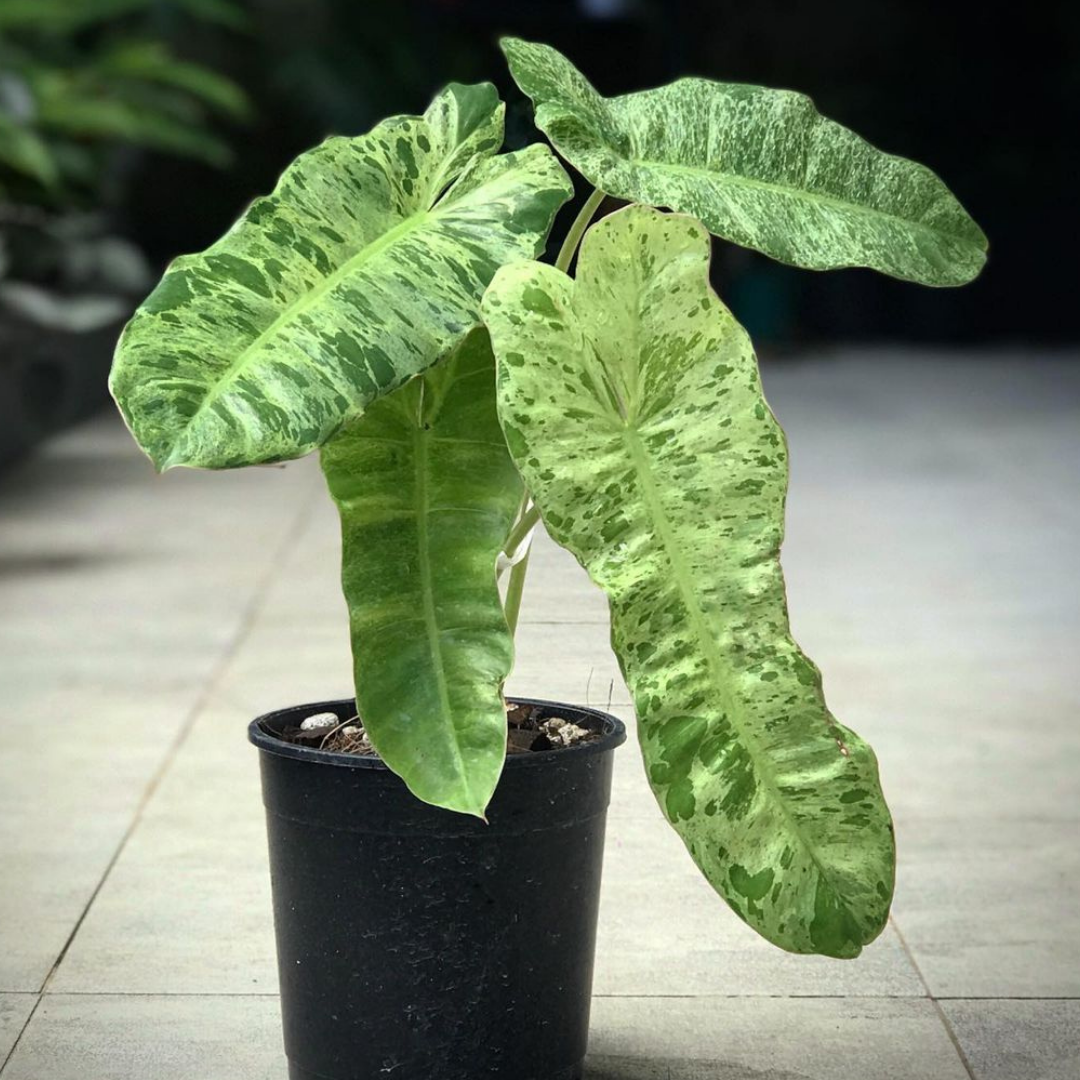
The Royal Horticultural Society record treats Philodendron ‘Paraiso Verde’ as a variegated climbing cultivar of a currently unidentified species. It reports that the source material was collected from plants growing on trees in rainforest in French Guiana. That is more precise than calling it a wild species native across Brazil, Colombia, Ecuador and Peru.
Use the cultivar name in quotation marks when writing botanically: Philodendron ‘Paraiso Verde’. “Paraiso Verde philodendron” and “Philodendron Paraiso Verde” are normal search and trade forms, but names such as Philodendron paraiso-verde imply a species that has not been established.
The cultivar’s exact species placement and pedigree should remain an open boundary. A seller story, social post or resemblance to another Philodendron is not enough to turn a trade hypothesis into a botanical fact.
How to identify Paraiso Verde
Look at the leaf shape and margins
RHS describes elongated, arrow-shaped blades with wavy or undulating edges. The rear lobes can angle forward, while mature leaves can reach about 60 cm under suitable conditions. Young or recently acclimated plants will be smaller and less diagnostic, so avoid identifying one from a single juvenile leaf.
Read the pattern across several leaves
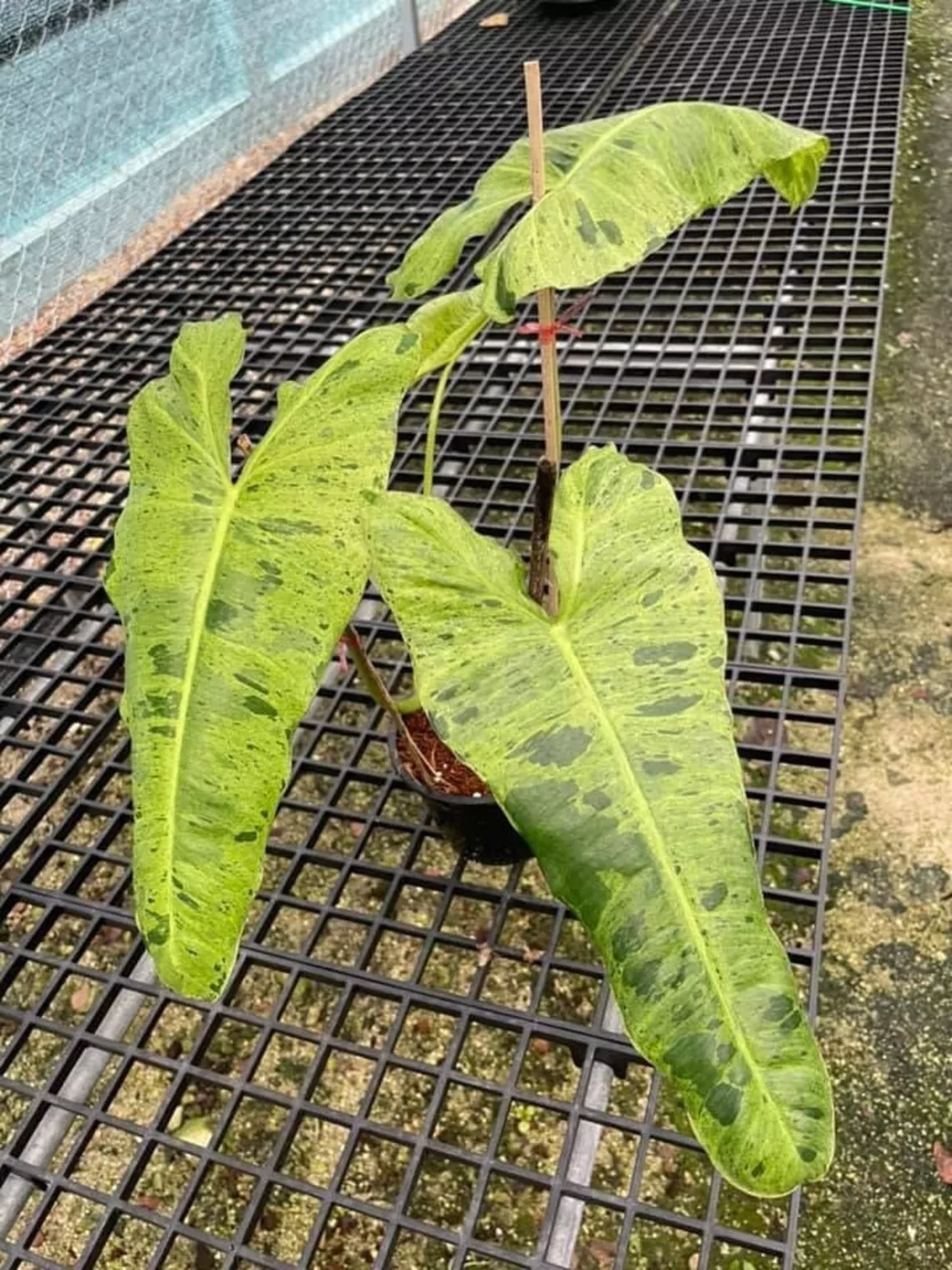
The blade is typically a pale yellow-green field with irregular darker green marks. One leaf may be heavily mottled while the next looks quieter. Compare the whole sequence: blade shape, petiole, stem, internodes, new growth and provenance matter more than one photogenic patch.
Confirm that the stem climbs
Paraiso Verde lengthens between nodes and produces aerial roots that can attach to a vertical surface. A mature plant allowed to climb can hold larger leaves more efficiently than the same stem repeatedly hanging, bending and being cut back. This architecture separates its care from a crawling Philodendron such as Dean McDowell.
Does temperature control Paraiso Verde variegation?
Collectors often report stronger mottling during warm, bright growth and greener leaves during cooler periods. However, no controlled cultivar-specific study establishes a temperature threshold or guarantees that the pattern will return. Treat the claim as useful observation, not a switch.
- Hold light, root health, support and watering reasonably stable before judging a change.
- Evaluate several successive leaves; one leaf can reflect transport, acclimation or a short environmental interruption.
- Do not overheat, scorch or starve the plant in pursuit of color.
- Do not pay a premium for a fully green cutting solely on a promise that warmth will restore mottling.
Variegated tissue has less chlorophyll than solid-green tissue, so a very pale plant is not automatically “better.” Healthy mixed-green growth, a functioning root system and a viable active point are more important than maximum pale area.
Why fixed care ranges can mislead
Translate popular shorthand into an observable decision before changing the plant’s environment.
| Common advice | What it leaves out | Use it this way |
|---|---|---|
| Low light makes leaves solid green | Identity, roots, temperature history and natural leaf-to-leaf variation | Improve usable light gradually, then compare several new leaves |
| Keep it within one temperature range | Leaf temperature, duration, acclimation and cultivar-specific evidence | Avoid damaging extremes and track actual growth; do not promise color recovery |
| Water when the top 1–2 inches are dry | A dry bark surface can sit above a saturated core | Probe deeper, learn pot weight and water the complete profile when ready |
| Maintain a precise humidity percentage | Sensor accuracy, airflow, root condition and household mold risk | Measure trends and intervene only when repeated symptoms support the need |
| A moss pole creates larger leaves | Light, roots, stem maturity, nutrition and secure attachment | Provide stable climbing architecture; treat size as a response, not a guarantee |
Give the climber a vertical runway
Use a stable plank, coir/moss-style pole or other support that can carry the plant’s mature weight. Position the stem against it and secure the internode area with soft ties; never cinch a petiole or emerging leaf. Guide aerial roots toward the support or substrate without forcing brittle roots.
Support does not need to be permanently wet. A constantly saturated pole can keep the adjoining pot wet, grow algae or make roots dependent on a water source the owner cannot maintain. The goal is mechanical stability and a usable rooting surface, not a second reservoir on a fixed misting schedule.
Treat numbers as measurements of your environment, not universal recipes copied from another room or greenhouse.
| Factor | Useful starting point | Adjust from evidence |
|---|---|---|
| Light | Bright, filtered exposure introduced gradually | Internodes stretch, leaves shrink or exposed tissue scorches |
| Water | Thorough watering after appropriate partial root-zone dry-down | Pot weight, root mass, light, leaf area or season changes |
| Substrate | Clean, airy and moisture-retentive particles in a draining pot | The core stays saturated or the mix collapses and dries unevenly |
| Warmth and air | Stable warmth, no cold glass or HVAC blast, gentle airflow | Measured conditions or repeated new-leaf damage identify a problem |
| Support | Stable vertical surface with soft ties around internodes | Stem weight, aerial roots or pot stability outgrow the setup |
| Fertilizer | Complete fertilizer at or below label rate during active growth | Growth slows, roots are damaged or salts accumulate |
Light: measure the response, not the window label
Start in bright, diffused light with a broad view of the sky. University of Minnesota Extension explains that insufficient light reduces energy, stretches internodes and slows water use, while excessive exposure can bleach or scorch leaves. “East window” or “indirect light” alone is incomplete because glass, trees, roof overhang, season and distance change the dose.
Long gaps between leaves, smaller blades and a root zone that stays wet much longer can support a low-light diagnosis. Pale, dry patches concentrated on the exposed side support a too-fast increase. Move the plant or adjust a grow light in steps, then judge new growth rather than damaged old tissue.
Water the root system, not the top inch
Feel or probe several centimeters into the medium and learn the weight of the watered versus partly dried pot. When the upper zone has dried somewhat but the root ball is still receptive, water the whole profile and let runoff leave the container.
A top-inch rule can be misleading: a bark-heavy surface may feel dry over a saturated core, while a small warm pot can dry below that line quickly. Iowa State University Extension recommends evenly moist but not wet conditions and warns against leaving Philodendron in soggy soil or a water-filled saucer. Reduce frequency naturally when light, warmth or active leaf area falls.
Build an airy, moisture-retentive root zone
Use a clean mix that holds useful moisture but retains air after watering. Fine bark or coco chips, coir or another water-holding component, perlite/pumice and a measured potting component can work. There is no universal ratio: particle size, root mass, pot material, room conditions and the owner’s watering style change the result.
Choose a pot only modestly larger than the working roots, with unobstructed drainage and enough stability for the support. Repot when roots crowd the volume, the mix collapses or dries unpredictably, or the support needs rebuilding—not automatically every two or three years.
Temperature, humidity and airflow
Keep the plant warm and stable, away from cold glass, air-conditioning blasts and heating vents. RHS rates the cultivar as a heated-glasshouse plant rather than a frost-tolerant outdoor perennial. An indoor plant can spend summer outside only after gradual light acclimation and before nights become cold.
Higher humidity can reduce moisture loss while a large leaf unfurls, but it cannot repair failing roots. Measure the room with a hygrometer if edges repeatedly crisp. Add a room humidifier only when needed, maintain air movement and avoid routine leaf wetting; a wet, still canopy makes pest and disease inspection harder.
Feed and repot in proportion to growth
Apply a complete houseplant fertilizer at or below label rate while roots and leaves are actively growing. Feed less or pause when the plant is cold, dark, newly repotted, root-damaged or barely using water. A stronger dose cannot force variegation and may add salt stress.
White crust, browned root tips and repeated margin damage justify checking fertilizer accumulation and water quality before adding more. Flush only if the pot drains freely and the roots are healthy enough to tolerate a thorough watering.
How to propagate Philodendron Paraiso Verde
A propagation needs viable stem tissue with a node. A leaf and petiole can remain decorative for a time but cannot rebuild the cultivar without a node or active bud.
- Choose a healthy, pest-free stem that is not dehydrated or actively rotting.
- Identify the node, aerial root and growth point before cutting; leave useful tissue on both mother plant and cutting.
- Use a clean, sharp blade and avoid crushing the internode.
- Root in water or a clean, airy medium kept moist but not saturated; provide warmth and bright diffused light.
- Pot only after functional roots have formed, then transition conditions gradually rather than moving from water or a sealed box to a large dry pot overnight.
The site’s Philodendron propagation guide covers node selection and rooting pathways. Iowa State’s Philodendron propagation guidance supports stem sections with nodes, while Penn State Extension emphasizes healthy stock, clean tools and moist-not-saturated media. No source can promise a fixed rooting week.
Tissue-culture acclimation is a separate care stage
An in-vitro plantlet has leaves and roots formed under sterile, high-humidity conditions. It should not receive established-plant light, fertilizer or dry-down immediately after deflasking.
- Work cleanly, remove culture gel carefully and place the plantlet in a small volume of fine, airy medium.
- Begin under protected humidity with bright but gentle light and enough ventilation to prevent stagnant condensation.
- Open the enclosure in measured steps as roots function and new growth appears.
- Change one major condition at a time; a sudden drop in humidity plus stronger light and fertilizer compounds stress.
- Move to a larger pot and climbing support only after the root mass and stem justify them.
UF/IFAS describes Stage IV acclimation as a vulnerable transition in which humidity is reduced and light is increased gradually. That principle matters more than copying a commercial greenhouse’s exact day count into a home environment.
Diagnose the pattern before treating
Change one major variable at a time so the next leaf can tell you whether the diagnosis was right.
| What you see | Check first | Safer next step |
|---|---|---|
| New leaves are mostly green | Identity, recent light/temperature change, roots and several leaves | Stabilize care and observe; do not scorch or overfeed for color |
| Long internodes, smaller leaves | Usable light, support contact, roots and nutrition | Increase exposure gradually and rebuild support before pruning |
| Yellow older leaf | Normal retirement versus slow-drying medium, low light or root loss | Inspect the full root zone before watering again |
| Crisp margins | Hard dry-down, roots, salts, hot exposure or measured dry air | Correct the measured cause rather than assuming humidity alone |
| Leaf curls or stalls | Moisture swing, roots, temperature, unfurling conditions and pests | Use the leaf-curl diagnostic and isolate the cause |
| Fine stippling or distortion | Mites, thrips, scale or mealybugs on hidden surfaces | Isolate, identify and use a treatment labeled for the site |
Safety: Philodendron is not pet-safe
ASPCA Animal Poison Control includes Philodendron varieties among plants containing insoluble calcium-oxalate crystals. Chewing can cause oral pain and irritation, drooling, retching, vomiting and difficulty swallowing. Keep the plant, cuttings and dropped material inaccessible; contact a veterinarian or poison-control service after exposure, especially if swallowing or breathing is affected.
Buying: established plant or tissue culture?
The best format depends on whether you want a visible specimen or have the skill and setup to acclimate a plantlet.
| Format | Best for | Verify before buying |
|---|---|---|
| Established plant | Owner who wants recognizable form, visible pattern and working roots | Actual plant, several leaves, active point, roots, pests and shipping condition |
| Tissue-culture plantlet | Experienced acclimator accepting a sensitive starting stage | Plant count, in-vitro/ex-vitro state, roots, acclimation responsibility and support |
| Special trade label | Collector who has confirmed what the seller means | Actual-plant photos, provenance and whether the term is registered or only descriptive |
Greenboog keeps these transactions separate: see the established Philodendron Paraiso Verde listing or the Paraiso Verde tissue-culture listing. Availability, size, quantity and price belong on those current product pages. Browse the Philodendron collection for other species and cultivars, and use the Philodendron discovery guide for broader genus context.
FAQ
Is Philodendron Paraiso Verde a species?
No settled species name is established for the plant sold under this cultivar name. RHS records it as a climbing cultivar of a currently unidentified Philodendron species.
Does Paraiso Verde need a moss pole?
It needs a stable vertical runway, but that can be a plank, coir/moss-style pole or another safe support. Mechanical stability and correct ties matter more than keeping a pole constantly wet.
Why is my Paraiso Verde turning green?
First verify identity and inspect several new leaves, usable light, temperature history, roots and overall vigor. Warm-condition variegation is widely reported but not a guaranteed switch; avoid damaging the plant to chase color.
Can a green Paraiso Verde cutting become variegated?
It may produce different-looking future leaves, but no buyer should be promised that a fully green cutting will regain mottling. Buy from actual-plant evidence and a viable node, not a color guarantee.
How often should I water Philodendron Paraiso Verde?
There is no safe fixed interval. Check the full root zone, pot weight, light, temperature and current growth; water thoroughly after partial dry-down and let all excess drain.
Can a Paraiso Verde leaf grow a new plant?
Not without viable stem tissue. Propagation requires a node or active bud; a detached leaf and petiole alone cannot reproduce the cultivar.
Is Philodendron Paraiso Verde safe for cats and dogs?
No. Philodendrons contain insoluble calcium oxalates and can cause painful oral and swallowing symptoms when chewed. Keep the plant inaccessible and contact a veterinarian after exposure.