
Syngonium code-label guide
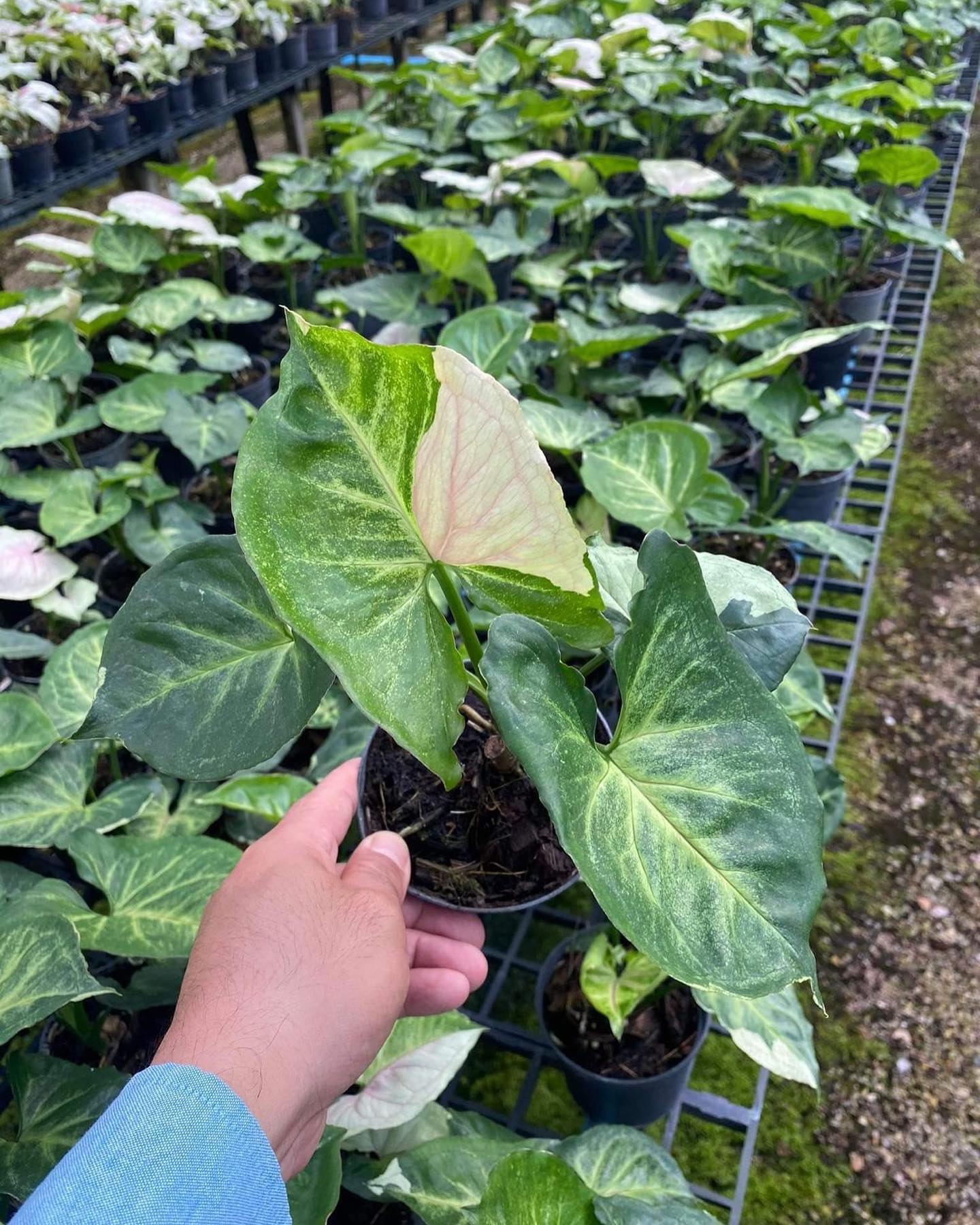
Syngonium T24 is best treated as a nursery or seller code until a matching breeder, registry or patent record is produced. Greenboog’s authentic nursery photograph supports a green, cream-sector and sometimes pale-pink-flushed phenotype; it does not establish a formal cultivar history.
- Exact code spelling, source nursery and acquisition record.
- Current whole-plant or current-lot photographs.
- Green field, cream sectors and any pale pink flush across hardened leaves.
- Leaf sequence on the same active stem.
- Viable node, growth point and current roots.
- Exact-plant, representative-lot or reference-image scope.
What the code does—and does not—prove
Kew accepts Syngonium podophyllum as a wet-tropical liana from Mexico to Tropical America. That is the broader species framework, not evidence that T24 is a botanical name or documented cultivar.
The reviewed UF/IFAS and NC State records plus patent search did not establish the exact T24 name. This does not make a nursery code useless: a code can preserve lot continuity. It does mean the legacy breeding, indoor-development, native-habitat and fixed-growth claims should not be attached to it without the matching source record.
Read the photographed phenotype
| Observation | Useful interpretation | Next check |
|---|---|---|
| Green field with cream sectors | Matches the authentic Greenboog T24-labelled example. | Confirm repetition and source-lot continuity. |
| Pale pink on cream tissue | A photographed flush, not a guaranteed permanent color. | Compare new and hardened leaves in neutral light. |
| One half-moon leaf only | Insufficient to authenticate a code-style label. | Request the whole sequence and parent/lot records. |
| Sudden yellowing or bleach | Condition change can imitate a cream sector. | Review timing, exposure, roots and protected leaves. |
| Wet lesions or stippling | Damage is not variegation. | Inspect undersides, sheaths, roots and progression. |
Buyer checklist
- Ask what T24 identifies: mother plant, source clone, nursery lot or only current seller copy.
- Request current neutral-light photographs of several hardened leaves.
- Confirm exact-plant, representative-lot or reference-image scope.
- Inspect node, growth point, stem and roots—not foliage alone.
- Confirm established plant, rooted cutting, fresh cutting or tissue-culture format.
- Use written terms for quantity, shipping, damage evidence and claim timing.
The online Syngonium buyer guide owns the full image-scope, format, policy, import and arrival workflow.
Care and propagation handoff
Use the Syngonium care hub for light, watering, substrate and troubleshooting. Do not use a fixed top-inch, 60–75°F, high-humidity or 2–4-week fertilizer schedule as proof of T24 identity or universal household care.
Propagation requires viable stem tissue, a node and growth point. Keep the T24 code, parent photographs and source lot with each cutting so the commercial record survives cloning.
Choose the next page by intent
Sources and evidence boundaries
- Kew Plants of the World Online: S. podophyllum — accepted species and liana boundary.
- UF/IFAS: Commercial Production of Syngonium — documented commercial cultivar and propagation context.
- NC State Extension: S. podophyllum — juvenile/adult morphology and cultivar context.
Evidence limit: the authentic photograph supports a Greenboog T24-labelled phenotype. It does not prove formal cultivar status, genotype or current listing scope.
