Colour sequence, red climbing structure and evidence-led care
Philodendron ‘Painted Lady’ combines yellow-green new leaves, darker green mottling and red-to-pink climbing stems, petioles and sheaths. The pattern changes as a leaf hardens, so compare several connected leaves before diagnosing stress, reversion or a wrong label.
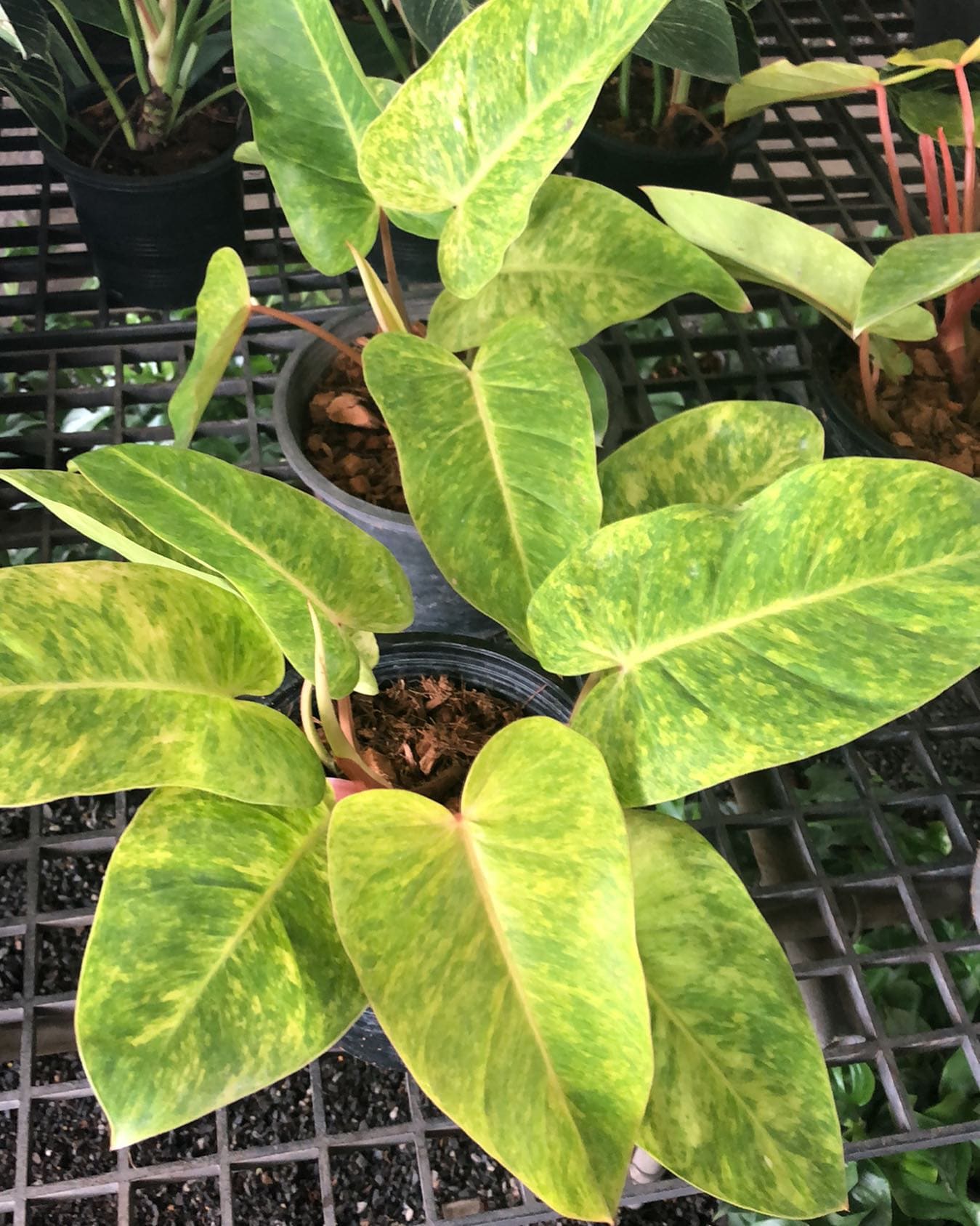
Identify a sequence, not a single bright leaf
RHS describes Painted Lady as a semi-climbing Philodendron with bright red spiralling stems and heart-shaped foliage speckled yellow and green. On a connected plant, the newest blade may open yellow-green or chartreuse, then gain or reveal darker green mottling as it hardens. Older leaves can look greener and less luminous.
Check the petiole, sheath, node and stem as well as the blade. Pink-red to red tissue around several nodes is useful supporting evidence. Camera exposure, a newly unfurled surface and nutrient stress can all make one leaf look unusually pale, so colour alone is not enough.
| Stage | Expected evidence | Question to ask |
|---|---|---|
| Newly opening | Yellow-green to lime surface; soft blade; red sheath may still be visible. | Has the leaf hardened yet? |
| Recently hardened | Darker green mottling becomes easier to compare. | Does it match the same stem’s sequence? |
| Older leaf | Often greener and less bright while mottling remains variable. | Is the leaf healthy or actually yellowing? |
| Stem evidence | Red/pink-red petiole, stem and persistent sheath tissue. | Are several connected nodes visible? |
What the 1976 patent establishes — and what it does not
Robert H. McColley’s US Plant Patent 3,958 describes an unnamed Philodendron hybrid selected from ‘Burgundy’ × ‘Emerald Queen’. Its newer leaves were yellow and green mottled, older leaves became two shades of green, and stems, petioles and curled persistent sheaths were bright red. Established plants tended to climb and required staking.
That description closely matches the horticultural Painted Lady profile and explains the common McColley parentage attribution. However, the patent itself never uses the name “Painted Lady.” Without documented clone-to-patent provenance, the careful statement is that Painted Lady is strongly linked to the patented hybrid — not that the two names are proven synonyms.
Light supports green tissue; it cannot create the next pattern
Place the plant in bright diffused light. Enough light supports the green parts that power growth, while harsh direct exposure can scorch the paler surface. Increase exposure gradually and judge hardened new growth rather than moving a stressed plant abruptly.
Low usable light may coincide with longer gaps, smaller leaves and slower drying. Excess can appear as bleaching or crisp tan injury on the exposed side. Neither signal proves anything about genetics by itself. Root health, temperature and recent movement belong in the same diagnosis.
Put a support beside the active stem
Painted Lady is a climber, not a permanently self-heading rosette. Place a plank or pole beside the active stem, tie stem tissue loosely and keep petioles free. Guide the newest flexible section first instead of forcing older hardened growth.
As nodes make useful contact, later leaves can orient more consistently. Support does not guarantee a larger or brighter next leaf, but it gives the plant a stable climbing axis and makes the growth-point sequence easier to observe.

Water from root-zone evidence
Use an open, well-drained medium that still retains useful moisture and a pot only modestly larger than the roots. Water across the rooted volume, allow excess to leave, then check below the surface and lift the container before watering again.
A top-two-inch or weekly rule ignores pot size, medium, roots, temperature, light and airflow. Yellowing can occur when roots are too wet and oxygen-poor, but it can also follow prolonged dryness, old-leaf turnover or root loss. The Philodendron watering guide owns the deeper wet-versus-dry diagnosis.
Keep the plant warm and away from cold drafts. Feed modestly during active rooted growth. Fertilizer cannot repair rot or promise more mottling, and a pebble tray or routine misting does not replace room humidity, root watering or airflow. Use the general Philodendron guide for broader room-level care.
Diagnose before cutting or treating
| Signal | Check first | Measured response |
|---|---|---|
| One greener leaf | Hardening stage and previous leaves on the same growth point. | Observe the next leaves before cutting. |
| Several plain-green leaves | Same stem, growth point, roots and usable light. | Correct verified stress; cut only with a viable-node plan. |
| Pale area turns tan | Recent sun, heat, spray or hydration change. | Filter exposure and stabilize the root zone. |
| Whole leaf yellows | Root texture, pot weight, leaf age and feeding history. | Separate chlorosis from normal colour progression. |
| Distorted newest growth | Growth point, thrips, mites and roots. | Isolate and identify before stacking sprays. |
Propagate a viable node and keep the label
A cutting needs stem tissue with a node and usable bud or growth point; a leaf and petiole cannot rebuild the vine. Photograph the mother plant, connected colour sequence and red stem/sheath tissue before cutting. Preserve aerial roots where practical and use clean tools.
- Choose a healthy node with enough green leaf tissue.
- Keep the base warm, airy and moist rather than saturated.
- Pot only after functional roots can support the shoot.
- Retain the Painted Lady label through later leaf hardening.
- Judge pattern over multiple leaves, not the cutting’s display leaf.
Use the Philodendron propagation guide for top-cut and transfer decisions. Tissue-culture plantlets require deflasking/acclimation before established-vine guidance applies, and a ten-plant pack cannot guarantee identical mature patterns.
Buyer checklist and live formats
- Request the exact plant or clearly labelled representative photos.
- Compare several leaf ages plus the stem, petioles, sheaths and growth point.
- Confirm potted versus lab format, count, rootedness and shipment terms.
- Ask for provenance before treating the patent link as a clone identity.
- Value healthy roots and useful green tissue, not only the palest leaf.
Safety and sources
Philodendron tissue contains insoluble calcium-oxalate crystals that can irritate the mouth and digestive tract when chewed. Keep plants and cut material away from children and pets, and seek appropriate medical or veterinary guidance after a significant exposure.