
Pothos cultivar guide
Manjula is the patented cultivar HANSOTI14, recognized in trade as an Epipremnum aureum pothos. Identify it from a repeated combination of broad leaves, compact internodes and irregular cream, silver-green and green marbling—not from one white leaf or a seller label.
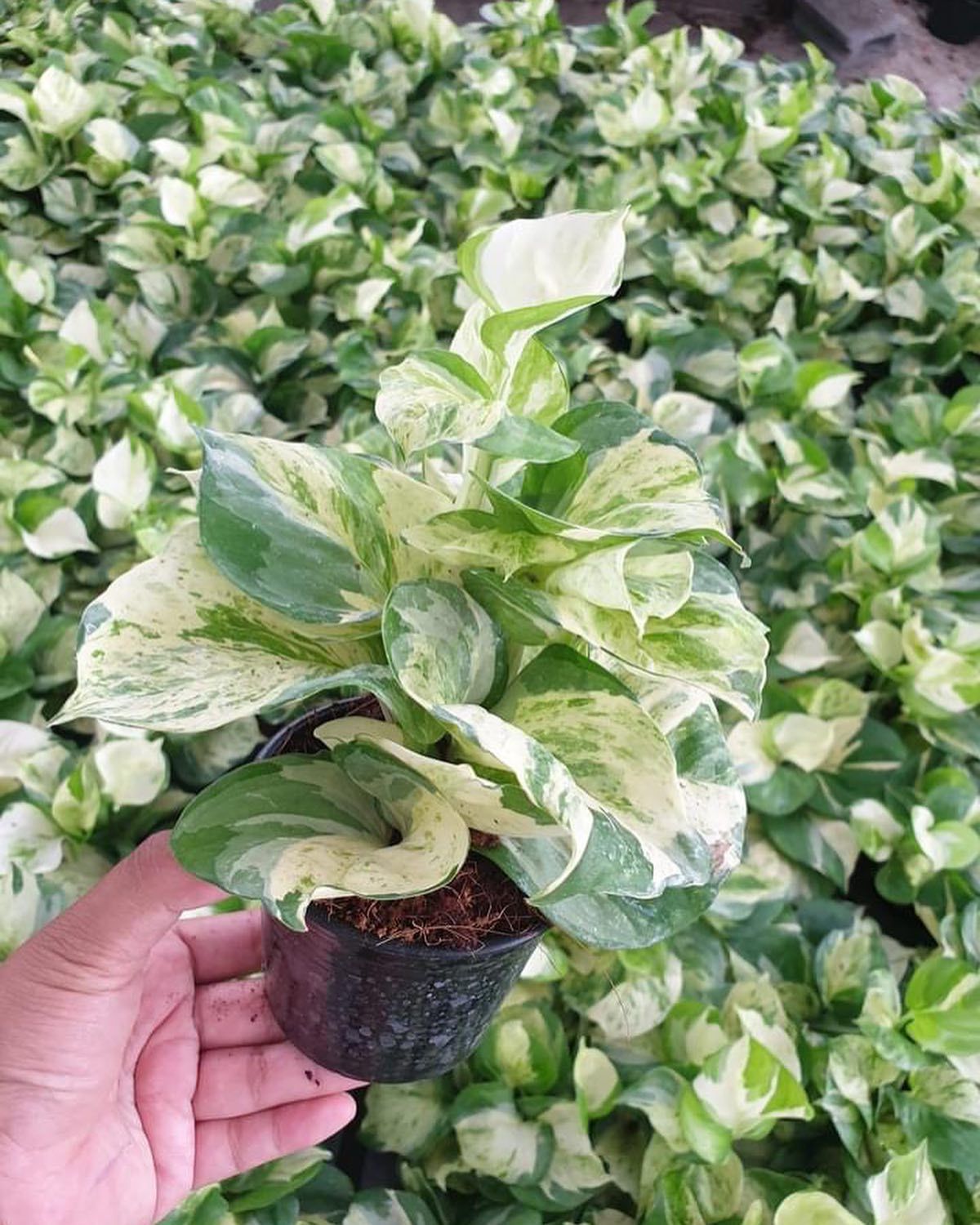
What is Manjula pothos?
U.S. Plant Patent PP27,117 names the cultivar HANSOTI14. Ashish Hansoti selected the naturally occurring branch mutation in 2010 from a large group near Mumbai. The filing describes medium broad-ovate to broad-deltate leaves, very short internodes, bright marbled and blotched green/yellow-green variegation, a mounding early habit that trails with maturity and relatively controlled growth.
The patent filed the plant under Epipremnum pinnatum. Current horticultural references place Manjula in the Epipremnum aureum framework: Costa Farms lists E. aureum ‘HANSOTI14’, and Kew accepts E. aureum as a separate species. This naming history is context, not evidence that two different Manjula cultivars exist.
Manjula identity at a glance
| Signal | Supports Manjula | Needs more context |
|---|---|---|
| Leaf shape | Broad ovate-to-deltate blade with a notably wide base. | Young, stressed or recently rooted leaves can be smaller and less typical. |
| Pattern | Irregular marbling and blotches in cream, silver/light green and darker green. | One white sector, sun bleaching or damage does not establish identity. |
| Habit | Shorter internodes and a compact, mounding early presentation. | A multi-cutting nursery pot looks fuller than a single vine. |
| Sequence | Several successive leaves repeat the broad form and variable palette. | The patent says environment can influence phenotype, so no two leaves must match. |
| Source | Traceable label or parent lot plus exact-plant or clearly labeled batch photos. | “Harlequin,” “high white” or “reverted” wording without provenance. |
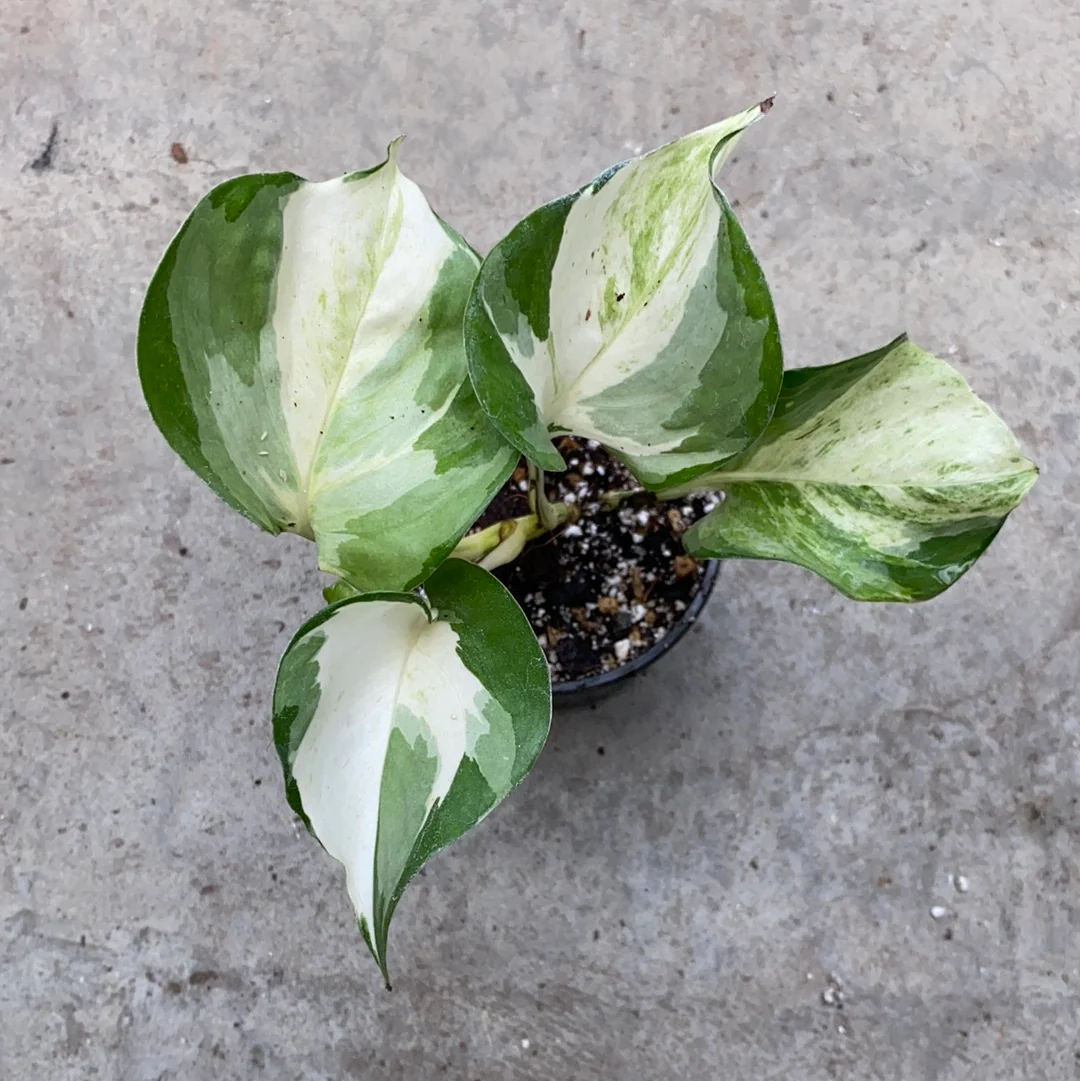
- Ask whether photos show the exact plant, current batch, mother plant or representative stock.
- Inspect several hardened leaves in neutral light, not only the brightest sector.
- Confirm firm stem, viable nodes, active growth point and healthy roots.
- Separate cultivar identity from current variegation intensity and future-leaf promises.
- Check whether the offer is an established pot, rooted cutting, bare-root plant or tissue-culture stage.
Manjula vs N’Joy and Marble Queen
Manjula is generally broader-leaved and more mounding than N’Joy, with a looser marbled/blotched palette rather than N’Joy’s relatively crisp green fields against cream-white tissue. The Manjula patent itself compares HANSOTI14 with NJOY and describes larger foliage, a different leaf shape, thicker petioles and a different pattern.
Marble Queen usually reads as more evenly marbled over a conventional juvenile pothos shape. These are comparison cues, not a photo-identification guarantee. Growth stage, exposure, root condition and seller photography can compress the differences. Use the N’Joy guide for its patent-specific evidence and the Epipremnum types hub for species-versus-cultivar boundaries.
Light and variegation without the myths
Start with bright filtered light so green tissue can support the plant without suddenly exposing cream tissue to hot direct sun. Weak usable light can contribute to longer internodes and less readable pattern; abrupt intense exposure can bleach or scorch pale areas. Move the plant gradually and evaluate several new leaves.
Light does not turn a mislabeled clone into Manjula or guarantee a target percentage of white. The patent explicitly notes that phenotype can vary with temperature, day length and light while genotype remains unchanged. Treat claims such as “30% more light” or a guaranteed future pattern as unsupported unless the seller defines a measured method and exact conditions.
Water and root-zone care
Water from pot weight, moisture depth and root condition—not a weekly promise. When the upper rooted mix has dried and the container is meaningfully lighter, wet the root ball evenly and let runoff leave. A dense multi-cutting pot can stay wet much longer than a newly rooted single cutting.
Use an airy, moisture-retentive mix in a freely draining pot only modestly larger than the root system. Repot for compacted mix, poor drainage or genuine root crowding. NC State notes that prolonged overwatering can lead to root rot and black leaf margins; inspect roots before assuming every yellow leaf is a light problem.
Troubleshoot by evidence
| Observation | Possible contributors | Next check |
|---|---|---|
| Yellow leaves + heavy pot | Prolonged saturation, cold roots or root loss. | Drainage, root firmness, odor and drying time. |
| Brown cream margins | Sudden sun/heat, salt concentration, cold contact or a dry episode. | Damage orientation and recent changes before adding humidity devices. |
| Long internodes | Weak usable light, root stress or sparse single-vine structure. | Light geometry, roots and number of rooted units. |
| New leaves mostly green | Current expression, weak light, a greener sport, reversion or mislabel. | Several new leaves, stem pattern and source record. |
| Distorted newest leaf | Thrips, mites, scale, mechanical injury or root stress. | Both leaf surfaces, petiole, stem and roots. |
Propagation, support and safety
Manjula remains a climbing vine even when a young multi-cutting pot looks mounded. A pole or board can support larger successive leaves; a hanging basket preserves a trailing display. For general node anatomy and root-to-pot handling, use the Golden Pothos propagation guide. Patent or other plant-propagation rights may differ by jurisdiction and purpose, so commercial growers should verify current local restrictions rather than relying on a care article.
NC State classifies E. aureum as containing calcium oxalate crystals and notes risks to people and pets. Keep cut material away from mouths and eyes, wash after pruning and place the plant beyond unsupervised children and animals.
Continue by intent
Sources and limits
- U.S. Plant Patent PP27,117: Epipremnum ‘HANSOTI14’ — selection history, comparisons and described phenotype under stated greenhouse conditions.
- Costa Farms patent list — current horticultural naming of Manjula as E. aureum ‘HANSOTI14’.
- NC State Extension: Epipremnum aureum — light, root-rot, propagation and safety context.
- Kew POWO: Epipremnum aureum — accepted species and native range.
Evidence limit: Patent observations describe a clone grown under specific production conditions. They do not guarantee home growth rate, size or the color balance of the next leaf.
