Seller-line identity, leaf-age colour and self-heading care
Philodendron Orange Marble is Greenboog’s horticultural seller line for a self-heading plant whose connected leaves can show copper-orange new growth, green-and-yellow marbling and darker hardened foliage. It is not a wild species with its own rainforest range, and the name should not be merged with Orange Marmalade or Prince of Orange without provenance.
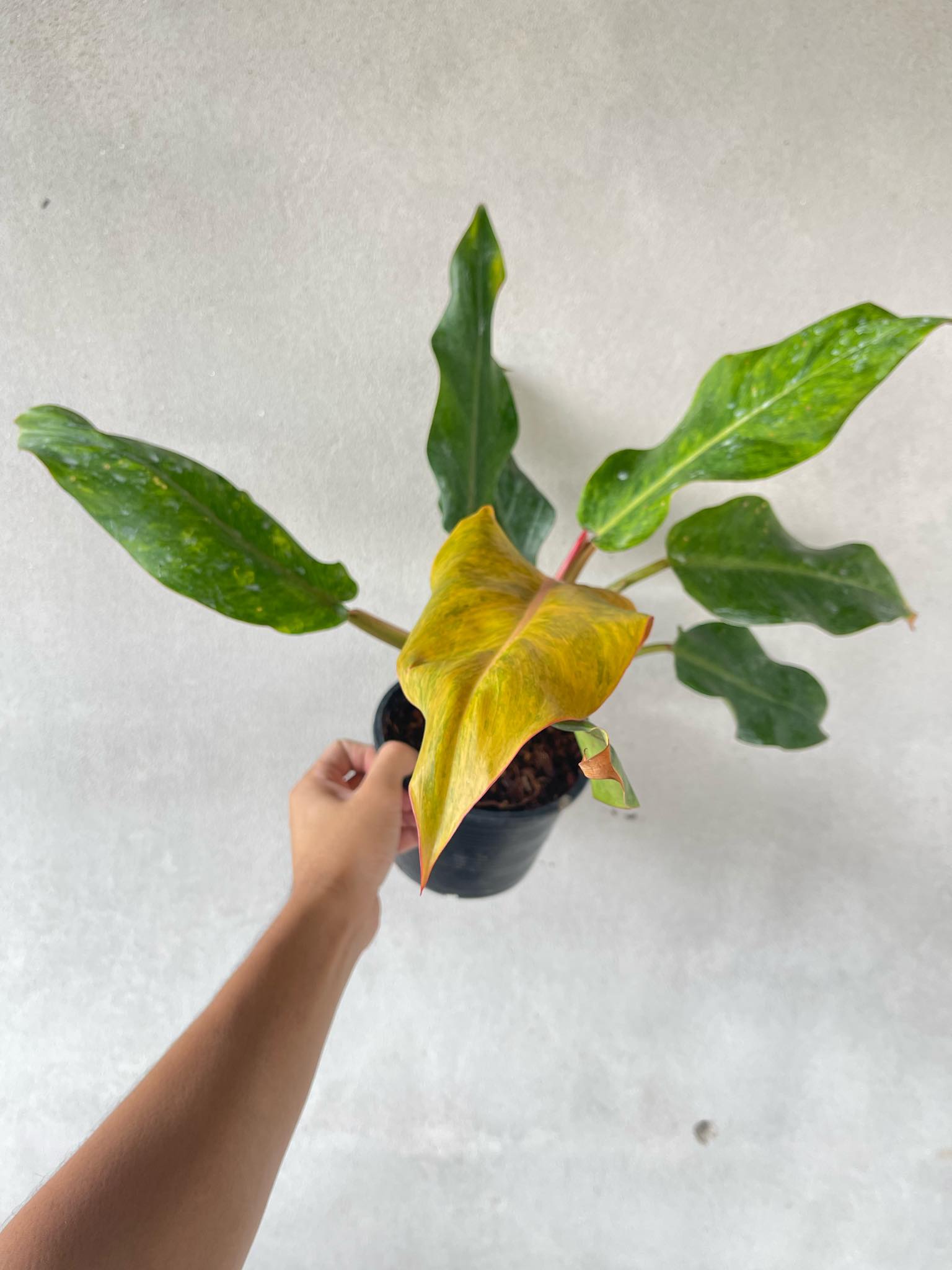
Orange Marble is a seller line, not a wild species
Greenboog’s potted-plant lists from 2023 through 2025 repeatedly carry Philodendron Orange Marble, which supports continuity of the commercial name. No accepted species record, breeder patent or authoritative cultivar registration was located during this review. The legacy claim that it is native to Central and South American rainforests therefore overstates what the label can prove.
Greenboog also maintains separate current Orange Marmalade listings. Similar market names and orange leaves do not establish synonymy. RHS accepts Prince of Orange as an upright cultivar whose foliage changes from yellow through copper-orange to dark green, but that comparison does not prove Orange Marble is Prince of Orange or a variegated form of it.
Separate hardening colour from persistent marbling
The exact product gallery shows several kinds of colour at once: a fresh copper-to-orange leaf, hardened green leaves and mottled yellow-green fields. Read them as a connected sequence. A young leaf that turns greener is not necessarily “reversion,” while a whole-plant yellowing pattern is not proof of premium marbling.
| Observation | Likely context | What to verify |
|---|---|---|
| Fresh leaf is copper or orange | Normal emergence and hardening may be involved. | Follow the same leaf over time. |
| Yellow-green mottling persists | Seller-line marbling may remain after hardening. | Compare several connected leaves. |
| Later leaf is mostly green | Line variability, hardening or lower pattern expression. | Check the next growth from the same crown. |
| Broad yellowing across the plant | Root, moisture, nutrition or temperature stress. | Inspect roots and recent conditions. |
| Tan bleached patch | Sun, heat, spray or physical damage. | Match the lesion to exposure history. |
Grow the crown upright—not on a climbing pole
The current Greenboog line presents as self-heading: leaves arise from a compact central crown rather than a long climbing vine. Keep the crown above the medium, allow petioles room to spread and rotate the container only as needed for balanced exposure. A moss pole cannot make the plant compact or guarantee larger leaves.
Support individual heavy petioles only when necessary; do not bind the crown tightly. If the plant leans, check root anchorage, pot balance and light direction before adding a trellis.
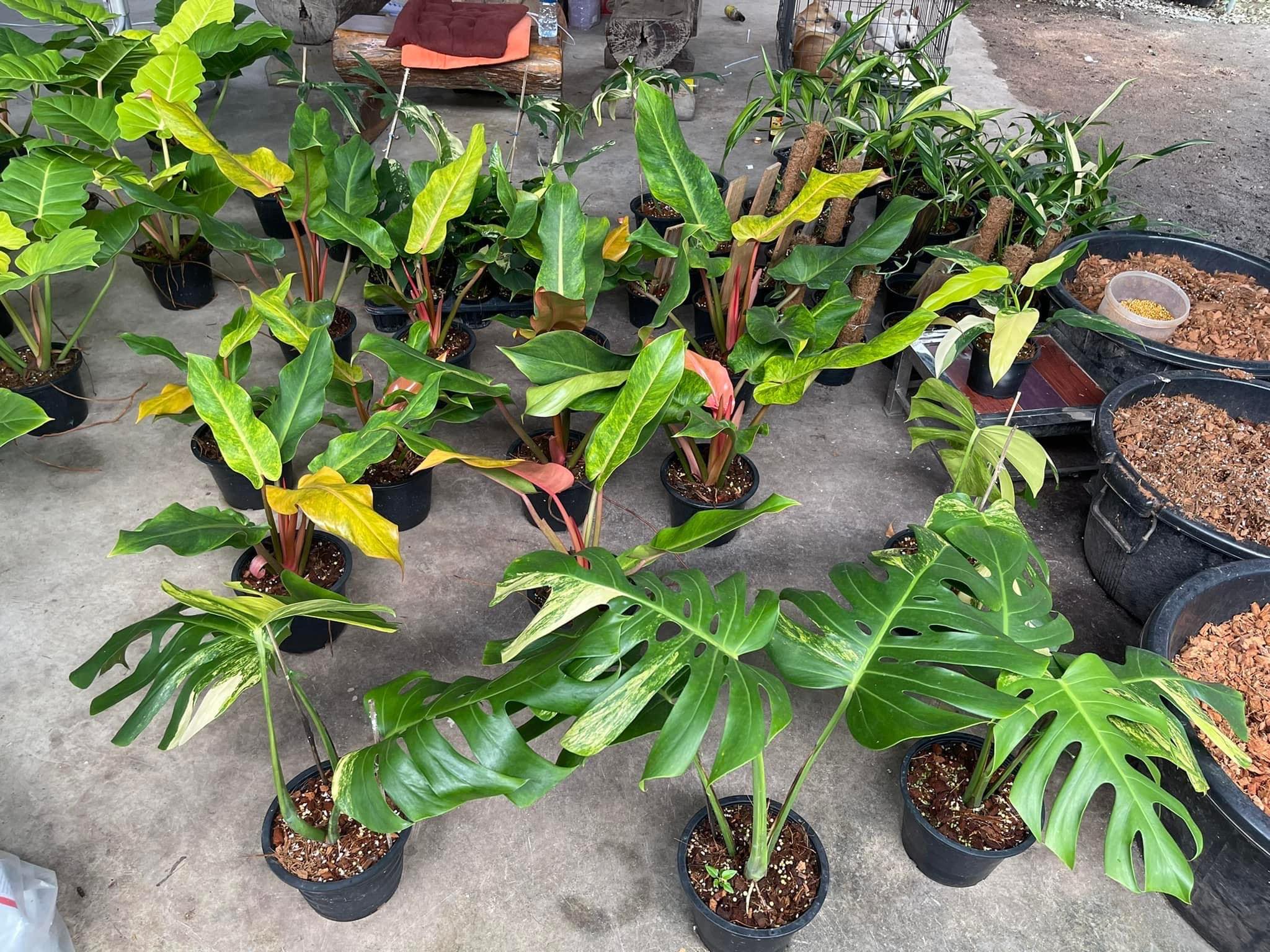
Use filtered light and observe the next leaf
Place Orange Marble in bright diffused light and acclimate increases gradually. Harsh direct exposure can bleach or scorch tender orange tissue; low usable light can slow growth and root-zone drying. More light cannot force a genetically fixed pattern, and fertilizer cannot manufacture orange colour.
Wait for a leaf to harden before judging its final balance. The Philodendron care guide owns broader room-level light, warmth and airflow decisions.
Water the rooted volume
Use an open medium that drains freely but holds useful moisture, and keep the pot only modestly larger than the root mass. Water across the rooted volume, allow excess to leave, then check pot weight and moisture below the surface. A top-inch calendar ignores root density, pot size, medium, temperature, light and airflow.
Daily misting does not replace root watering or room humidity. Feed modestly during active rooted growth; fixed four-to-six-week recipes cannot diagnose colour or root problems. Use the watering guide for deeper diagnosis.
Diagnose before cutting or treating
| Signal | Check first | Measured response |
|---|---|---|
| New leaf turns greener | Hardening timeline and connected sequence. | Observe the next leaf before cutting. |
| Whole crown yellows | Roots, moisture, temperature and feed history. | Correct the verified stressor. |
| Plant is limp in a wet pot | Drainage, roots and crown depth. | Pause watering; inspect if recovery stalls. |
| Leaf has a tan patch | Sun, heat, spray and physical contact. | Change the matched exposure. |
| Newest growth distorts | Growth point, thrips, mites and damage. | Isolate and identify before spraying. |
Propagate only a viable growth point
Self-heading Philodendrons do not always provide the obvious long internodes of a vine. A viable division or cutting needs a growth point and enough stem/crown tissue to produce new growth; a detached leaf and petiole cannot rebuild the plant. Do not cut only because one leaf hardens greener.
- Map the crown, nodes and active point before cutting.
- Prefer a rooted basal offset when one is clearly independent.
- Use clean tools and avoid dividing a stressed shipment.
- Keep the base warm, airy and moist rather than saturated.
- Carry the Orange Marble seller-line history forward.
Use the Philodendron propagation guide for node and transfer decisions.
Buyer checklist and live routes
- Confirm exact-plant versus representative-gallery scope.
- Compare fresh, hardening and hardened leaves on one crown.
- Ask whether Orange Marble is the original seller label.
- Do not assume Orange Marmalade or Prince of Orange synonymy.
- Verify live stock, option and shipment terms on the product.
Safety and sources
Philodendron tissue contains insoluble calcium-oxalate crystals that can irritate the mouth and digestive tract when chewed. Keep plants and cut material away from children and pets, and seek appropriate medical or veterinary guidance after significant exposure.