
Botanical boundary, mottled leaf development and climbing care
Greenboog’s Philodendron Minarum Lime Fiddle / Golden Dragon is a horticultural seller line with lobed, mottled leaves. Accepted Philodendron minarum is a Brazilian climber, but Kew describes its leaves as ovate to ovate-triangular and cordate—not the deeply lobed form in the current gallery. Keep the botanical species and seller-line evidence separate.
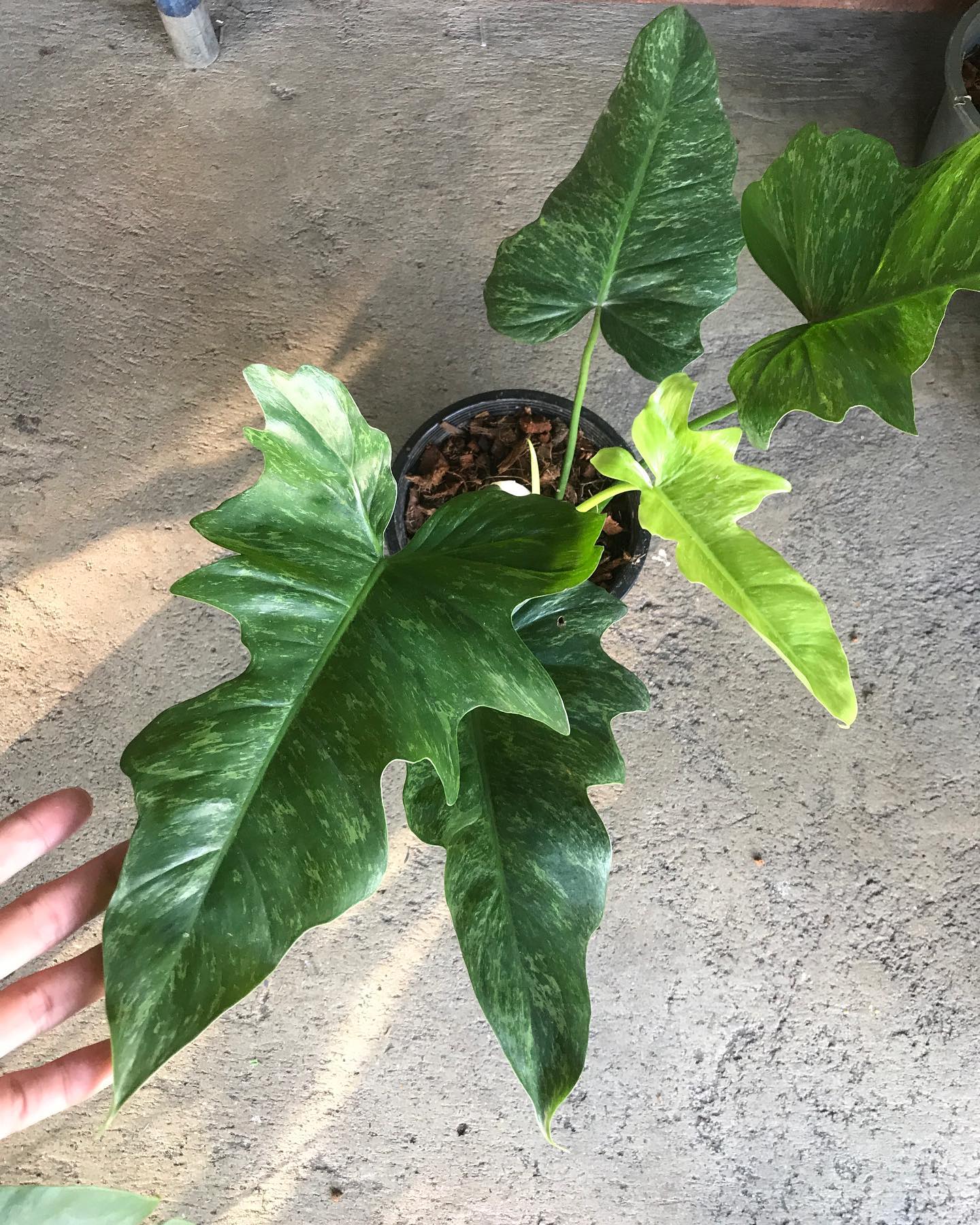
Accepted minarum and the seller line do not yet match
Kew accepts Philodendron minarum Engl., published in 1878 and native to Minas Gerais and São Paulo in southeastern Brazil. It is a climber from seasonally dry tropical habitats. The Kew/CATE description gives ovate to ovate-triangular blades with cordate, subcordate or subsagittate bases, bright cream primary veins and green petioles.
Greenboog’s current Lime Fiddle / Golden Dragon gallery instead shows strongly lobed leaves with lime-to-green mottling. Greenboog plant lists from 2023 through 2025 connect “Minarum / golden dragon,” but commercial continuity is not botanical proof. No authoritative cultivar registration or clone-level record tying this lobed line to accepted P. minarum was located.
Compare names and traits without inventing synonyms
| Evidence | Accepted P. minarum | Greenboog seller line |
|---|---|---|
| Name status | Accepted species published in 1878. | Minarum Lime Fiddle / Golden Dragon trade label. |
| Native range | Southeastern Brazil. | Cultivated line; no wild range of its own. |
| Blade | Ovate to ovate-triangular; cordate/subcordate/subsagittate. | Juvenile-to-deeply-lobed connected sequence. |
| Colour | Cream primary veins in the botanical description. | Lime-to-green mottling across the blade. |
| Proof needed | Herbarium and taxonomic description. | Original source, connected plant and clone history. |
Golden Dragon, Lime Fiddle, Mottled Dragon and Camouflage are used inconsistently in wider trade. Do not silently merge them. Preserve the original label and qualify identity when the source history is incomplete.
Read leaf shape and mottling across the stem
Juvenile leaves may be less divided, while later leaves on established growth can express deeper side lobes. A fresh leaf may open lighter before hardening, and mottling can vary leaf to leaf. Compare several connected leaves, petioles, nodes and the active point before calling reversion or misidentification.
A single lime leaf does not prove nutrient deficiency, and a greener leaf does not automatically mean the seller line has reverted. Diagnose from the whole plant and recent conditions.

Support the active climbing stem
Place a board or pole beside the active stem, secure stem tissue loosely and leave petioles free. Guide the newest flexible section first and allow aerial roots to contact a stable surface where practical. Support creates a consistent climbing axis; it does not guarantee a fixed lobe count or variegation pattern.
If later growth becomes smaller or internodes stretch, check roots, usable light, warmth and attachment before adding fertilizer. The Philodendron care guide owns broader room-level care.
Water from the rooted volume
Use an open medium that drains freely but holds useful moisture, and keep the pot only modestly larger than the roots. Water across the rooted volume, allow excess to leave, then check pot weight and moisture below the surface. A fixed routine cannot account for root density, pot size, light, warmth or airflow.
Humidity can reduce rapid edge drying, but a rigid 40–60% target does not diagnose slow growth or curl. Feed modestly during active rooted growth; routine flushing or extra fertilizer should follow evidence, not a pale leaf alone. Use the watering guide for deeper root-zone diagnosis.
Diagnose the pattern before treating
| Signal | Check first | Measured response |
|---|---|---|
| Fresh leaf is very lime | Hardening timeline and connected sequence. | Wait before changing feed. |
| New leaf has fewer lobes | Plant maturity, roots, support and light. | Correct the verified bottleneck. |
| Plant is limp in a wet pot | Drainage, roots and crown depth. | Pause watering; inspect if recovery stalls. |
| Leaf develops a tan patch | Sun, heat, spray and physical damage. | Change the matched exposure. |
| Newest growth distorts | Growth point, thrips, mites and damage. | Isolate and identify before spraying. |
Propagate a viable node and preserve the label
A viable cutting needs stem tissue with a node and bud or active growth point; a detached leaf and petiole cannot rebuild the vine. Photograph connected leaves, petioles, stem and original label before cutting.
- Choose a healthy node with useful leaf area.
- Use clean tools and retain aerial roots where practical.
- Keep the base warm, airy and moist rather than saturated.
- Transfer after functional roots can support new growth.
- Carry the seller-line name and unresolved taxonomy forward.
Use the Philodendron propagation guide for node and transfer decisions.
Buyer checklist and live routes
- Confirm exact-plant versus representative-gallery scope.
- Request connected juvenile and later leaves, stem and active point.
- Ask whether the source label says Lime Fiddle, Golden Dragon or both.
- Do not accept botanical P. minarum certainty without resolving the leaf mismatch.
- Verify stock, option and shipment terms on the live listing.
Safety and sources
Philodendron tissue contains insoluble calcium-oxalate crystals that can irritate the mouth and digestive tract when chewed. Keep plants and cut material away from children and pets, and seek appropriate medical or veterinary guidance after significant exposure.

1 thought on “Philodendron Minarum Lime Fiddle: Name, Leaves & Care”