Epipremnum ownership guide
Epipremnum earns its space through flexible display, visible vine growth and a broad range of leaf patterns—not as a substitute for ventilation, filtration or medical care. Here is a practical way to separate useful ownership benefits from claims that outpace the evidence.
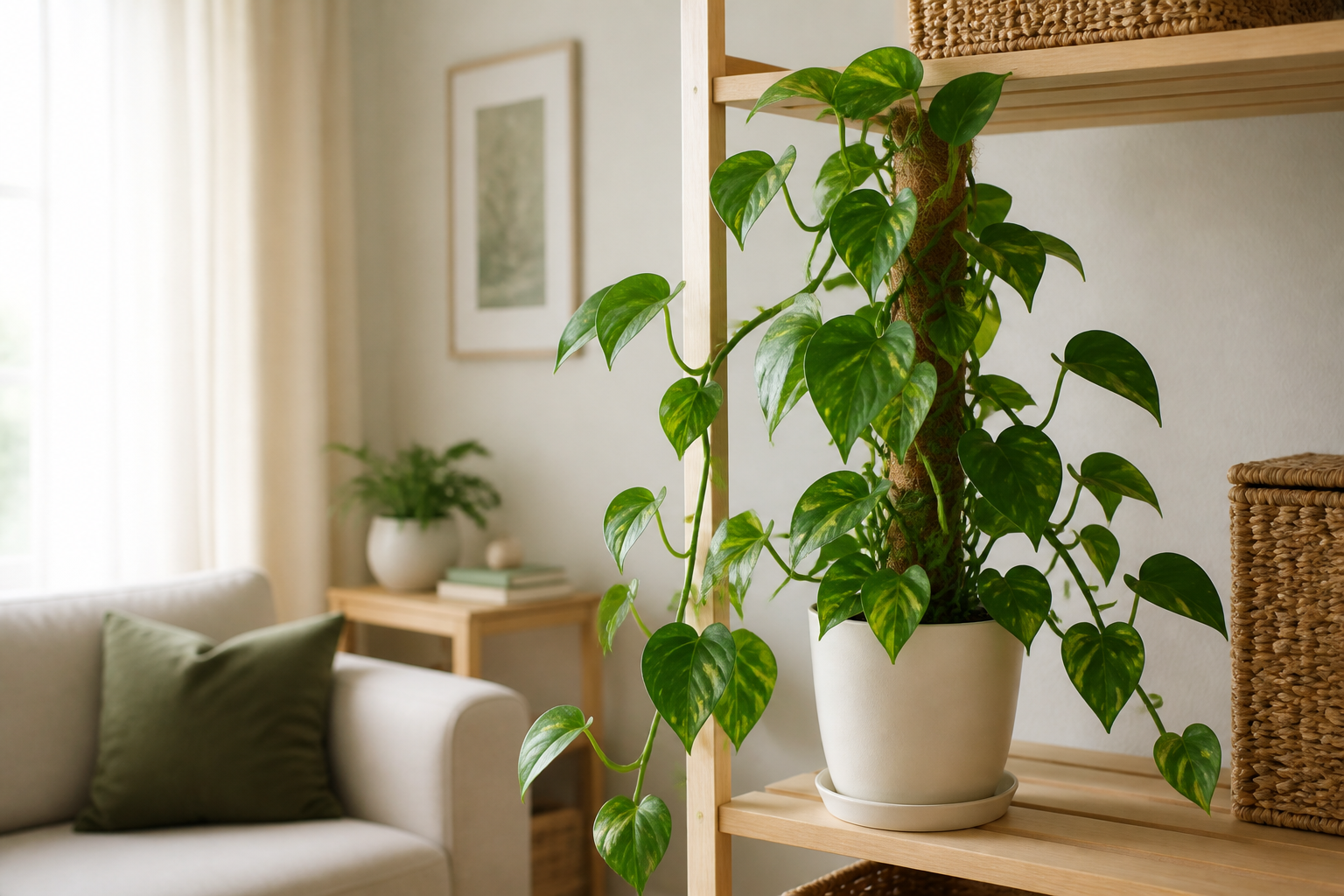
- Flexible display: trail the vine, direct it along a structure or let it climb a suitable support.
- Living texture: foliage adds shape, color and depth without pretending to solve indoor-air problems.
- Readable growth: nodes, roots and new leaves make propagation and plant observation approachable.
- Collection range: species and commercial selections offer different blade forms and patterns.
- Enjoyable routine: care can be a satisfying hobby when it fits your own space and schedule.
What does an Epipremnum genuinely add to a room?
Its clearest advantage is design flexibility. NC State describes Epipremnum aureum as a cascading houseplant whose vines can also climb. A shelf, hanging pot or vertical support therefore changes the silhouette without requiring a different species. The useful result is visual: foliage can soften a hard corner, frame a shelf or create a vertical accent.
Kew treats E. aureum as an accepted climbing species native to Society Islands (Mo’orea). That corrects a common sales-page error: the familiar golden pothos is not native to Southeast Asia or the Solomon Islands. Other plants sold under the broader Epipremnum label may be different species, so use the full botanical or trade name when comparing them.
Claim check: useful wording versus overpromising
| Popular claim | What the evidence supports | Responsible takeaway |
|---|---|---|
| “Purifies room air” | Small sealed-chamber experiments show VOC uptake, but a 2020 review found passive plants perform far below normal building air exchange at realistic densities. | Use source control, ventilation and appropriate filtration for indoor air quality. |
| “Boosts room oxygen” | Plants photosynthesize, but that fact alone does not establish a meaningful oxygen change in an occupied room. | Enjoy the foliage; do not treat the pot as an oxygen device. |
| “Reduces stress” | Enjoyment is personal, and generic plant studies do not prove that Epipremnum treats stress or lowers cortisol for every owner. | Describe your own experience without making a medical promise. |
| “Improves focus” | A decorative plant is not an Epipremnum-specific cognitive intervention. | Design a workspace you like, but do not promise productivity or cognition gains. |
| “Supports conservation” | A normal retail purchase does not automatically fund habitat protection or document wild-population benefit. | Require a named, traceable program before repeating an impact claim. |
Why chamber air-cleaning results do not equal a cleaner home
Laboratory chambers are small, controlled and often sealed for hours or days. Cummings and Waring converted results from 12 chamber studies into clean-air delivery rates and estimated that roughly 10–1,000 plants per square metre of floor area would be needed to match the VOC removal already provided by typical outdoor-to-indoor air exchange. The point is not that leaves do nothing; it is that the measured rate does not justify a room-scale purifier promise for a passive pot.
EPA’s practical hierarchy is clearer: reduce or remove pollutant sources, improve ventilation, then use suitable filtration or air cleaning as a supplement. An Epipremnum can remain part of the room because you value it, while the building and exposure controls do the air-quality work.
Growth makes a useful learning plant
A healthy vine exposes the basic structure of a climbing aroid: stem, node, aerial root, petiole, blade and active growth point. That makes it easier to record what changed after a move, compare a supported vine with a trailing one and understand why a leaf alone is not a viable cutting.
Propagation is also a practical lesson in evidence. A viable cutting needs node and growth-point tissue; a decorative leaf in water may remain green for a time without producing a new vine. Keep parent and cutting labels, date the cut and photograph the source if cultivar identity matters.
Choose by display goal, not a “miracle plant” list
- For a shelf or hanging pot, compare internode length, current vine fullness and the space available below.
- For a support, check that the stem is flexible enough to position without forcing the petioles.
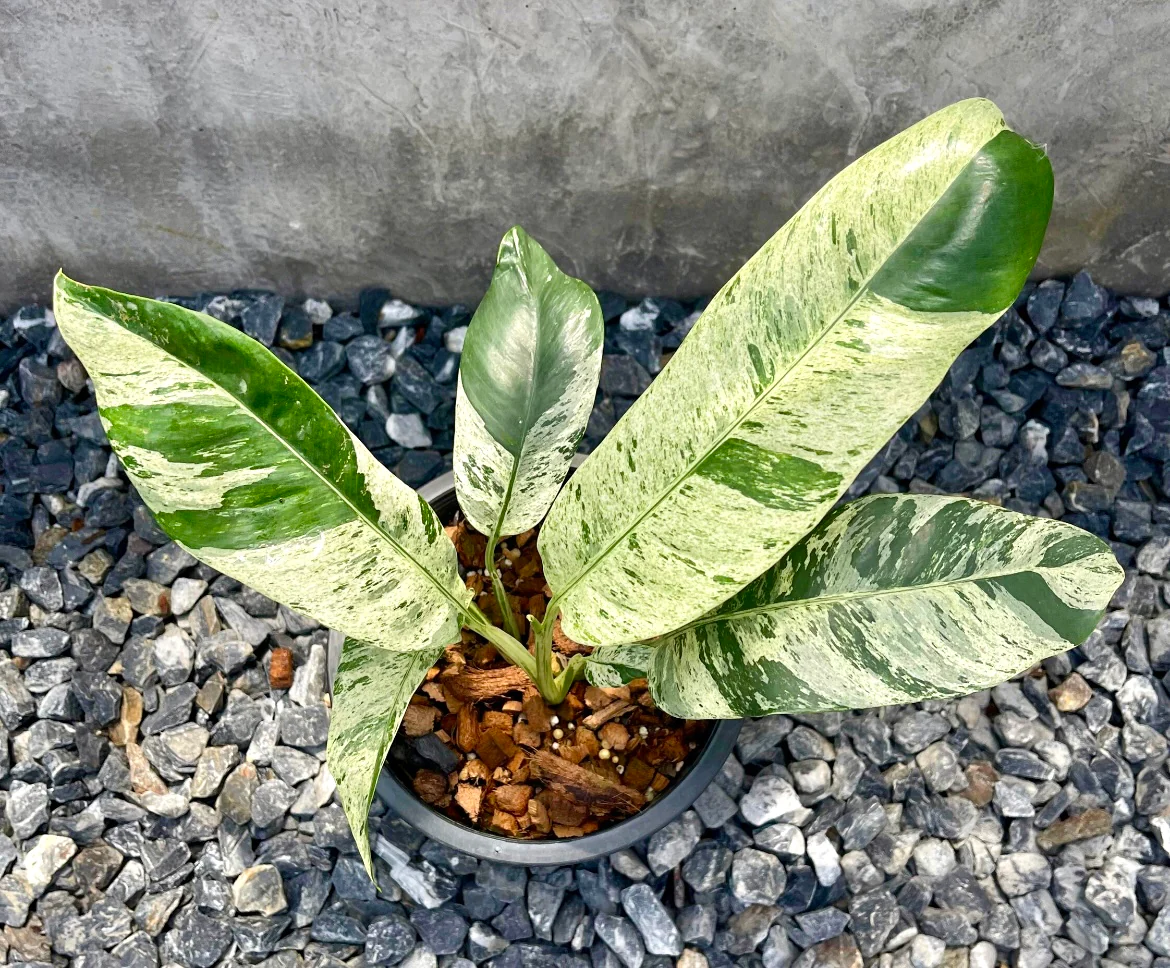
- For variegation or named selections, ask whether photographs show the exact plant, its lot or only a representative mother plant.
- For a beginner project, prioritize healthy roots, an active growth point and a manageable acclimation stage over rarity.
- For a home with children or pets, plan a location that prevents chewing; NC State records poison characteristics for E. aureum.
The complete watering, light, support and troubleshooting workflow belongs in the Epipremnum care guide. If identity and leaf differences are your next question, use the Epipremnum varieties guide before comparing live listings.
Safety and responsible ownership
Members of the aroid family can contain irritating calcium oxalate crystals. Keep the plant away from children and animals likely to chew it, wear gloves if sap irritates your skin and seek veterinary or medical advice after suspected ingestion rather than relying on a blog diagnosis.
In warm climates, do not discard live cuttings outdoors. Kew records E. aureum as introduced in many tropical and subtropical regions. Contain unwanted material and follow local disposal guidance instead of assuming a popular houseplant is harmless beyond the pot.
Continue by intent
Sources and limits
- US EPA: Improving Indoor Air Quality — source control, ventilation and filtration hierarchy.
- Cummings & Waring (2020): passive potted-plant VOC removal — chamber-to-building clean-air-delivery-rate analysis.
- Kew Plants of the World Online: Epipremnum aureum — accepted name, climbing habit, native and introduced ranges.
- NC State Extension: Epipremnum aureum — ornamental habit, growth and safety context.
Evidence limit: room layout and horticultural use are not medical outcomes. This page does not diagnose exposure, promise health effects or establish the identity of a plant from an illustration.