
Tissue culture trait evidence
Variegation is a visible phenotype, not one single mechanism. In a juvenile tissue-culture plantlet, pattern, leaf age, growth point, transit stress and culture history all matter—so the strongest practical evidence comes from several leaves and nodes, not one dramatic patch.
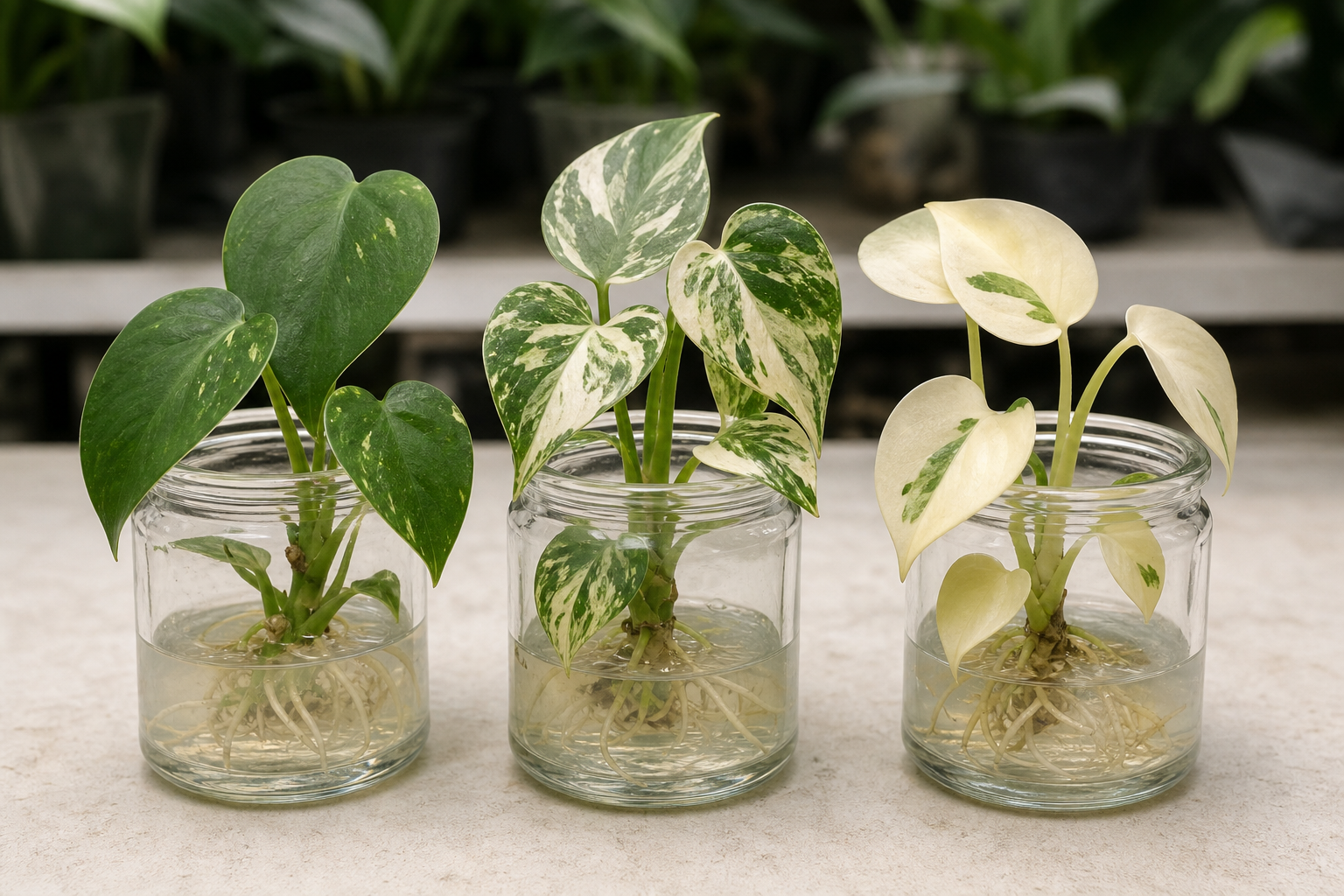
- Pattern describes where colors appear: margin, fleck, sector, splash, mosaic or netting.
- Mechanism explains why the colors appear; it may require anatomy, pigment analysis or genetic work.
- Off-type is a plant that differs from the production standard—not automatically a novel cultivar.
- Damage is tissue decline from transit or environment and should not be sold as variegation.
Variegation is more than “less chlorophyll”
Many white, cream or yellow sectors contain less chlorophyll or altered chloroplasts, so they usually contribute less photosynthesis than fully green tissue. That explains why a plant with very little green may grow slowly. It does not explain every visible leaf pattern.
Botanical studies separate pigment-related effects from structural effects. A pale area can arise from chlorophyll deficiency, another pigment such as anthocyanin, or tissue architecture that reflects light differently. Some ornamental plants are chimeras: genetically different cell populations occupy layers or sectors of the shoot apical meristem. As leaves develop, the contribution of those layers can create margins, sectors or mosaics.
| Observation | Possible explanation | Evidence limit |
|---|---|---|
| White or cream sector | Reduced chlorophyll, altered plastids or a cell population that differs from adjacent tissue. | Color alone does not identify the mutation or meristem layer. |
| Silver or reflective patch | Structural air spaces or epidermal anatomy can change reflected light. | It should not automatically be called chlorophyll loss. |
| Pink or red area | Other pigments may mask green or develop with leaf age and light. | Color change does not prove a new stable lineage. |
| New pattern after culture | Normal juvenile expression, stress response or tissue-culture-induced variation are all possible. | A photograph cannot separate genetic from epigenetic change. |
How tissue culture changes the evidence question
Micropropagation aims to multiply a chosen plant efficiently and true to type. At the same time, in-vitro regeneration can produce genetic or epigenetic changes collectively described as somaclonal variation. The chance is not equal in every laboratory or cultivar: starting tissue, genotype, time in culture, plant-growth regulators, number of subcultures and whether regeneration passed through disorganized callus all influence fidelity.
Tissue culture does not create every variegated plant—and it does not preserve every variegated chimera automatically. Research with defined ornamental models shows that culture conditions can affect whether known chimeral patterns are retained. That finding supports better laboratory quality control; it is not a recipe for collectors to induce mutations at home.
Read several leaves, nodes and plantlets
Juvenile leaves can be small, thin and different from mature foliage. One pale leaf may be emerging, one green leaf may precede a variegated leaf, and a bruised patch may appear only after shipping. Build a record instead of forcing a diagnosis:
- Photograph the whole plant and each node in consistent light, with a date and lot identifier.
- Separate old and new tissue. A mark that spreads through existing tissue behaves differently from a pattern emerging with a new leaf.
- Compare siblings from the same lot. A single unusual plant among many consistent siblings deserves documentation.
- Track the growth point. Several sequential leaves provide stronger evidence than one isolated sector.
- Record format and stage. Sealed, newly deflasked and established plants have different stress signatures.
- Preserve seller evidence. Photograph the vessel, seal, roots and listing before opening or trimming.
Pattern trend, off-type or damage?
| Pattern | Check next | Practical response |
|---|---|---|
| Clean cream/green boundary on a new leaf | Same pattern across the petiole, stem and next node. | Document and observe; do not cut a juvenile plantlet for one leaf. |
| Several increasingly green leaves | Growth point, stem pattern, cultivar history and light stability. | Call it a green-dominant trend until the run is long enough to support a stronger conclusion. |
| Nearly all-cream new growth | Amount of functioning green tissue and root activity. | Avoid light shock or extra fertilizer; prioritize survival and measured observation. |
| Water-soaked, translucent or expanding brown patch | Transit bruise, temperature injury, contamination and crown/root condition. | Use arrival or tissue-decline triage; this is not decorative variegation. |
| One sibling differs from a consistent lot | Labeling, vessel position, several new leaves and production records. | Quarantine the claim: document as a suspected off-type, not a named mutation. |
What “reversion” should mean in a record
Collectors often use “reversion” for any greener leaf. That is too broad. Light and developmental stage can alter the visibility, size and color of a pattern without changing genotype. A chimeral plant can also produce a shoot dominated by one cell population. Somaclonal change is another possibility in tissue-culture material.
Use neutral language first: “green-dominant leaf,” “three-leaf green run,” “cream-dominant growth point” or “suspected off-type.” Reserve a definitive explanation for evidence that can support it. Environment can change expression; it does not let a photograph reveal the underlying genome.
Use the correct owner page next
For cultivar-specific expectations, use the relevant guide—for example, the Thai Constellation tissue-culture buyer’s guide. If a vessel arrived broken, leaking or suspicious, start with arrival and flask triage. Healthy plantlets ready to open follow the exact deflask protocol, then the hardening guide.
Live grade, price and stock belong to the shop. Compare the Tissue Culture Aroid collection or browse rare variegated plants without treating a category photo as an individual-plant guarantee.
Sources and evidence boundaries
- Sheue et al.: mechanisms of foliar variegation — pigment-related and structural examples.
- Beardsell & Norden: a chlorophyll-deficient leaf chimera — cell-layer and leaf-development evidence in a defined Ficus cultivar.
- Krishna et al.: somaclonal variation in horticultural crops — in-vitro fidelity and variation.
- Pathirana et al.: plant germplasm conservation review — culture-pathway risk factors.
- Bogaert et al.: meristem stability in a petunia chimera model.
Evidence limit: mechanisms demonstrated in Begonia, Ficus or petunia cannot be assigned automatically to a specific Monstera, Philodendron, Anthurium or Alocasia plantlet. Individual diagnosis may require production records, anatomy or molecular testing.

How do I know if the variegation in my plant is stable?
There are a few ways to tell if the variegation in your plant is stable:
Plant History and Variety:
Research your plant’s variety: Some plant varieties, like the Philodendron ‘Ring of Fire’ or the Epipremnum Aureum, are known for having stable variegation that’s passed down through propagation (taking cuttings). You can find this information online by searching for “[plant variety name] variegation stable” or checking houseplant forums.
Look for variegation in the stem: Stable variegation is often present in the stem itself, even as a thin line or speckles. This indicates the variegation is caused by a genetic mutation, not environmental factors.
New Leaf Growth:
Observe new leaf variegation: Pay attention to the variegation pattern on new leaves. If the new leaves consistently show variegation similar to the established leaves, it’s a good sign of stability.
Beware of entirely green or white leaves: If your variegated plant produces entirely green or entirely white leaves, it’s a sign of unstable variegation. The plant might be reverting to its all-green form (entirely green) or struggling to produce chlorophyll (entirely white).
Light and Care:
Light can affect variegation: While some plants might show more variegation with brighter light, significant changes in light levels can also stress a plant and cause fluctuations in variegation. Maintain consistent, indirect light for your variegated plant.
Unstable variegation can be managed: Even with unstable variegation, you can try to encourage more variegation by providing brighter indirect light. However, be mindful of burning the leaves. Pruning off all-green shoots can also help promote the growth of variegated leaves, but this requires careful selection to avoid harming the plant.
Remember, some level of variation in variegation is normal, even for stable varieties. But if you see a consistent shift towards entirely green or white leaves, that’s a strong indicator of unstable variegation.