
Epipremnum collector guide
Epipremnum Shangri-La Aurea is a commercial label for a pothos selected for repeatedly folded, rolled or puckered foliage with green and yellow-to-chartreuse patterning. Verify the trait across a healthy leaf sequence and keep the seller/source record attached; one curled or yellow leaf can also reflect unfurling damage, pests or root stress.
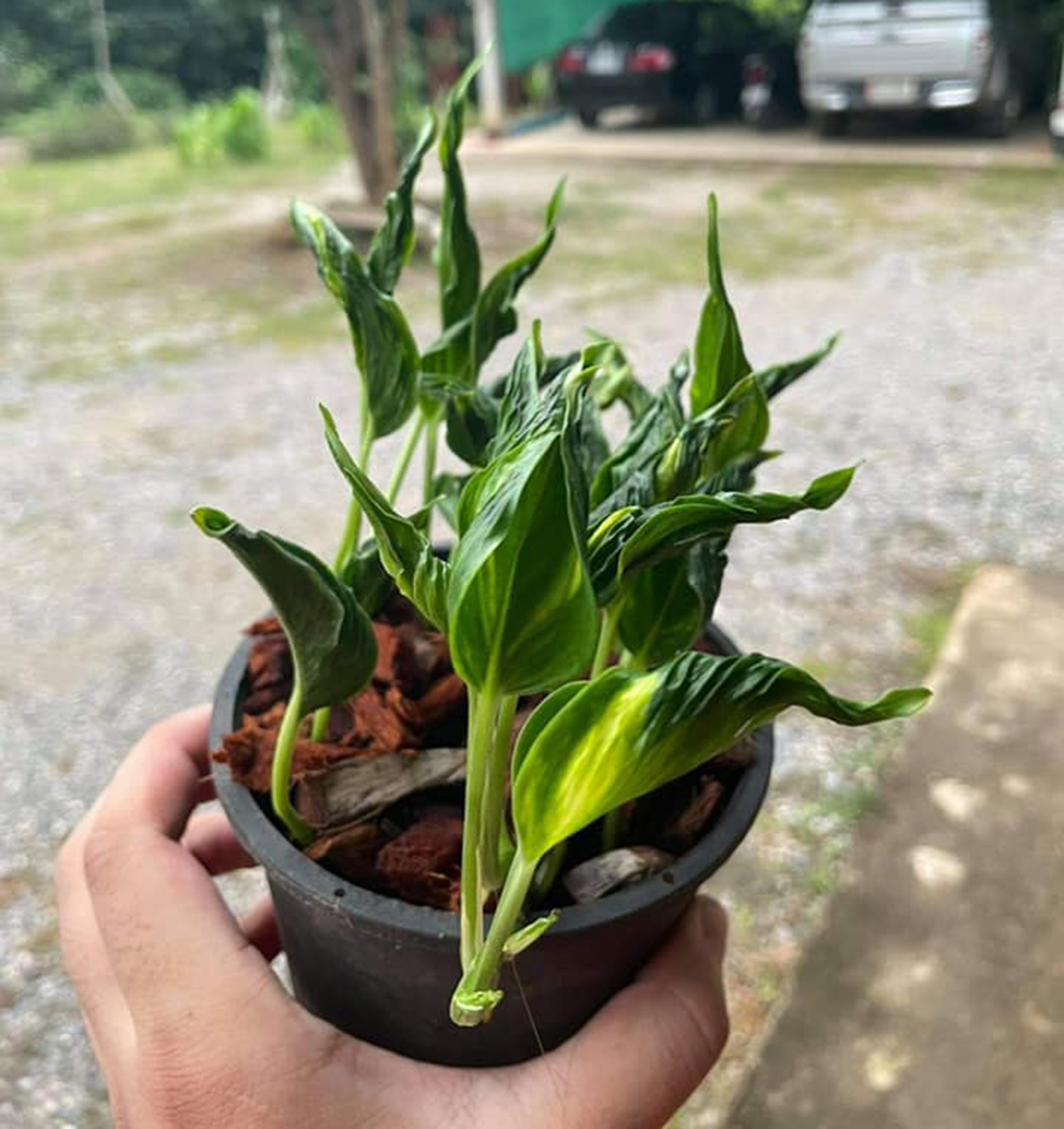
- Sequence: several hardened leaves repeat the folded or puckered form.
- Pattern: green and yellow/chartreuse areas are recorded without promising the next leaf.
- Structure: stem, nodes, petioles, growth point and aerial-root habit fit an Epipremnum vine.
- Condition: inspect new growth, undersides and roots for active damage.
- Source: distinguish the exact plant from a mother-plant, reference or representative-lot image.
Species framework and trade-label boundary
Kew accepts Epipremnum aureum as a wet-tropical climber native to the Society Islands, including Mo’orea. Its records place the species as introduced in the Solomon Islands and Thailand. That makes the old “native Solomon Islands mutation” story unsuitable without a primary cultivar record.
The reviewed botanical and extension sources establish the species framework, but they do not establish a breeder, patent, registration or country-of-origin history for the exact Shangri-La Aurea label. Preserve that name as a commercial selection label linked to a traceable plant and seller history.
Selection feature or a stress signal?
| Observation | Useful interpretation | Next check |
|---|---|---|
| Repeated folded blades | Supports the selection phenotype when several hardened leaves remain firm and functional. | Compare the active stem and source plant. |
| One twisted new leaf | May record friction, dryness, handling or damage during unfurling. | Inspect the next leaf and both surfaces. |
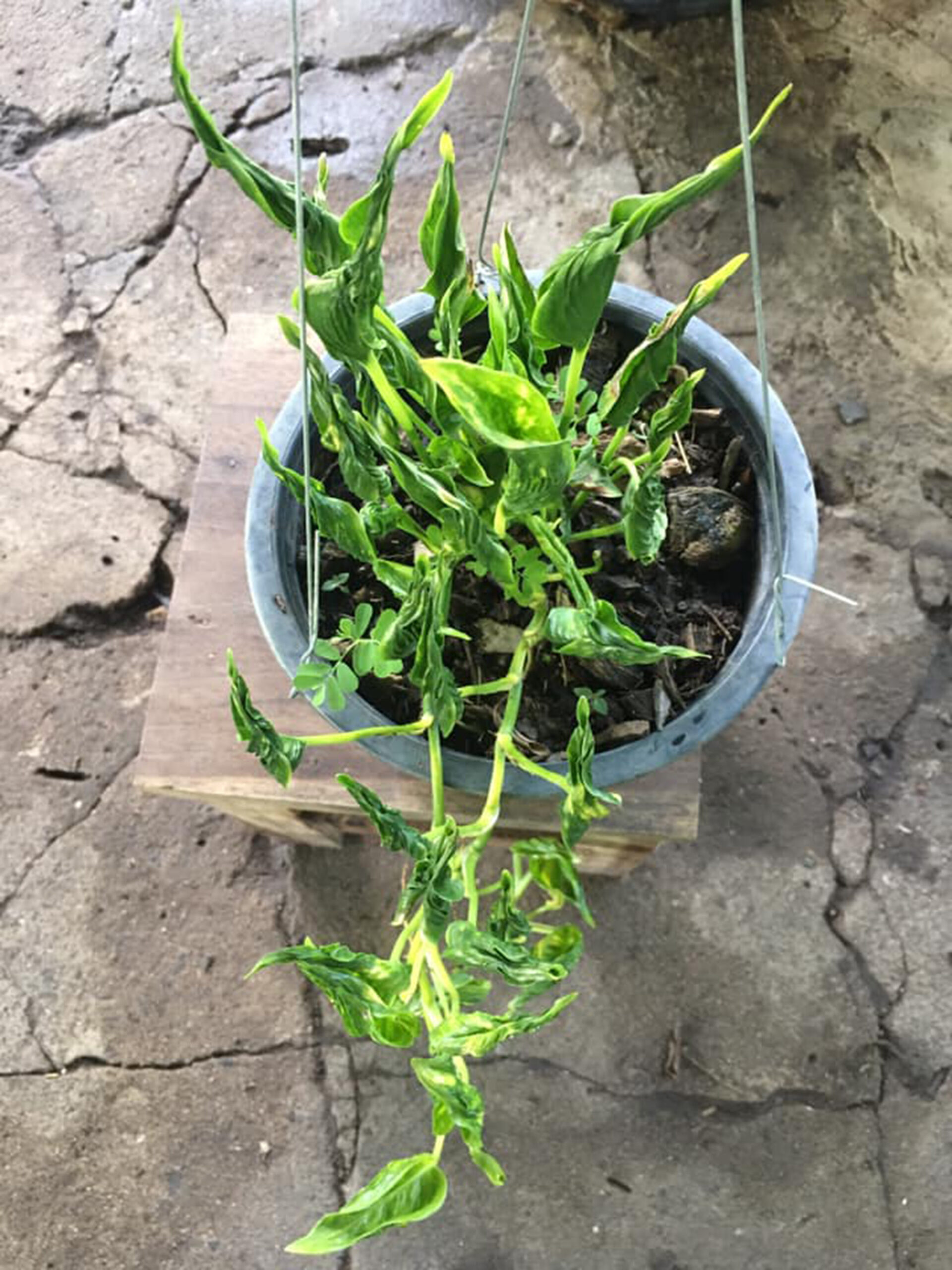
| Green + chartreuse pattern | Matches Greenboog’s photographed examples, but intensity can vary by leaf and conditions. | Request neutral-light current images. |
| Sudden general yellowing | Not proof of Aurea pattern; roots, watering and exposure may be involved. | Review timing, roots and recent changes. |
| Scars, stippling or wet lesions | Active damage should not be marketed as decorative texture. | Inspect undersides, sheaths and progression. |
Authentic photographs show the trait across the vine
The Greenboog images show compact and longer plants whose leaves vary in openness, curl and color ratio. That variation is useful evidence: a selection trait can repeat without making every leaf identical.
Buyer checklist
- Request current neutral-light photographs of several hardened leaves.
- Confirm whether the images show the exact plant, a representative lot or a reference plant.
- Inspect a viable node, active growth point, stem and current roots.
- Check new growth and leaf undersides before treating every curl as a selection trait.
- Confirm established plant, rooted cutting, fresh cutting or tissue-culture format.
- Use the live listing for quantity, pot size, stock, price, shipping and claim terms.
Care handoff: protect the next readable leaf
The Epipremnum care guide owns the complete light, watering, substrate, climbing-support and troubleshooting workflow. For Shangri-La Aurea, keep changes gradual and inspect each emerging leaf because injury can be hidden inside tightly folded tissue.
Use bright filtered light and an aerated root zone, then water from pot weight, moisture depth and root activity rather than a fixed top-inch calendar. A support can help a climbing Epipremnum develop, but fertilizer, humidity or low light cannot authenticate the Shangri-La Aurea label.
Choose the next page by intent
Sources and evidence boundaries
- Kew Plants of the World Online: Epipremnum aureum — accepted species, native range and introduced-range boundary.
- NC State Extension: Epipremnum aureum — juvenile container form, climbing habit, petiole characters and support-related development.
- UF/IFAS: Commercial Production of Interiorscape Epipremnum — production and interior-acclimation context, not cultivar provenance.
Evidence limit: authentic Greenboog images document plants sold under this label. They do not prove genotype, pedigree, future variegation or the exact scope of a current offer.
