
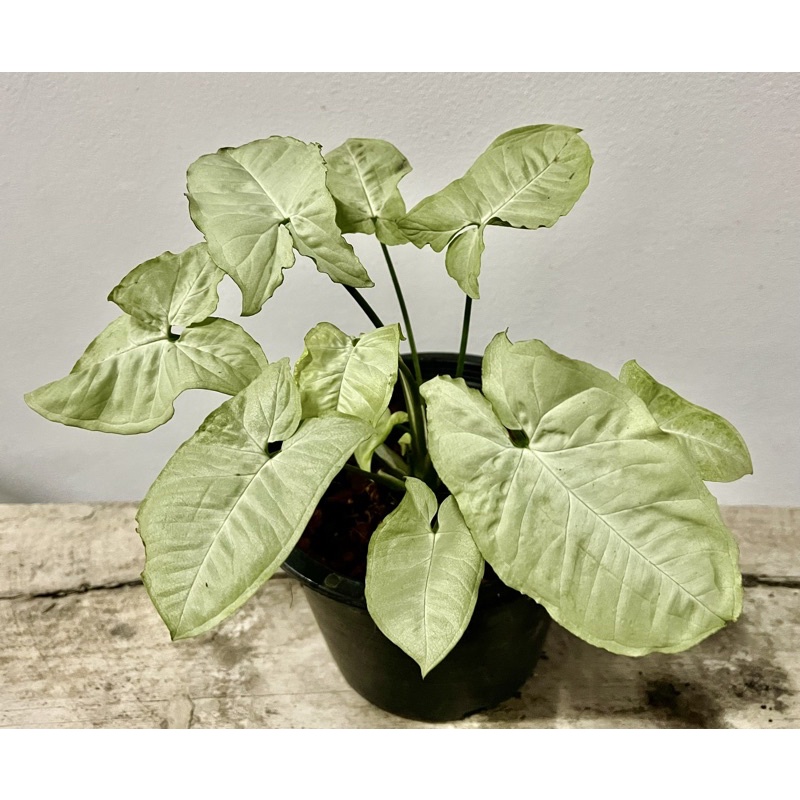
Syngonium label guide
“Syngonium Moonlight” appears in commerce as a pale-leaved seller label, but the reviewed Kew, UF/IFAS and NC State records do not establish that exact name as a botanical taxon or documented cultivar. Use the current plant’s leaf sequence, provenance and image scope instead of filling the evidence gap with an origin story.
- The exact spelling on the seller and parent/source records.
- Current neutral-light photos of several hardened leaves.
- Repeated pale field versus temporary new-leaf color.
- Viable node, active growth point and current root status.
- Exact-plant, current-lot or reference-image scope.
- Established plant, rooted cutting or tissue-culture format.
What the name does—and does not—prove
Kew accepts Syngonium podophyllum as a wet-tropical liana from Mexico to Tropical America. That species record supports the broader plant framework, not the Moonlight label’s breeder, parentage or introduction date.
UF/IFAS’s reviewed commercial cultivar table documents many pale and patterned Syngonium selections but does not list Moonlight. NC State also documents the species and several cultivars without establishing this exact label on the reviewed page. Absence from those sources is not proof that the label is false; it means pedigree and formal status should remain unclaimed.
Pale label, documented selection or condition change?
| Observation | Useful interpretation | Next check |
|---|---|---|
| Pale field repeats on hardened leaves | Supports the photographed Moonlight seller phenotype. | Compare current plant and parent/lot records. |
| Only the newest leaf is very pale | Emergence color may not represent the hardened pattern. | Wait and photograph under the same neutral light. |
| Nearly white with dark marginal speckles | Resembles UF/IFAS’s Holly M description, not proof of Moonlight. | Compare provenance and multiple mature leaves. |
| Pale field with defined green margin | Creates an adjacent Silver Holly comparison. | Use the Silver Holly guide, then verify the listing scope. |
| Sudden overall bleaching or scorch | Condition change can imitate a paler phenotype. | Review timing, exposure, roots and protected leaves. |
Keep Silver Holly as a comparison, not a synonym
The Silver Holly guide owns its pale-field, green-margin and buyer-evidence framework. Do not collapse Moonlight into Silver Holly from one seller photo, and do not transfer Silver Holly’s wording to authenticate a Moonlight-labelled lot. Compare both pages, then preserve the source label and current-plant evidence.
Buyer checklist
- Ask what record supports the Moonlight name and exact spelling.
- Request current photos before and after leaves harden.
- Confirm whether the pictured plant, lot and delivered plant are the same scope.
- Inspect node, growth point, crown and roots rather than foliage alone.
- Confirm quantity and living format; never infer size from a reference plant.
- Use the live offer for current price, stock, shipping and replacement terms.
Care and propagation handoff
Use the Syngonium care hub for light, watering, substrate, support and troubleshooting. Pale tissue may have less chlorophyll, but that does not justify fixed temperature, humidity, misting or top-inch schedules. Adjust conditions gradually and read the root zone.
Propagation needs viable stem tissue, a node and growth point. Keep the source label and parent/lot photographs with each cutting; a detached leaf cannot reproduce the vine by itself.
Choose the next page by intent
Sources and evidence boundaries
- Kew Plants of the World Online: S. podophyllum — accepted species and liana boundary.
- UF/IFAS: Commercial Production of Syngonium — documented cultivar comparison and commercial context.
- NC State Extension: S. podophyllum — juvenile/adult morphology and cultivar context.
Evidence limit: the historic Greenboog image supports a cultivated pale phenotype under a seller label. It does not prove genotype, registration, parentage or the scope of a current listing.
