Greenboog shingling guide
Rhaphidophora cryptantha is built to climb flush against a surface. The care question is therefore not only “Is the plant alive?” but “Does the setup keep the active stem close enough to attach and continue its overlapping, silver-veined shingle pattern?”
Correct the identity first: this is not “Mini Monstera”
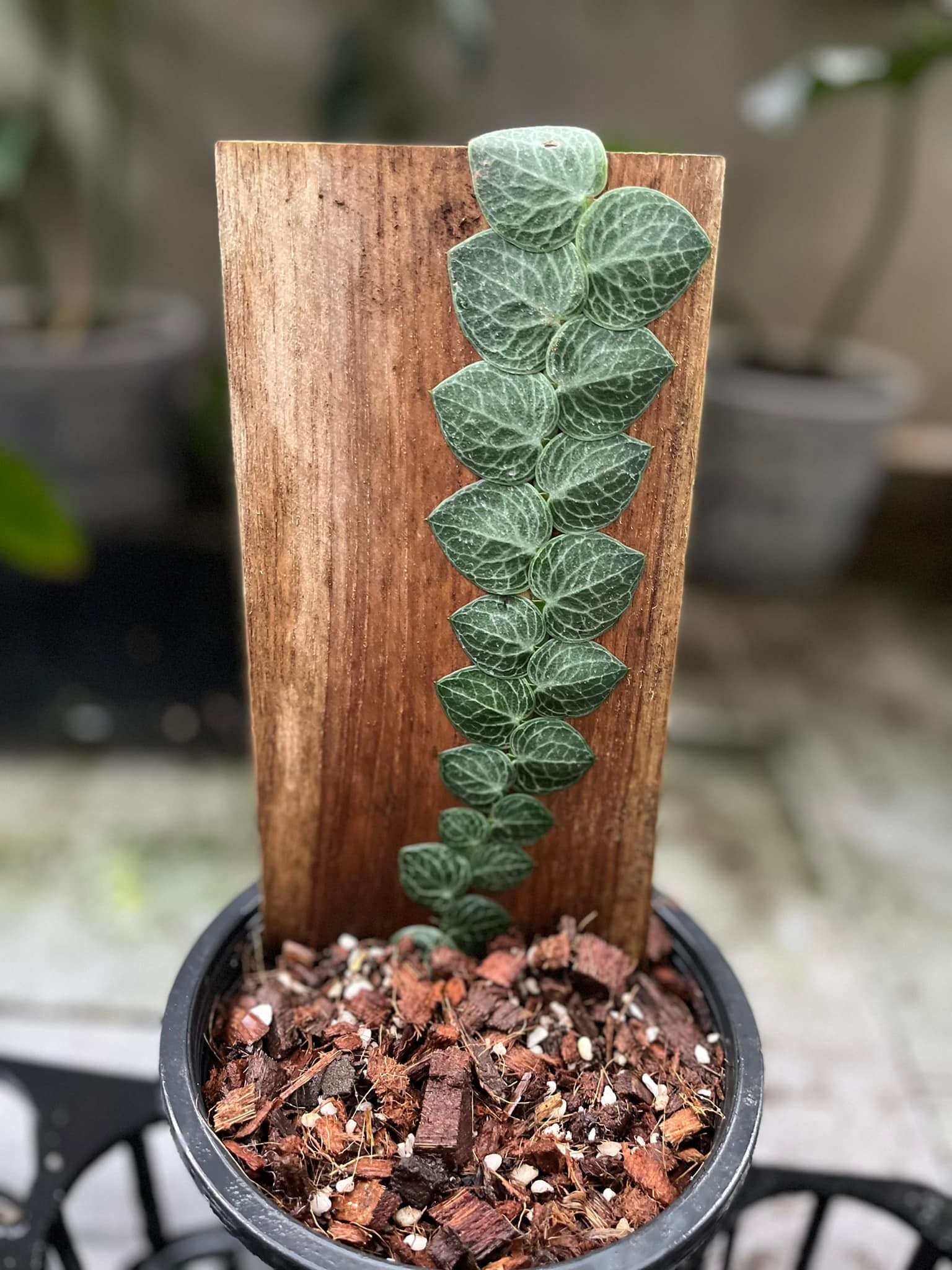
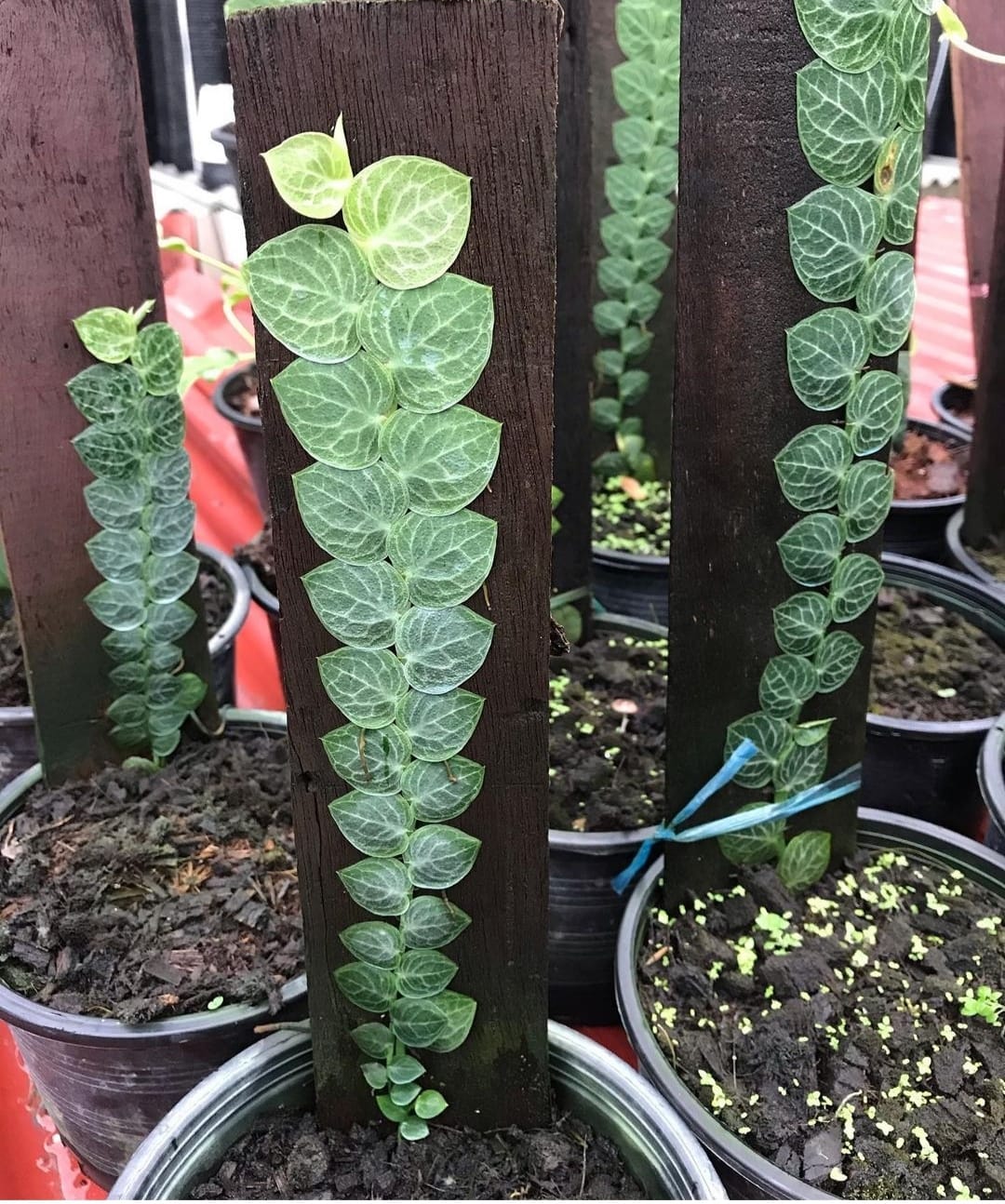
Kew recognizes Rhaphidophora cryptantha P.C.Boyce & C.M.Allen as an accepted species associated with Papua New Guinea. It is a wet-tropical climber with broadly ovate, leathery leaves held flat and ascending against its support. The upper surface carries a fine silver-grey network of veins.
The legacy article misspelled the plant as “Ryptantha,” equated it with R. tetrasperma and promised huge split leaves. Those are not small editorial errors: they describe a different growth architecture. Cryptantha’s collector appeal is its dense shingling display, not Monstera-like fenestration.
The species name also refers to an unusual hidden feature. The botanical treatment describes flowering shoots behind the appressed leaves, where the inflorescences may be almost completely concealed. You do not need flowers to grow the plant well, but this character helps explain why leaf-and-surface architecture is central to its identity.
Choose a support that the plant can actually use
A board gives the vine one continuous route and makes the appressed habit easy to inspect. Choose untreated or plant-safe material with enough width for the next leaves and enough height for continued growth. Seal or replace material only with a coating known to be safe after curing; do not press active roots against sticky, flaking or chemically treated surfaces.
NParks notes that clasping roots can damage painted walls. A removable board protects the room and makes repotting possible without peeling the plant from the building. Secure the board deep in the pot or to a stable external frame before attaching the vine.
A moss pole can work when it presents a broad, even face, but a narrow cylinder may twist the leaves around the pole rather than creating the flat display many collectors want. Whatever the material, place the active stem close enough for roots to find it; do not tape leaf blades to the surface.
Why leaves lift, space out or stop shingling
Diagnose from the newest section first. Older leaves will not rearrange after the setup changes.
| What you see | Likely boundary | Check | First response |
|---|---|---|---|
| Tip grows away from board | The route is missing, angled or too far away | Gap at newest node; board extension | Redirect the flexible stem with one loose tie |
| Long gaps between leaves | Usable light or surface contact may be inadequate | Light duration, distance and root contact | Improve one variable gradually; judge only new nodes |
| Leaf edge lifts | Contact was lost during expansion or the support curves away | Stem position, not the blade itself | Guide the next internode; do not tape the leaf flat |
| New leaf is small/pale | Root, light or recent transition stress | Pot moisture, roots, pests and recent moves | Stabilize care before feeding or pruning |
| Base yellows while mix stays wet | Root-zone aeration may be failing | Drainage, odor and root firmness | Inspect roots; correct the confirmed cause |
| Surface gets hot | The mount is storing direct-sun heat | Touch temperature during peak exposure | Move to filtered light before roots and leaves scorch |
Light: judge internodes and new attachment
NParks places the species in semi-shade; indoors, translate that to bright, filtered light without a hot surface. Rotate a free-standing pot only when the plant and board move as one unit. Turning the vine away from its support interrupts the very architecture you are trying to build.
Use new growth as the meter. If the newest internodes lengthen and the stem searches sideways, verify light and support contact together. If the board heats in direct sun or pale marks repeat on the exposed side, reduce the harsh exposure. Change conditions gradually and allow several nodes before judging the result.
Water the roots, not the display
The potting mix needs both moisture and air. Check beneath the surface and compare pot weight; water thoroughly after the upper portion has partly dried, then let excess drain. Do not keep the entire pot saturated simply because the plant comes from a wet-tropical biome.
An airy medium helps, but there is no universal bark-to-perlite ratio. Particle size, pot depth, temperature and the grower’s watering habits change how the mix performs. Use the Rhaphidophora soil owner for substrate selection and the genus care owner for the broader routine.
If entire leaves yellow, work through the Rhaphidophora yellow-leaf diagnostic rather than assuming the silver network is fading or applying fertilizer immediately.
Humidity helps expansion; airflow protects the surface
Stable moderate humidity can help new leaves expand close to the support, but a pebble tray or occasional mist does not create a measured climate. Wet leaves pressed against a board also dry slowly. If repeated unfurling problems justify a humidifier, keep it clean and pair it with gentle air movement.
Do not spray leaf shine or oils into the narrow space behind appressed leaves. Inspect with a small light and clean only accessible surfaces with water and a soft cloth. Look behind the board and around the pot rim for pests before treating the entire collection.
Cryptantha, hayi or Monstera dubia?
All three can shingle, so common names are weak evidence. The comparison below is a screening tool, not a substitute for provenance or a botanical key.
| Plant | Useful visible clue | Official diagnostic context | Owner |
|---|---|---|---|
| R. cryptantha | Ascending appressed leaves with fine silver-grey reticulation | Inflorescences arise behind the shingling leaves | This guide |
| R. hayi | Also shingling; leaf form and venation differ by specimen/stage | Kew accepts it as a separate species; flowering shoots are not concealed in the same way | Hayi-specific article |
| Monstera dubia | Juvenile leaves shingle but are described as descending rather than ascending | Different genus; morphology changes substantially with maturity | Monstera dubia care |
Propagation: preserve the route
A stem cutting must include a viable node. Take it only from healthy, established growth with clean tools, and keep track of which side faced the support. When potting, place the node near a fresh vertical surface so the new shoot does not spend its first growth searching across open space.
Do not strap the mother leaf flat or bury the node deeply to force attachment. Keep full rooting-media and transition instructions with the Rhaphidophora propagation owner; this page owns the cryptantha-specific requirement to restore a close climbing route.

Before buying a mounted specimen
A mounted plant is a plant–support system. Evaluate both parts.
| Evidence | Why it matters | Useful proof | Weak substitute |
|---|---|---|---|
| Exact plant | Shows the specimen you will receive | Current full-plant photo and label | Catalog hero image only |
| Active tip | Predicts whether the route can continue | Clear photo of newest node and remaining support height | Old lower leaves only |
| Board condition | The roots may already be attached | Material, dimensions and shipping plan | “Includes pole” without detail |
| Rooted status | A weak root system has less transition margin | Current medium, drainage and root-stage description | Fixed “easy care” claim |
| Provenance | Shingling aroids are visually confused | Documented source and consistent botanical name | “Shingle plant” alone |
A weekly five-point check
- Find the active tip and confirm the support continues above it.
- Check that ties hold only the stem and are not tightening around a node.
- Compare the newest two internodes for spacing and surface contact.
- Check pot weight and moisture below the surface before watering.
- Inspect behind accessible leaves, the board edge and pot rim for pests or trapped moisture.
Frequently asked questions
Is Rhaphidophora cryptantha the same as Rhaphidophora tetrasperma?
No. Kew accepts them as separate species. Cryptantha is grown for ascending appressed shingle leaves with silver-grey reticulation, not the divided leaves associated with mature tetrasperma.
Why is my cryptantha growing a bare runner?
The shoot may be searching for a usable climbing route, or conditions may be limiting compact growth. Check support contact and usable light together, then guide the flexible stem back without tying the growing tip.
Should I grow it on a wall?
A wall can provide a route, but NParks warns that clasping roots may damage painted surfaces. A removable board is easier to inspect, move and repot.
Can I tape lifted leaves back down?
No. Tape can trap moisture and damage the blade. Guide the stem near the support and let future roots and leaves attach naturally; an older lifted leaf may remain lifted.
Does cryptantha need daily misting?
No fixed misting routine is required. Misting gives only a brief moisture pulse and can keep appressed foliage wet. Use measured humidity, clean equipment and airflow when the environment genuinely needs adjustment.
How can I distinguish it from Monstera dubia?
The botanical treatment notes ascending leaves in cryptantha versus descending leaves in juvenile dubia, but use several traits and provenance. Do not make a high-value identification from one leaf photo.
Sources and further reading
- Kew POWO: accepted name, range, habit and diagnostic description of R. cryptantha
- NParks Flora & Fauna Web: form, cultivation, support and wall-damage guidance
- Singapore Botanic Gardens: original taxonomic treatment and lookalike boundary
- Kew POWO: accepted status and diagnostic description of the separate species R. hayi