
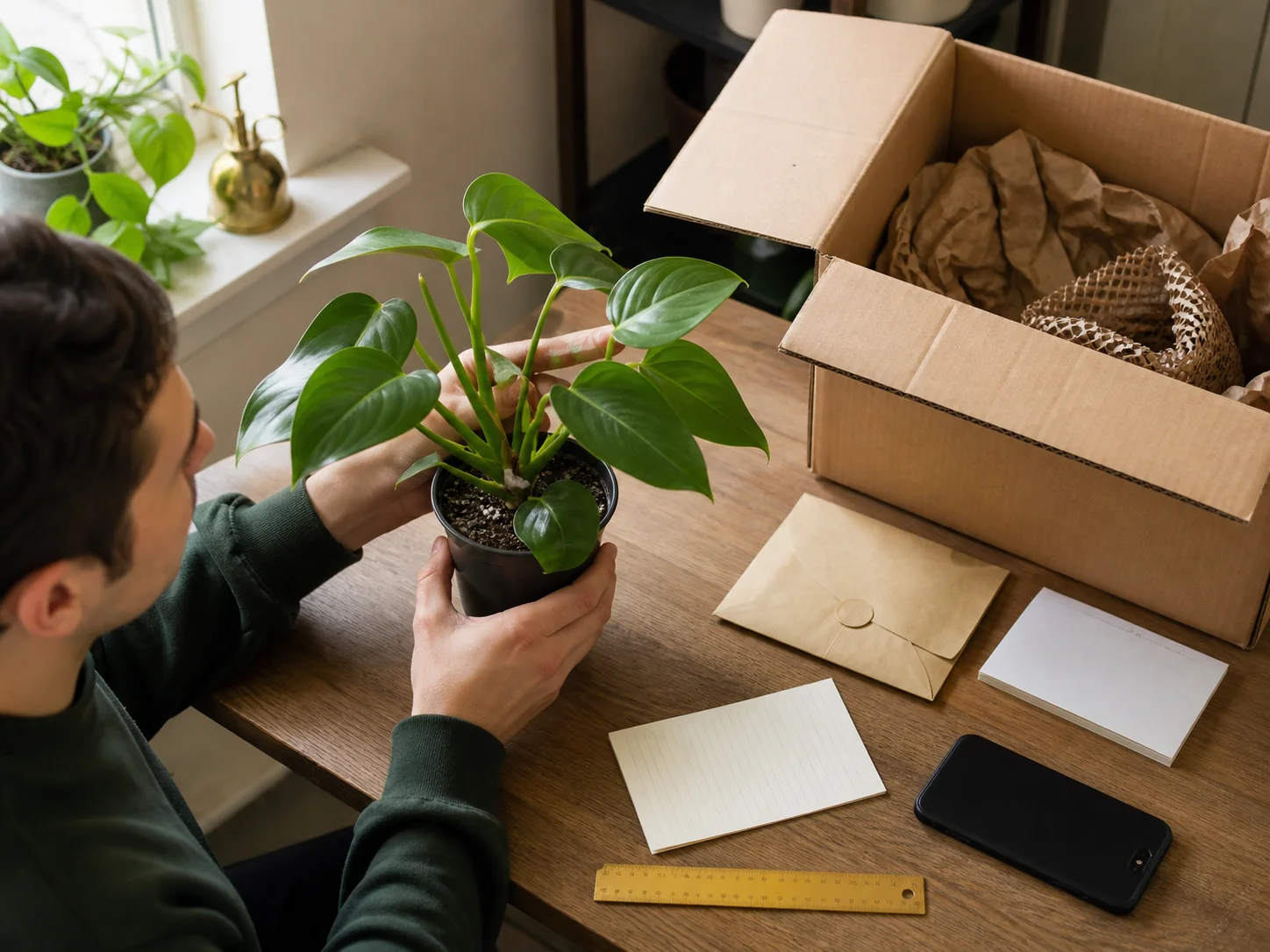
Listing evidence, plant format, import checks and arrival records
Buying a Philodendron online is less about finding the loudest rarity claim and more about matching the listing, plant format, destination rules and recovery capacity to evidence you can save.
Start with five evidence layers
| Layer | Stronger evidence | Weak signal |
|---|---|---|
| Identity | Accepted species name or preserved cultivar/seller-line label, connected morphology and source history. | One colourful leaf, “rare,” “high var” or a social-media nickname. |
| Image scope | Explicit “exact plant” statement or a defined representative batch with recent whole-plant views. | A cropped hero with no date, stem, crown, node or growth point. |
| Format | Potted/rooted cutting/in-vitro status, pot or vessel size, quantity and acclimation stage stated separately. | “Plant” with no rootedness or shipment format. |
| Transaction | Origin, destination, dispatch window, carrier scope, documents, weather boundary and claims process. | “Worldwide,” “guaranteed” or “express” with no conditions. |
| Arrival | Saved order record plus timestamped package, label, count, plant and root photos. | Repotting first and documenting later. |
Use Greenboog’s rare Philodendron varieties guide to compare collection roles. The live category—not this evergreen article—owns current stock and price.
Exact plant or representative batch?
An exact-plant listing should connect every decision to the photographed specimen. Look for the whole plant, several hardened leaves, stem or crown, newest growth and enough root/format evidence to understand what will ship. Save the page because images and availability can change after checkout.
A representative image can be appropriate for tissue culture, wholesale lots and consistent nursery batches, but it must not silently promise the brightest specimen. Ask what varies: leaf count, size range, variegation, roots, vessel condition or selected lot. Future growth and colour cannot be guaranteed from one representative plant.
Know the format that will arrive
| Format | Confirm before payment | Plan after arrival |
|---|---|---|
| Established potted plant | Pot size, rootedness, medium, exact/representative image and whether the pot ships. | Stabilize light and moisture; inspect before automatic repotting. |
| Rooted cutting | Viable node/growth point, root evidence, leaf count and medium. | Protect the small root volume from saturation and abrupt exposure. |
| Unrooted cutting | Node anatomy, cut condition and any rooting-risk boundary. | Prepare a clean, airy propagation system before dispatch. |
| Acclimated tissue culture | Deflasked stage, rooted plug, quantity and current environment. | Match the seller’s documented stage; do not treat it as sealed in-vitro material. |
| Sealed in-vitro vessel | Plant count, seal, contamination boundary and destination import requirements. | Keep sealed while intact and use a staged deflask/acclimation protocol. |
Check destination rules before paying
Plant-import rules are destination-, material- and date-specific. USDA APHIS states that plants for planting are regulated and may require a permit. GOV.UK states that plants for planting arriving in Great Britain from outside the EU, Switzerland and Liechtenstein need a phytosanitary certificate, and postal buyers should ensure the seller includes it. These are examples—not universal legal advice.
- Identify the destination plant-health authority or NPPO.
- Check the exact botanical material and growing medium.
- Confirm permit, phytosanitary, inspection and pre-notification requirements.
- Ask who obtains each document and where it travels.
- Understand what happens if customs or plant health holds, treats, returns or destroys a consignment.
Requirements can change between research and dispatch. Recheck the official authority immediately before payment and again before shipment; do not rely only on an old forum post or seller summary.
Read shipping and claims language literally
Separate dispatch time from transit time. A courier estimate begins after handoff and may exclude documentation, weather holds, weekends, customs and inspection. Ask whether a heat/cold pack, bare-root preparation, pot removal or medium change alters the plant and whether those choices are included in the price.
Record the claims window and required evidence before ordering. “Live arrival,” “healthy delivery,” refund and replacement can have different definitions. Preserve the order confirmation, listing, tracking and seller messages in one folder. Greenboog-specific current process belongs in the shopping guide and shipping information.
Inspect first, then acclimate
- Photograph all sides of the unopened package and shipping label.
- Record opening time, seals, documents, plant count and packing condition.
- Photograph the whole plant, connected leaves, stem/crown, pot or vessel and visible roots.
- Compare exact listing evidence or the promised batch range.
- Contact the seller within the stated window before discarding packaging.
After the evidence record is complete, stabilize the plant instead of stacking interventions. Use bright filtered light, warmth and a root-zone decision appropriate to the delivered format. Existing mechanical or cold damage will not reverse; recovery is shown by firm viable tissue, functioning roots and later clean growth. Use the Philodendron care pillar for environment-level care.
Buying Philodendrons online FAQ
Does a phytosanitary certificate guarantee plant identity?
No. It is plant-health documentation issued within a regulatory process; it does not prove a cultivar, exact variegation or future growth.
Is an exact photo always better?
It gives stronger specimen-level evidence, but only if the listing clearly states that the photographed plant ships. Representative images remain practical for defined batches and tissue-culture lots.
Should I repot immediately after delivery?
Not automatically. Document and inspect first. Repot when failed roots, unsuitable medium, contamination or another verified condition outweighs the stress of another change.
Can a seller guarantee future variegation?
No listing can guarantee the exact pattern of every future leaf. Judge connected growth and provenance, and keep enough green tissue for plant function.
