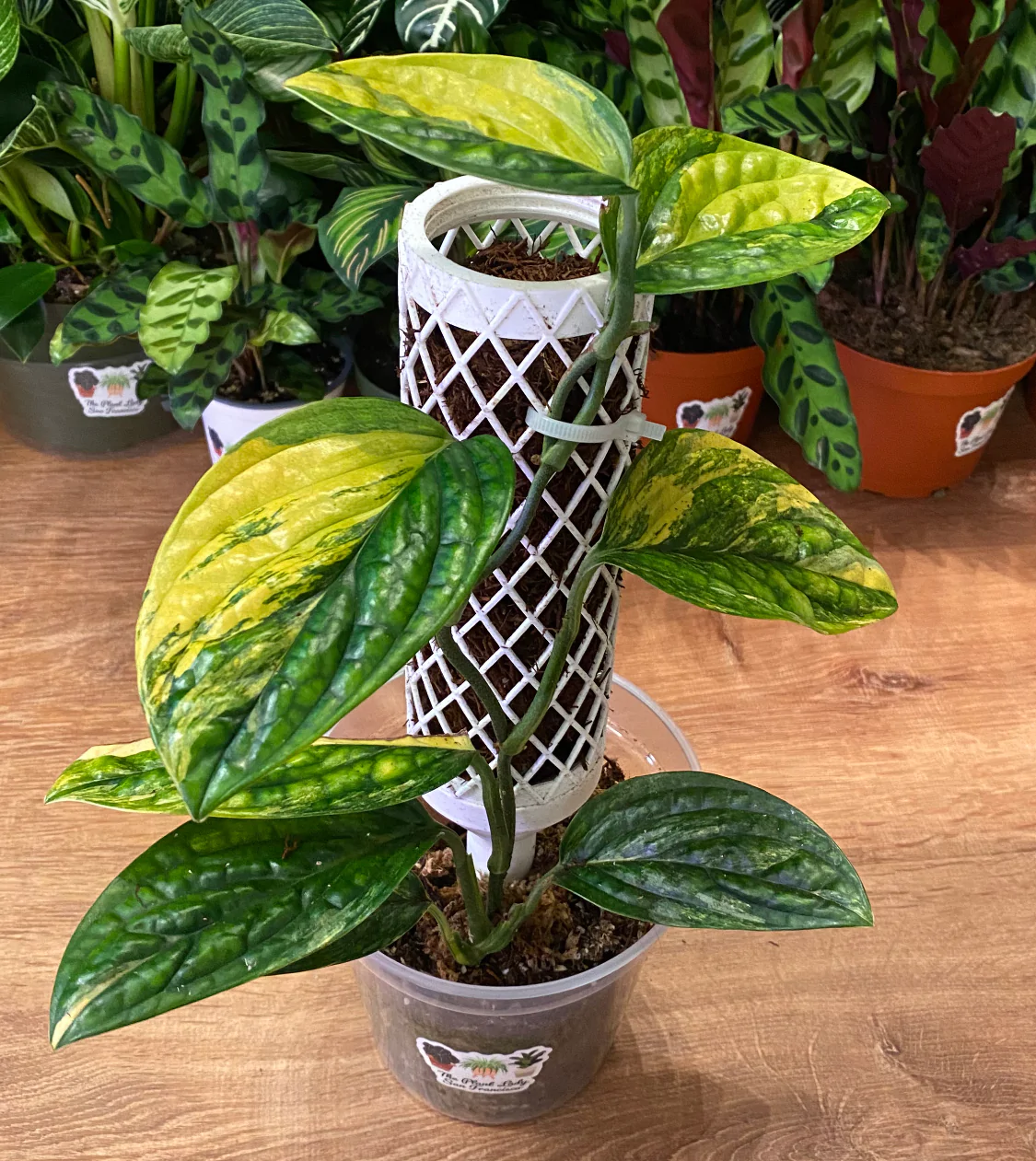
Monstera Peru Variegated is best treated as a trade label for a root-clinging aroid with thick, glossy, strongly textured leaves and persistent cream-to-yellow-green patterning. The name is useful when shopping, but it is not enough to prove a botanical species or cultivar. Before you buy or prune, compare several hardened leaves, inspect the active stem and ask how the plant was propagated.
This distinction matters because `Monstera Peru`, `Monstera karstenianum`, `Marble Planet` and `variegated/aurea` are not used consistently across the plant trade. A good specimen should be evaluated as an actual plant with a growth history—not as a label attached to one attractive leaf.
Quick identification checklist
| Feature | Useful evidence | What it does not prove |
|---|---|---|
| Leaf surface | Hardened leaves are thick, glossy and visibly quilted or corrugated between darker veins | Texture alone does not confirm an exact cultivar |
| Leaf shape | Blades are compact, elongated to oval and usually remain entire on young indoor plants | A solid blade does not make it a juvenile Monstera deliciosa |
| Growth | A flexible climbing stem produces leaves and aerial roots at nodes | A support, pot or seller photo does not establish botanical identity |
| Pale pattern | Cream, yellow or yellow-green sectors repeat across several hardened leaves on the same active shoot | One pale leaf does not prove stable variegation |
| Plant health | The growth point is firm, roots function and new leaves harden without expanding damage | High variegation is not automatically high quality |
| Provenance | The seller can show the actual plant, its recent leaves and how the offered piece was propagated | A copied name or stock photo cannot verify the individual plant |
Why the Monstera Peru name is complicated
The trade label problem is visible in authoritative records. The Royal Horticultural Society lists Monstera Peru and Monstera karstenianum as synonyms for Epipremnum pinnatum ‘Ppiepi003’, sold as Marble Planet. Its profile describes a tender evergreen, root-clinging climber with glossy, textured leaves and deeply impressed veins.
However, Kew accepts Philodendron opacum and lists Monstera karstenianum Nicolson as a heterotypic synonym marked nom. nud.. That nomenclatural record is not proof that the houseplant in a listing is P. opacum. It shows why attaching `karstenianum` to a sales name does not settle the identity.
| Name seen in a listing | Safe interpretation | Do not assume |
|---|---|---|
| Monstera Peru | A widely recognized trade label for the textured climbing houseplant | That it is a formally accepted Monstera species |
| Monstera karstenianum | An older name still used commercially | That the name proves the plant is the Kew taxon record |
| Marble Planet / Ppiepi003 | The RHS name attached to its Epipremnum pinnatum profile | That every seller’s Peru plant is necessarily that exact clone |
| Variegated / aurea | A claim about persistent pale foliage pattern | Its biological mechanism, stability or future pattern from one leaf |
The International Aroid Society’s cultivar guidance emphasizes that a cultivar should be distinct, stable and uniform through appropriate propagation. Registration records identity; it is not a quality endorsement and does not by itself provide legal protection. For a purchase, the practical evidence remains the actual plant, a reliable propagation history and a consistent sequence of leaves.
What a well-established plant looks like
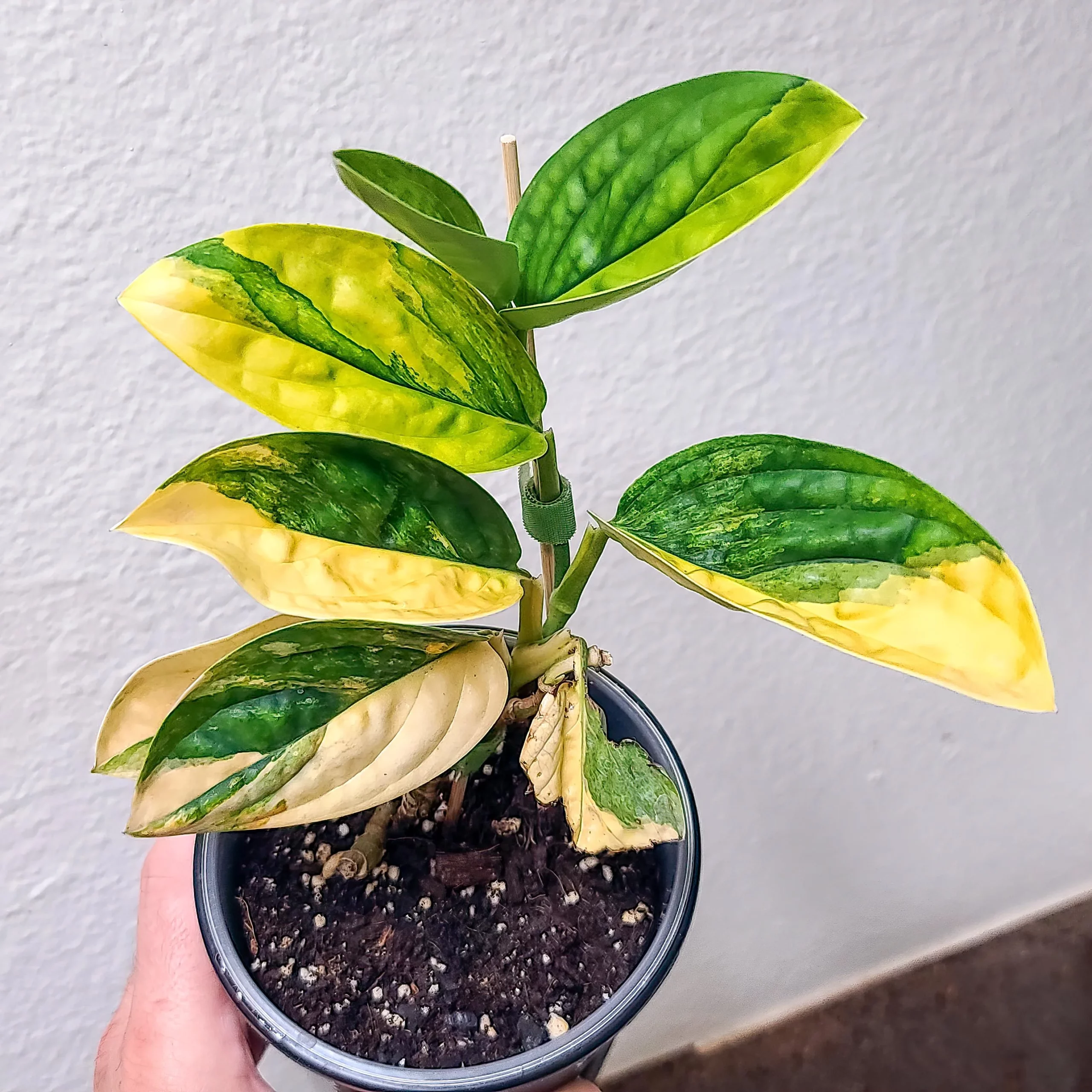
Look for a coherent combination rather than one magic feature:
- Texture: the blade should retain its raised, quilted surface after it has fully hardened.
- Veins: darker impressed veins make the lighter tissue between them look dimensional.
- Pattern: pale sectors or marbling should appear on more than one leaf and remain visible after hardening.
- Architecture: leaves emerge along a climbing stem with identifiable nodes and aerial roots.
- Trend: the active tip, newest leaves and roots should be stable or improving.
Do not use leaf color alone. UF/IFAS explains that variegation can arise from several mechanisms, including genetic patterning, chimeras, transposons and pathogen-associated changes. Without clone-specific evidence, it is not responsible to declare the mechanism of this plant from a photograph.
Variegation or a problem?
Persistent variegation usually has a repeatable visual relationship to the leaf and shoot. Stress damage is more likely to appear as a new change: expanding yellow tissue, water-soaked patches, crisp scorch, distorted emerging leaves or fine stippling associated with pests.
- Likely established pattern: distinct pale and green areas repeat across several leaves while the tissue hardens normally.
- Needs investigation: a previously uniform plant suddenly develops irregular mosaic color, deformation or a declining growth point.
- Not enough evidence: a single fresh leaf is light before hardening, or one old leaf yellows while the rest of the plant remains stable.
Use the health trend alongside the pattern. Our healthy Monstera assessment explains how to compare the growth point, leaf sequence, root zone and pest evidence without diagnosing from one symptom.
How to inspect a plant before buying
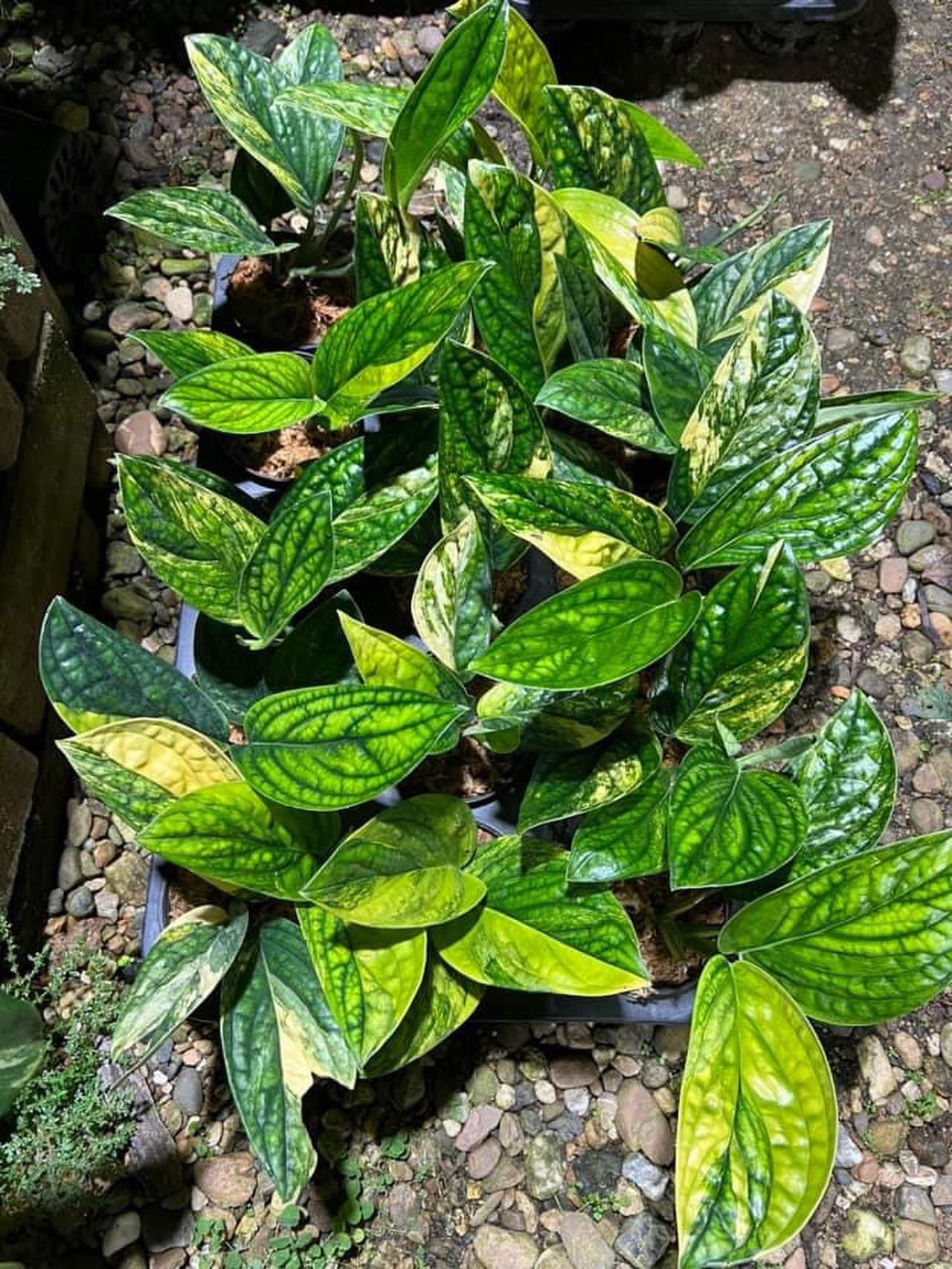
- Request a current whole-plant image or video. It should show the newest leaf, active tip, lower stem and pot—not only a detached close-up.
- Count the evidence. Compare at least several hardened leaves. Note whether the newest sequence is becoming greener, paler or remaining balanced.
- Locate the node. For a cutting, identify the stem node and growth point. A leaf and petiole without viable stem tissue are not equivalent.
- Check roots and acclimation stage. Ask whether the plant is freshly cut, rooted, newly potted or established. Each stage carries a different risk.
- Clarify the label. Ask whether the name comes from documented stock, a supplier invoice or visual resemblance. Keep the answer with your plant record.
- Separate identity from fulfillment. Confirm size, quantity, shipping conditions and replacement terms on the product page rather than assuming them from this guide.
Light: enough energy, introduced gradually
Start with bright indirect light and watch the plant’s response. Iowa State Extension describes bright indirect light as strong enough to cast a distinct shadow without direct rays striking the foliage. The University of Minnesota notes that indoor light categories should be matched to the plant and location; a window direction alone does not measure what reaches a leaf.
Pale tissue has less chlorophyll than green tissue, but brighter light does not manufacture genetic variegation. Move the plant toward stronger light in steps, especially after shipping or indoor winter conditions. A hard-edged bleached patch on the window-facing side after an abrupt move suggests exposure injury; long internodes and progressively smaller leaves suggest the plant may need more usable light or better root function.
Water by root-zone condition, not weekday
Water thoroughly, let excess leave the pot and wait for an appropriate dry-down before watering again. Probe below the decorative surface and learn how the pot feels after watering and before the next irrigation. The goal is a repeatable wet-dry cycle with air returning to the root zone—not permanent saturation and not prolonged collapse.
Frequency changes with light, temperature, root mass, pot material and substrate. A plant in a small nursery pot under warm grow lights may need water sooner than the same clone in a large glazed pot in winter. Do not convert `bright indirect light` into a fixed weekly schedule.
Choose a mix and pot as one system
Use a container with working drainage and a clean, aerated houseplant substrate. Bark, coir or peat-based components and mineral aeration materials can be combined in many workable ratios. The right mix is the one that wets evenly, holds enough water for your conditions and still regains air before roots remain deprived of oxygen.
- A mix that stays wet for many days despite active growth may be too water-retentive, the pot may be oversized or light may be insufficient.
- Water running immediately down a gap at the pot edge may leave a shrunken root ball dry in the center.
- Repot for a real reason: a collapsed medium, damaged roots, an unmanageable wet-dry cycle or a root mass that no longer functions in the container.
Support the stem; do not restrain the leaves
RHS describes the plant under its Marble Planet profile as a root-clinging climber. A board, pole or other stable support can keep the active stem organized and improve presentation. Place soft ties around the stem between nodes. Do not bind a petiole, emerging leaf or growth point.
Aerial roots are normal climbing structures. Guide them toward a support or substrate when practical. Routine removal is unnecessary; if one must be shortened for damage or space, use a clean tool and avoid injuring the node.
Fertilizer and humidity without ritual
Feed only while the plant is actively using water and producing growth. Use a complete houseplant fertilizer according to its label, beginning conservatively. If the mix remains wet, roots are damaged or salts are accumulating, adding more fertilizer does not solve the underlying problem.
Average indoor humidity can be workable when watering and roots are managed well. Do not depend on occasional misting as humidity control; Iowa State notes that foliage dries too quickly for misting to be an effective way to raise room humidity. If the environment is exceptionally dry, a humidifier with ventilation and a hygrometer gives more measurable control.
How to respond to possible reversion
One green leaf is an observation, not a verdict. Mark the leaf, photograph the stem and wait for the next growth if the plant is otherwise healthy. The decision depends on the sequence and the active shoot.
- Confirm the pattern change. Compare the newest two or three hardened leaves under similar lighting.
- Trace the active stem. Identify nodes, the growth point and where variegated tissue was last expressed.
- Protect the only viable growth point. Do not make a blind cut merely because one leaf is greener.
- Prune only with a mapped plan. If an entire vigorous shoot repeatedly grows solid green and a viable variegated node remains below, a selective cut may be reasonable.
UF/IFAS documents that chimeral plants can differ in stability and can revert. That general principle does not prove this clone is a particular type of chimera, so observe the actual shoot before acting.
Propagate from a stem node
A viable cutting needs stem tissue with at least one node and a growth point or bud. A detached leaf may remain attractive or even form roots in some aroids without having the structures required to continue as a normal plant. Penn State’s houseplant propagation guidance explains that stem cuttings form roots at buried nodes and shoots at exposed nodes.
- Choose a healthy stem section and identify the node before cutting.
- Photograph the leaf and stem pattern so the cutting’s provenance is retained.
- Use a clean, sharp tool and avoid crushing the growth point.
- Root in a clean medium or water while keeping the node appropriately moist and oxygenated.
- Pot up after a functional root system forms; do not rush a barely rooted cutting into an oversized wet container.
For the broader anatomy and aftercare process, use our Monstera propagation guide. The same node-first principle is useful here even though the trade plant’s exact botanical placement is disputed.
Troubleshooting: start with the next check
| Observation | Check next | Avoid |
|---|---|---|
| Newest leaves become progressively smaller | Total light, root function, support and recent cutting history | Adding fertilizer before checking roots and light |
| Several leaves yellow while mix stays wet | Drainage, pot size, stem base, root firmness and odor | Watering again because the surface looks dry |
| Crisp pale patch on one side | Recent move, hot glass or grow-light distance | Treating stable scorch as a spreading disease |
| Fine stippling or distorted new growth | Leaf undersides with magnification; isolate while identifying pests | Assuming every pale mark is variegation |
| One solid-green leaf | The next leaves and the active stem pattern | Cutting before mapping a viable node |
| One nearly all-pale leaf | Remaining green leaf area and the next growth | Trying to create chlorophyll with fertilizer |
| Stem will not attach to support | Tie placement, support stability and aerial-root direction | Binding petioles or cutting all aerial roots |
For general container care outside this plant’s identity questions, see our Monstera care guide.
Choose the product path that matches your stage
Keep the identity check separate from quantity and fulfillment. Greenboog currently provides three relevant catalog paths:
- The established variegated plant listing is the appropriate path when you want to review the single-plant offer.
- The five-pot variegated listing owns the wholesale quantity and fulfillment details.
- The five-pot green-form listing is the separate option for buyers who do not need the variegated form.
Availability, plant size and shipping conditions can change. Verify those details on the relevant product page and ask for current-plant evidence when pattern is central to the purchase.
Frequently asked questions
Is Monstera Peru actually a Monstera?
The trade uses that name, but the name alone is not botanical proof. RHS places Monstera Peru among synonyms for an Epipremnum pinnatum cultivar profile, while Kew’s nomenclatural record for Monstera karstenianum points to Philodendron opacum. Treat the sales label as a starting point and document the individual plant.
Is Marble Planet the same as every Monstera Peru?
RHS links the names in its profile, but that does not verify every plant circulating under a trade label as the exact same clone. Provenance, repeated traits and propagation history matter.
Can stronger light increase variegation?
Light provides energy and can change growth rate or how colors appear, but it does not create a genetic mutation on demand. Increase light gradually for plant function, not to force a pattern.
Should I cut off a green leaf?
Not solely because one leaf is green. Watch the next leaf or two, trace the active stem and make sure a viable patterned node remains before considering a cut.
Can I propagate it from a leaf?
Use a stem cutting with a node and viable growth point. A leaf or petiole without the necessary stem tissue should not be sold or treated as an equivalent propagation piece.
Is Monstera Peru Variegated safe for pets?
Use a conservative safety rule and keep the plant away from pets and children. ASPCA includes Epipremnum species among houseplants containing insoluble calcium oxalates. If chewing or ingestion is suspected, contact a veterinarian or animal poison service rather than waiting for symptoms.
Evidence-first takeaway
Monstera Peru Variegated is recognizable as a trade plant by the combined evidence of thick quilted leaves, climbing nodes and persistent pale pattern across a sequence of growth. Its commercial names are not a substitute for documented identity. Buy the actual plant, record its provenance, manage light and water by measured response, and make reversion or propagation cuts only after mapping the stem.