
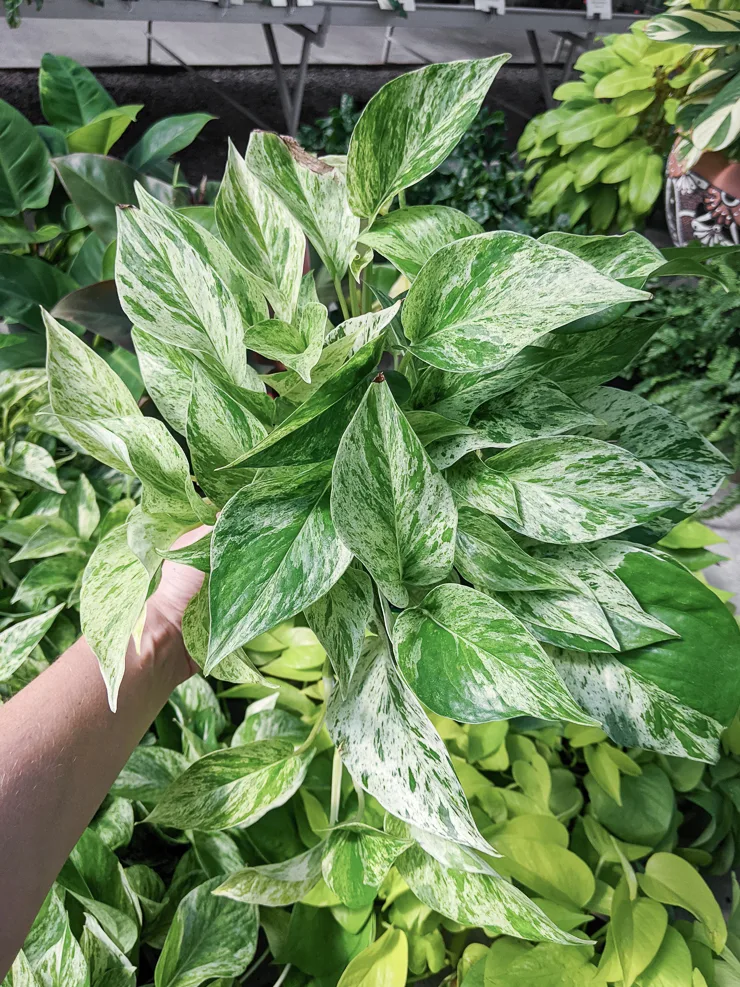
Greenboog practical Epipremnum guide
This guide is for owners and buyers who want to keep the plant full, diagnose yellow or greener leaves, propagate a real node and distinguish Marble Queen pothos from the different Epipremnum pinnatum Marble trade plant.
Start with the accepted species, the growth response and the root zone rather than a fixed calendar.
| Factor | Useful starting point | Adjust from evidence |
|---|---|---|
| Identity | Epipremnum aureum ‘Marble Queen’; cream-and-green marbled juvenile leaves | Do not merge it with E. pinnatum Marble or Snow Queen marketing |
| Light | Bright, filtered exposure introduced gradually | Track internode length, new-leaf size, contrast and scorch |
| Water | Water the full profile after suitable partial dry-down | Use pot weight, deeper moisture and root condition—not a weekday |
| Growth habit | Trail for display or climb for larger mature expression | Support changes architecture; it does not guarantee size or color |
| Safety | Insoluble calcium oxalates typical of pothos | Keep plants and cuttings inaccessible to pets and children |
What is a Marble Queen pothos?
Epipremnum aureum is an accepted species in the Araceae family. Kew describes it as a wet-tropical climber native to Mo‘orea in the Society Islands and introduced widely in tropical regions. ‘Marble Queen’ is a cultivated form selected for irregular cream-and-green marbling.
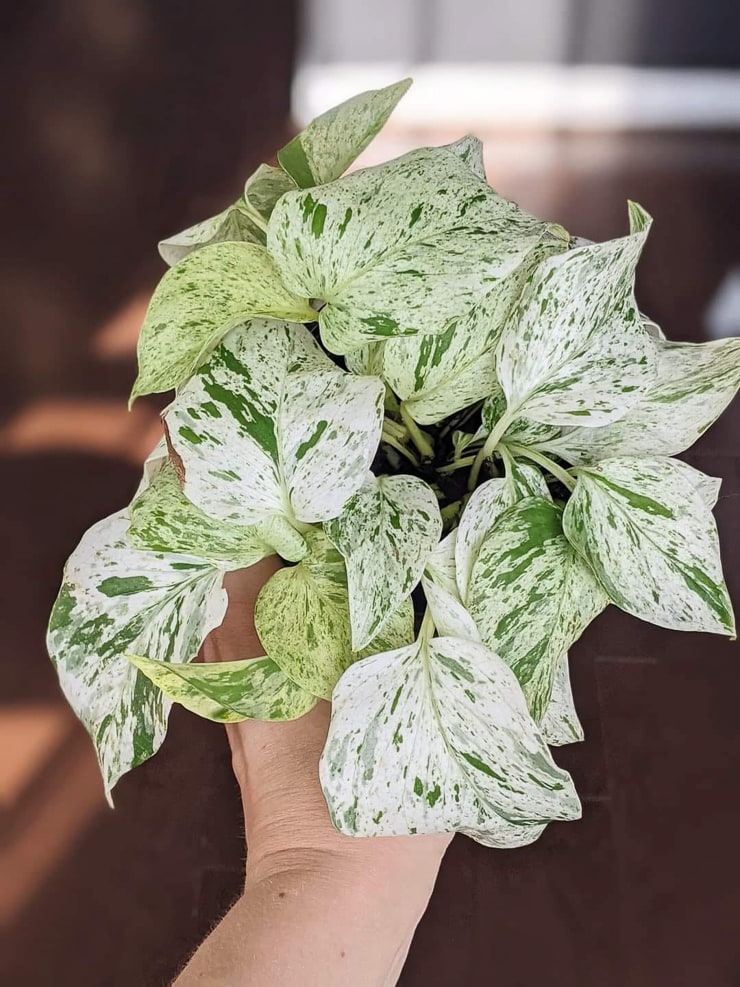
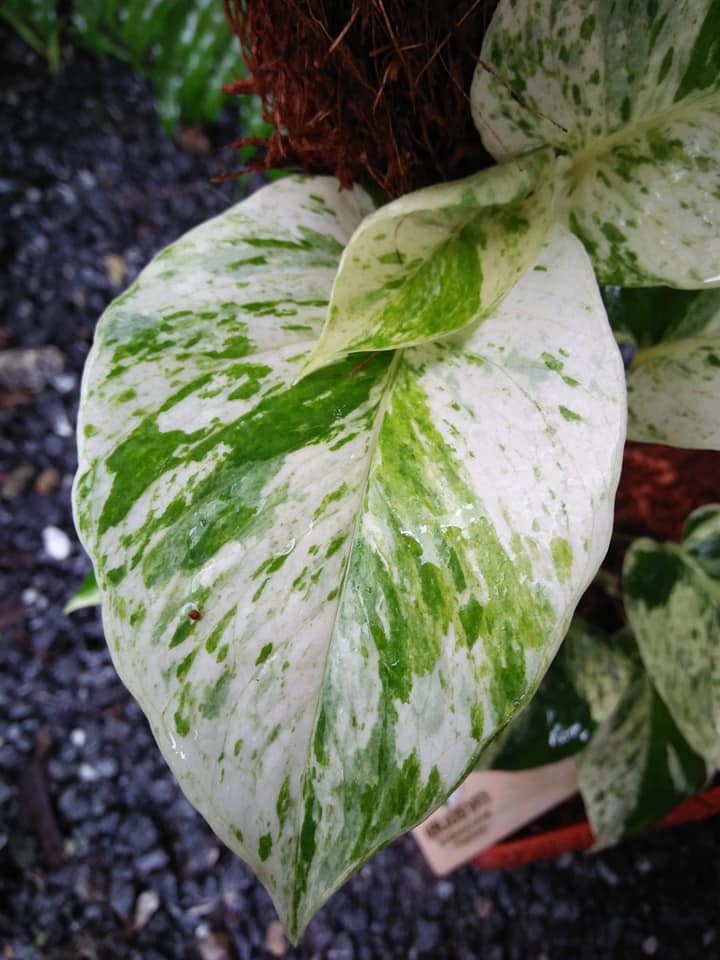
The UF/IFAS Epipremnum guide describes Marble Queen as having dark green leaves marbled with white. Juvenile indoor leaves are usually compact and heart-shaped. A vine trained upward in good conditions can produce larger leaves than one kept trailing, although the timing and final size depend on the plant and environment.
Marble Queen pothos is not Epipremnum pinnatum Marble
The shared word “Marble” does not make these plants the same cultivar or species.
| Trait | Marble Queen pothos | E. pinnatum Marble |
|---|---|---|
| Botanical owner | E. aureum ‘Marble Queen’ | A marbled E. pinnatum trade form |
| Juvenile leaf | Typically compact and heart-shaped with fine-to-broad marbling | More elongated blade as the vine develops |
| Mature climbing response | Leaves can enlarge; mature splits require substantial conditions | Pinnatifid/fenestrated mature progression belongs to its own owner |
| Buying check | Verify actual plant, roots and cream/green balance | Verify species-level leaf and stem evidence, not the word “Marble” |
Check the botanical name rather than buying from “Marble” alone. See the separate Epipremnum pinnatum Marble guide for that plant, or compare more forms in the Epipremnum varieties overview.
Care should move with the plant as leaf area, roots, pot and seasonal light change.
| Factor | Start here | Change when |
|---|---|---|
| Light | Broad bright filtered exposure or a suitable grow light | Internodes stretch, leaves shrink or pale areas scorch |
| Root zone | Moisture-retentive but airy particles in a draining pot | The center remains saturated or dries before roots can use it |
| Warmth and air | Stable room conditions away from cold glass and HVAC blast | Measured conditions or repeated new-leaf damage show a problem |
| Fertilizer | Complete formula at or below label rate in active growth | Growth slows, roots are damaged or salts accumulate |
| Training | Trail, loop cuttings back into the pot or train a supported vine | The display goal or mature leaf goal changes |
Light and variegation
Place Marble Queen in bright filtered light. An east-facing window is often forgiving. Near a stronger south- or west-facing window, add distance or a sheer curtain and increase exposure gradually. Watch the leaf surface: crisp tan areas concentrated on the window-facing cream sections point toward excessive heat or direct sun.
Low light can produce smaller, more widely spaced growth and new leaves with less visible contrast. Light supports the plant’s green tissue; it does not rewrite the genetics or guarantee a whiter next leaf. Assess several nodes before calling a plant “reverted.” One greener leaf can help a highly marbled vine regain energy.
If natural light is limited, use a grow light designed for plants and follow its manufacturer’s distance guidance. Heat output, intensity, lens, and fixture type vary too much for one universal “6 to 12 inch” rule.
Why fixed Marble Queen care rules conflict
Translate popular shorthand into an observable decision before changing care.
| Common advice | What it leaves out | Use it this way |
|---|---|---|
| Give 10–12 hours of bright indirect light | Fixture output, distance, daylight, leaf temperature and acclimation | Increase usable light gradually and read new growth/scorch |
| Water after the top 1–2 inches or half dries | A dry surface can sit above a saturated core | Probe deeper, learn pot weight and water the full profile when ready |
| Use potting soil, perlite and orchid bark | Particle size and product composition vary widely | Build for aeration and useful moisture in the actual room |
| Feed monthly; stop in autumn/winter | Indoor growth may not follow a calendar season | Feed active healthy roots at label rate; reduce when growth slows |
| Pruning makes a bushier plant | One cut does not create multiple vines automatically | Root and replant node cuttings to increase stem count |
How to water Marble Queen pothos
- Feel below the dry surface and lift the pot to judge how much water remains.
- Check that the drainage holes are open and the outer pot is not holding runoff.
- When the upper portion has dried and the pot is clearly lighter, water the whole root ball.
- Let excess drain fully before returning the plant to its location.
Do not wait for severe drooping as the normal trigger, and do not treat every yellow leaf as overwatering. A wet, heavy pot with soft roots suggests saturation; a very light pot and crisp mix suggest a strong dry-down. Check the root zone before changing frequency.
Soil, pot, and repotting
Use a substrate that holds some moisture but contains enough coarse material for air. A practical mix combines a quality indoor potting base or coco-based medium with bark and pumice or perlite. Increase the coarse fraction in a humid, slow-drying room; retain slightly more moisture in a hot, fast-drying position.
Choose a pot with free drainage and only modest extra space around the roots. A small root system in a very large wet pot is slow to dry. Repot when roots are crowded, drainage is failing, or the mix has compacted—not simply because two years have passed.
Temperature, humidity, and feeding
Warm, stable rooms suit Marble Queen. Keep it away from cold glass, air-conditioning discharge, and heater exhaust. Normal household humidity can work when watering is consistent. Misting changes surface moisture briefly and is not a reliable humidity system; a room humidifier with airflow is more predictable when air is persistently dry.
Feed only during active, healthy growth using a complete houseplant fertilizer at the rate on its label. Start conservatively after shipping, repotting, or root damage. A high dose will not correct low light, cold roots, or rot, and excess salts can burn roots and pale leaf margins.
Trailing, climbing, pruning, and fullness
Let vines trail from a shelf or basket for a cascading display, or guide them up a stake, plank, trellis, or pole for more mature growth. Secure the stem loosely; do not tie the movable leaf stalks tightly.
Pruning above a node can activate a lower bud, but one vine does not always become a dense pot on command. Commercially full pothos pots usually contain multiple rooted cuttings. To build fullness, root healthy node cuttings and return several established cuttings to the same container instead of repeatedly cutting a weak parent.
How to propagate Marble Queen pothos
A cutting needs at least one node. A detached leaf and petiole may remain green temporarily but cannot create a continuing vine.
- Select a healthy stem section with a visible node and at least one leaf.
- Cut between nodes with a clean blade and remove any leaf that would sit underwater or under the medium.
- Root in water, lightly moist sphagnum, perlite, or an airy propagation mix.
- Keep it warm in filtered light and watch for rot rather than promising roots by a fixed date.
- Move to potting mix after a small branching root system forms, then keep moisture stable during the transition.
A water-rooted cutting can stay in water longer when it receives appropriate nutrients and maintenance, but “water indefinitely” is not the same as leaving it in plain, stagnant water without care.
Common problems: check the pattern first
Check the symptom pattern and root-zone state before changing several variables at once.
| What you see | Check first | Safer next step |
|---|---|---|
| Yellow leaf, wet heavy pot | Drainage, core moisture, root smell/texture and light | Inspect roots before watering or feeding again |
| Crisp cream margin | Abrupt sun/heat, hard dry-down, damaged roots and salts | Correct the measured stress; damaged tissue will not refill |
| Long internodes, small leaves | Usable light, support, roots and nutrition | Increase light gradually and decide whether to train upward |
| Mostly green new leaves | Several nodes, usable light and root condition | Stabilize care; do not cut from one leaf alone |
| Fine stippling/distortion | Mites, thrips, scale or mealybugs on hidden surfaces | Isolate, identify and use a treatment labeled for the site |
Does Marble Queen pothos purify indoor air?
Houseplants can remove some chemicals in controlled laboratory chambers, but that does not mean one Marble Queen meaningfully cleans the air in a normal room. The US Environmental Protection Agency states that there is currently no evidence a reasonable number of houseplants removes significant pollutant quantities in homes and offices.
Grow Marble Queen for its foliage and the experience of caring for it—not as a replacement for source control, ventilation, or properly selected filtration. Also avoid keeping the pot constantly wet in pursuit of “more humidity”; damp substrate can support microorganisms.
Pet safety
The ASPCA lists Epipremnum aureum as toxic to cats and dogs because of insoluble calcium oxalates. Chewing can cause oral irritation, drooling, vomiting, and difficulty swallowing. Keep the plant and cuttings out of reach, and contact a veterinarian promptly if exposure occurs.
Buying and acclimating a shipped plant
Confirm whether a listing photo shows the exact plant or a representative specimen, and check pot size, rootedness, and recent growth. After delivery, unpack promptly, photograph the parcel and plant, inspect roots and stem, and start in warm filtered light away from the established collection.
If the roots and medium are stable, avoid combining repotting, strong fertilizer, intense sun, and a sudden humidity change on the first day. Review Greenboog’s shipping information before ordering so you know the preparation and evidence requirements.
Frequently asked questions
Why is my Marble Queen growing mostly green leaves?
Weak light can reduce visible contrast and leaf size, but one greener leaf is not proof of permanent reversion. Improve light gradually and observe several nodes.
Should Marble Queen dry out completely?
A brief partial dry-down is useful; a severe, repeated wilt is not. Use pot weight, moisture below the surface, and root condition rather than one rigid “fully dry” rule.
Can Marble Queen grow in water?
Node cuttings root readily in water. Long-term water culture requires clean water, oxygen, nutrients, and maintenance; plain stagnant water is not a complete growing system.
How do I make the pot look fuller?
Root several node cuttings and plant the established cuttings back into the pot. Pruning can activate buds, but multiple vines create fullness more reliably.
Is Marble Queen rare?
Availability varies by location, but Marble Queen is an established pothos cultivar. Buy for plant health and the pattern you like rather than a generic rarity claim.
Sources and review note
Taxonomy was checked against Kew Plants of the World Online. Cultivar and horticultural guidance was checked against UF/IFAS. Real-room air-quality context was checked against the US EPA, and pet safety against the ASPCA. This guide was reviewed and updated on August 16, 2026.
