
Greenboog collector-to-climber field guide
This guide is for collectors comparing Marble with Albo, indoor growers trying to mature a climbing vine, and buyers choosing between one specimen and a batch—not for generic pothos promises.
Start with plant stage and observable conditions rather than a calendar.
| Factor | Evidence-led starting point |
|---|---|
| Identity | Distributed cream/green mottling across several leaves, stem and active growth—not one edited display leaf |
| Light | Bright filtered exposure, increased gradually after shipping; protect pale tissue from hot direct sun |
| Water / roots | Water fully after partial upper-zone drying and a lighter pot; drain runoff completely |
| Support | Stable plank, pole or trellis for uninterrupted climbing and progressive leaf maturity |
| Propagation | A viable stem node; a detached leaf and petiole cannot continue a vine |
| Safety | Calcium-oxalate risk: keep plant parts and propagation water away from pets and children |
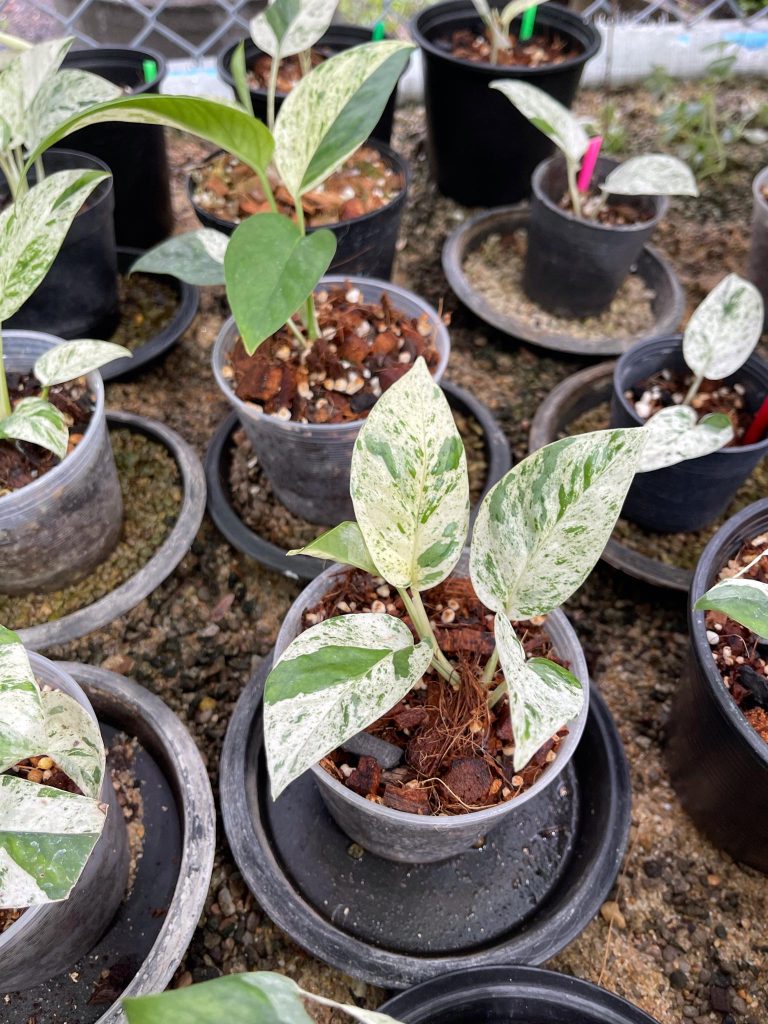
What is Epipremnum pinnatum Marble Variegated?
Epipremnum pinnatum is an accepted species in the Araceae family. Kew records a native range across tropical and subtropical Asia to the Pacific and describes a root climber of wet tropical habitats. The wild species is green; Marble Variegated is a cultivated trade form selected for mottling in its foliage.
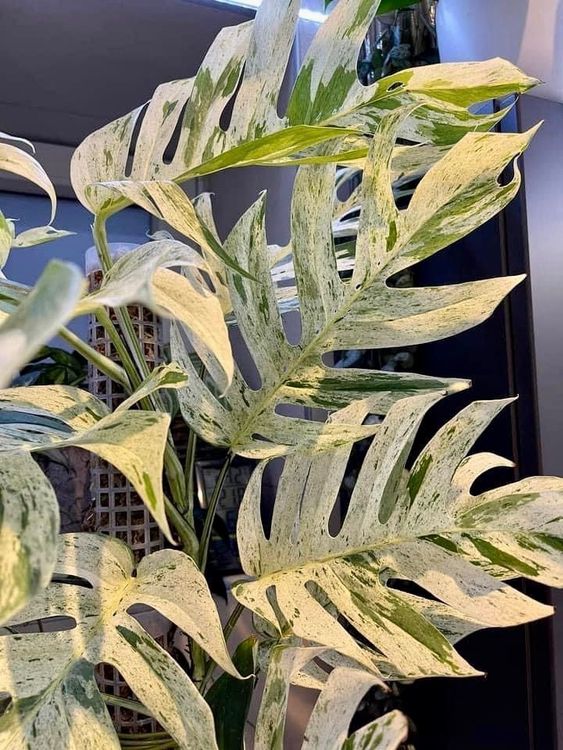
Juvenile leaves are usually entire and elongated. As a healthy vine climbs, the stem thickens, leaves increase in size, and mature blades can develop deep divisions and small perforations near the midrib. A small plant without splits is not automatically mislabeled. Juvenile stage, lack of support, weak light, recent propagation, and root stress can all delay mature traits.
Marble Variegated vs Albo: what is the useful difference?
Both names are used for variegated E. pinnatum, and seller terminology is not perfectly standardized. In practical listings:
Seller terminology varies, so let the exact plant—not the label—carry the claim.
| Listing term | Usually communicates | Evidence limit |
|---|---|---|
| Marble Variegated | Cream, pale-green and green mottling distributed through the blade | Pattern varies by node and leaf; one marbled leaf does not establish stability |
| Albo | Stronger white/cream sectors or blocks of contrast | Usage is not standardized; compare the exact plant and use the Albo care guide |
| Either form | A cultivated variegated E. pinnatum line | Light supports growth but does not manufacture or guarantee the next node’s pattern |
Compare the exact plant, stem, petiole, active growth point, and several consecutive leaves. If your interest is white-sector growth, read the separate Epipremnum pinnatum Albo care guide. Keeping these intents separate helps collectors choose the pattern they actually want and prevents two articles from giving the same generic advice under different names.
How to evaluate a plant before buying
- Photo type: confirm whether the photo is the exact plant, a representative specimen, or a batch.
- Rootedness: check whether it is a rooted potted plant, fresh cutting, or another propagation format.
- Growth point: look for an active, undamaged node rather than judging only the oldest display leaf.
- Green balance: a plant needs enough chlorophyll-bearing tissue to support new growth.
- Pattern history: review more than one leaf when possible; one highly marbled leaf does not establish stability.
A 10-plant order serves a different buyer from a single collector specimen. For a batch, ask about size consistency, rootedness, plant-to-plant variation, packing, documents, and how much acclimation space you have ready.
Light and the marble pattern
Use bright filtered light as the baseline. An east-facing window can be forgiving; beside a strong south- or west-facing window, add distance or a sheer curtain. Increase exposure gradually after shipping, especially if the plant has been in a dark box.
Appropriate light helps the green parts of a variegated leaf produce energy, but it cannot guarantee more cream on the next leaf. Long internodes and progressively smaller growth suggest the plant may need more usable light or a better climbing surface. Pale, dry patches on the window-facing side suggest heat or sun stress.
How to judge variegation and maturity advice
Use broad care advice as a prompt to inspect, not a prescription.
| Common claim | Useful core | Safer boundary |
|---|---|---|
| High light preserves cream | Green tissue needs enough usable light | Light cannot guarantee marbling and abrupt heat can scorch pale tissue |
| Dry 1–2 inches completely | Avoid continuous saturation | Check below the surface, pot weight, root mass and container depth |
| Moss pole triggers splits | Stable climbing supports progressive maturity | Support, roots, light, time and uninterrupted growth work together; no pole guarantees fenestration |
| Prune for a bushier plant | A cut can redirect growth to another viable node | Repeated cutting interrupts climbing maturity and does not guarantee more growing points |
Watering: inspect before you act
- Feel below the surface and compare the pot’s weight with its weight after watering.
- Check that drainage holes are open and the cachepot or saucer is empty.
- When the upper portion has dried and the pot is noticeably lighter, water the whole root ball.
- Let excess drain completely before returning the plant to its place.
Yellowing is not a command to water. A wet, heavy pot with soft roots points toward prolonged saturation; a very light pot, crisp mix, and loss of turgor point toward a dry-down. Diagnose the root zone before changing frequency.
Substrate and container
Build a mix with both moisture retention and coarse air spaces. A quality indoor potting base or coco-based medium can be combined with bark and pumice or perlite. In a humid, low-airflow room, use more coarse material. In a hot, fast-drying position, retain slightly more moisture.
Use a pot with free drainage and only modest extra space around the roots. Oversized pots leave a small root system surrounded by wet mix. Repot when the current medium compacts, drainage fails, or the root mass genuinely needs more room—not on a fixed calendar.
Temperature, humidity, and fertilizer
Keep the plant warm and protect it from cold glass, air-conditioning discharge, heater exhaust, and abrupt transitions. Moderate humidity can help new leaves open, but airflow and root health matter more than chasing an extreme number. Misting is brief surface wetting, not a durable humidity system.
Feed during active, healthy growth with a complete houseplant fertilizer used according to its label. Start conservatively after shipping or repotting. Fertilizer cannot repair roots damaged by saturation, cold, or low oxygen, and excess salts can show first as brown margins on pale tissue.
Support and mature leaf development
NC State Extension describes E. pinnatum as a climber that benefits from a stake or moss pole and can develop fenestrated mature foliage when allowed to climb. Attach the stem—not the movable leaf stalks—loosely to the support, and guide new aerial roots toward it.
Look for gradual progress: shorter internodes, a thicker stem, increasing leaf size, then deeper divisions. Changing poles every few weeks or repeatedly cutting the vine interrupts that sequence. A trailing plant can still be attractive, but it is less likely to show the mature architecture collectors associate with the species.
Propagation requires a node
A new vine develops from a stem node. A leaf and petiole without stem tissue may stay green temporarily but cannot produce continuing growth.
- Choose a healthy section with a clear node and, ideally, one leaf.
- Cut between nodes with a clean blade and keep track of the basal end.
- Root in water, lightly moist sphagnum, perlite, or another airy medium.
- Provide warmth, filtered light, and airflow; inspect the node instead of promising a fixed rooting date.
- Pot after a small branching root system develops, then keep conditions stable during transition.
Do not keep cutting a weak vine in an attempt to force a more marbled leaf. Preserve enough green tissue to support both the cutting and the parent plant.
Troubleshooting by visible pattern
Pair the leaf symptom with pot weight, roots, recent change and node history.
| Pattern | Check first | Do next |
|---|---|---|
| Yellow leaf + wet pot | Drainage, mix density and root firmness | Pause calendar watering; restore oxygen and remove only confirmed rot |
| Brown cream tissue | Direct sun, heat, abrupt dryness and fertilizer strength | Correct the measured stress; damaged tissue will not become green |
| Long internodes / small leaves | Usable light, roots and support continuity | Improve exposure gradually and secure new stem growth to support |
| Distorted new leaf | Thrips, mites, scale, mealybugs and root stress | Isolate and identify before treating |
| Greener new leaf | Several consecutive nodes and the active growth point | Observe the trend; one green energy-producing leaf is not an automatic cut |
Acclimating an imported plant or batch
Prepare a warm, filtered-light isolation area before delivery. Unpack promptly, photograph the parcel and plants, and inspect stems, growth points, roots, and moisture. If the roots and medium are stable, avoid combining repotting, strong fertilizer, intense light, and a sudden humidity drop on the first day.
For a batch, label plants and track them individually; variation in moisture and root mass means they may not all need the same intervention. Review Greenboog’s shipping information for preparation and evidence requirements, and use the Epipremnum collection to compare formats before ordering.

Pet and child safety
NC State Extension classifies Epipremnum pinnatum as harmful if ingested and identifies calcium oxalate crystals as the toxic principle. Keep the plant, trimmings, and propagation water away from pets and children. If chewing or swallowing occurs, contact a veterinarian or local poison service and provide the botanical name.
Frequently asked questions
Is Marble Variegated the same as Albo?
They are both trade names used for variegated E. pinnatum, but Marble usually describes distributed mottling while Albo usually emphasizes white or cream sectors. Always compare the exact plant because usage varies.
Will more light create more marbling?
No. Good light supports healthy growth but cannot guarantee the pattern of the next node. Increase light only within a range the pale tissue can tolerate.
Why are new leaves not split?
The plant may still be juvenile or recently propagated. Healthy roots, sufficient filtered light, vertical support, and uninterrupted climbing growth help mature features develop over time.
Can I propagate a marble leaf without a node?
No. A continuing vine requires a viable stem node. A node-less leaf may survive temporarily but cannot make a new growth point.
Should I repot immediately after delivery?
Only when the existing medium, drainage, or roots clearly require it. If the plant is stable, reduce simultaneous stresses and allow it to acclimate first.
Sources and review note
- Kew POWO: accepted species, native range, climbing habit and mature morphology
- NC State Extension: climbing support, propagation, pest/root-rot context and calcium-oxalate safety
Taxonomy and mature morphology were checked against Kew; horticultural support, propagation, pest, root-rot and safety context was checked against NC State Extension. Care ranges in this guide are treated as contextual starting points, not universal prescriptions.
