
Greenboog collector-to-climber guide
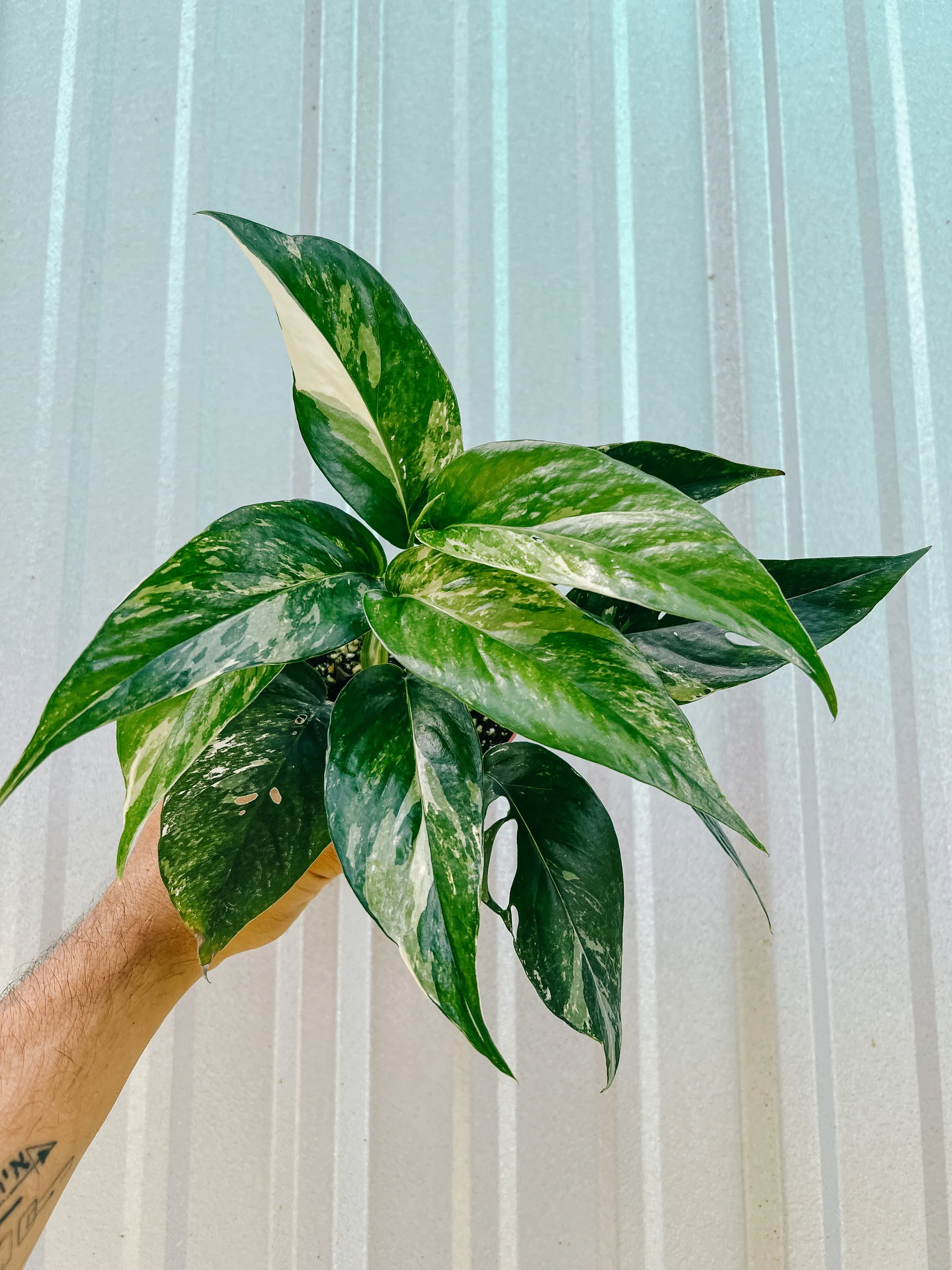
This guide is for collectors and owners who want to identify the correct species, protect chlorophyll-poor tissue, train a juvenile vine toward maturity, propagate a viable node and distinguish Albo from Marble Queen or other Epipremnum trade forms.
Use these as starting decisions, then adjust from the plant, pot and room.
| Factor | Start here | Adjust from evidence |
|---|---|---|
| Identity | Elongated juvenile leaves; white sectoring/marbling on an E. pinnatum vine | Compare stem, petiole, newest leaves and source—not the word Albo alone |
| Light | Bright filtered exposure introduced gradually | Track internodes, leaf size and scorch on pale sectors |
| Water | Thorough watering after suitable partial root-zone dry-down | Use deeper moisture, pot weight and root condition |
| Support | Stable plank, pole or comparable climbing surface | Maturity requires light, roots, attachment and time as well |
| Safety | Calcium-oxalate risk typical of Epipremnum | Keep plant and cuttings inaccessible to pets and children |
What is Epipremnum pinnatum Albo?
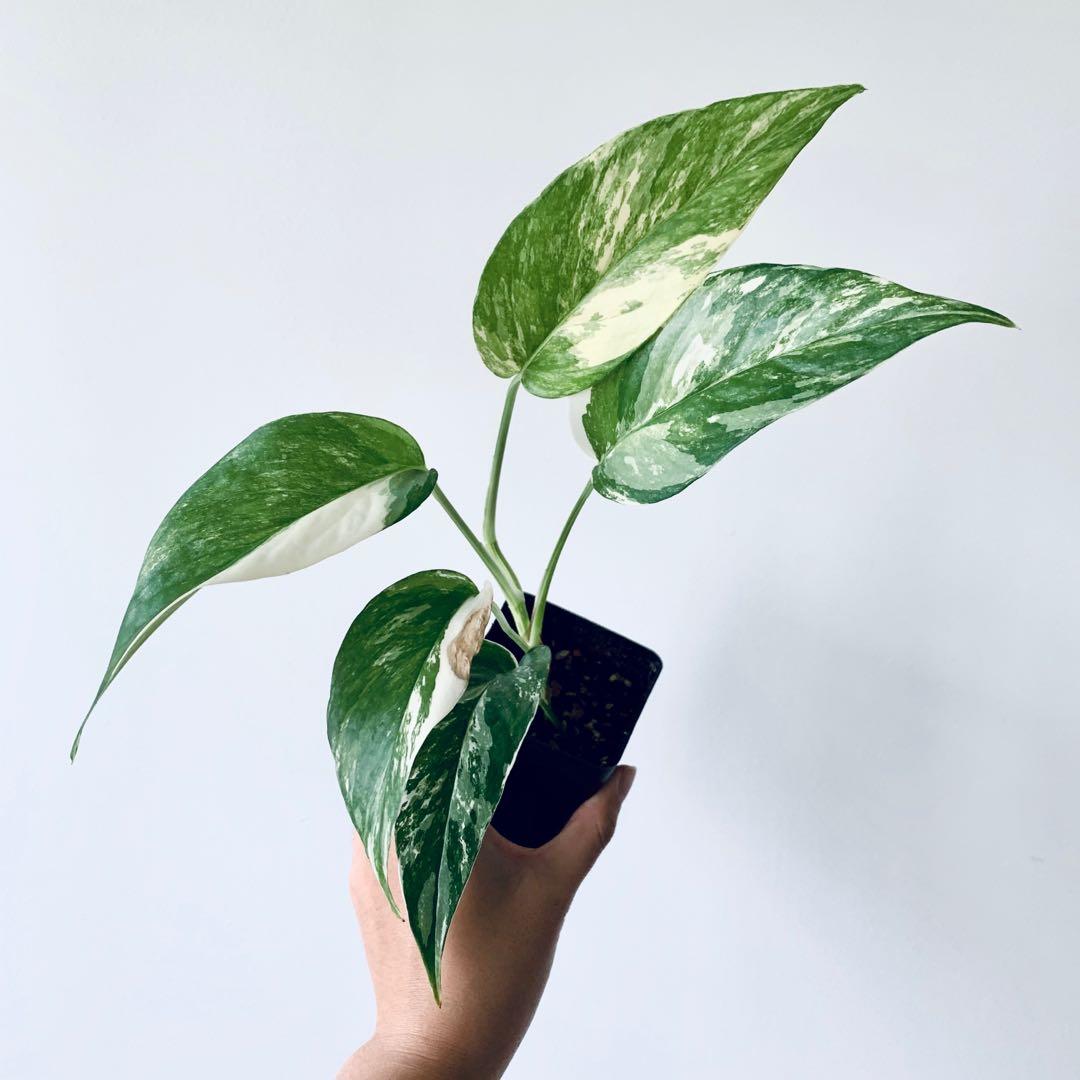
Epipremnum pinnatum is an accepted species in the Araceae family. Kew Plants of the World Online describes it as a climber native across tropical and subtropical Asia to the Pacific. ‘Albo-Variegata’ is a cultivated variegated form; NC State Extension lists it among the recognized cultivars of the species.
Young plants usually have entire, elongated leaves. As a vine climbs and matures, its leaves can become much larger and develop deep splits and small openings near the midrib. A juvenile plant without fenestrations is not necessarily mislabeled. Support, light, root health, and time all influence how quickly mature traits appear.
How to distinguish it from similar plants
Juvenile listings overlap. Compare botanical owner and growth sequence rather than one leaf.
| Plant or label | Useful clue | Why it is not enough |
|---|---|---|
| Marble Queen pothos | E. aureum; broader heart-shaped juvenile leaves with cream marbling | Young photos can hide leaf/stem differences |
| Golden pothos | E. aureum with common yellow/cream variegation | Trade names and lighting can distort color comparison |
| Cebu Blue | E. pinnatum cultivar with blue-green juvenile foliage | Species-level mature traits do not prove the Albo cultivar |
| Marble-variegated trade forms | May share white/cream marbling on elongated leaves | Verify actual plant, stem and source; labels are inconsistent |
Variegation can differ from leaf to leaf. A highly white leaf is visually striking but has less green tissue for photosynthesis. When choosing a plant, balanced green-and-white growth is usually a more practical target than the whitest possible leaf. See our Epipremnum varieties overview for more comparison context.
Protect roots and green tissue first; mature expression follows plant function.
| Factor | Useful direction | Change when |
|---|---|---|
| Light | Broad filtered exposure or suitable grow light | Internodes stretch, leaves shrink or white tissue scorches |
| Root zone | Airy particles with useful moisture in a draining pot | The core stays saturated or dries before roots use it |
| Warmth/air | Stable warmth away from cold glass and HVAC blast | Measured conditions or repeated new-leaf damage show a problem |
| Feeding | Complete fertilizer at/below label rate in active growth | Growth slows, roots are damaged or salts accumulate |
| Climbing | Attach internodes and guide aerial roots to a stable surface | Stem weight, pot stability or growth outpaces the support |
Light: support growth without scorching the white areas
Place the plant where it receives bright, filtered light for much of the day. An east-facing window is often forgiving. Near a stronger south- or west-facing window, use distance or a sheer curtain and watch the leaf temperature. Pale tissue can scorch before the green tissue shows damage.
Do not use light as a promise of future variegation. Brighter appropriate light helps the existing green portions support the plant, but it cannot guarantee how much white the next leaf will carry. If internodes stretch and new leaves remain small, the plant may need more usable light or a better climbing surface. If pale areas turn tan and crispy on the window-facing side, reduce direct exposure first.
Why precise Albo care recipes can mislead
Translate popular shorthand into an observable decision.
| Common advice | What it leaves out | Use it this way |
|---|---|---|
| Low light causes genetic reversion | Stem pattern, roots, identity and normal leaf variation | Improve usable light gradually; compare several nodes |
| Water after the top 1–2 inches dry | A dry surface can sit above a saturated core | Probe deeper, learn pot weight and water the full profile when ready |
| Use soil, perlite, bark and charcoal | Particle size and product composition vary | Build for aeration and useful moisture in the actual room |
| Climbing triggers fenestrations | Light, roots, attachment, maturity and time | Provide a vertical runway; treat splits as a response, not a guarantee |
| Water less in winter | Indoor growth may not follow calendar seasons | Let actual drying and growth determine frequency |
How to water without using a fixed schedule
- Feel below the surface rather than judging only the top few millimeters.
- Lift the pot and compare its weight with the weight just after watering.
- Check that drainage holes are open and the saucer is not holding water.
- When the upper portion has dried and the pot is noticeably lighter, water the whole root ball until excess drains.
A plant in a warm, bright, airy position may need water sooner than the same plant in a cool, dim room. Persistent wetness is the greater risk: oxygen-starved roots can decline, making the plant look thirsty even while the mix is wet. If leaves yellow while the pot remains heavy for many days, inspect drainage and roots before adding more water.
Substrate and pot choice
The root zone should hold some moisture while still admitting air. A useful starting mix combines a quality indoor potting base or coco-based medium with coarse bark and pumice or perlite. Change the proportions for your room: add more coarse material in a humid, slow-drying space; retain slightly more moisture in a hot, fast-drying one.
Use a pot only modestly larger than the root mass, with unobstructed drainage. A very large volume of wet mix around a small root system dries slowly. Repot because the roots and substrate need it—not simply because a certain number of months has passed.
Temperature, humidity, and feeding
Warm and stable conditions suit this tropical climber. Keep it away from air-conditioning discharge, cold glass, heaters, and abrupt moves between environments. Moderate humidity can help new leaves open cleanly, but constant root health and airflow matter more than creating a sealed, saturated space.
Misting is not a substitute for room humidity and leaves water on the foliage for only a short time. If your air is persistently dry, grouping plants or using a room humidifier with airflow is more predictable. Keep foliage clean enough to inspect for pests.
Feed during active growth with a complete houseplant fertilizer at the label rate appropriate for your product and medium. Start conservatively after shipping or repotting. If growth has stopped because roots are damaged, the room is cold, or light is weak, adding more fertilizer will not solve the underlying problem.
Support and mature leaf development
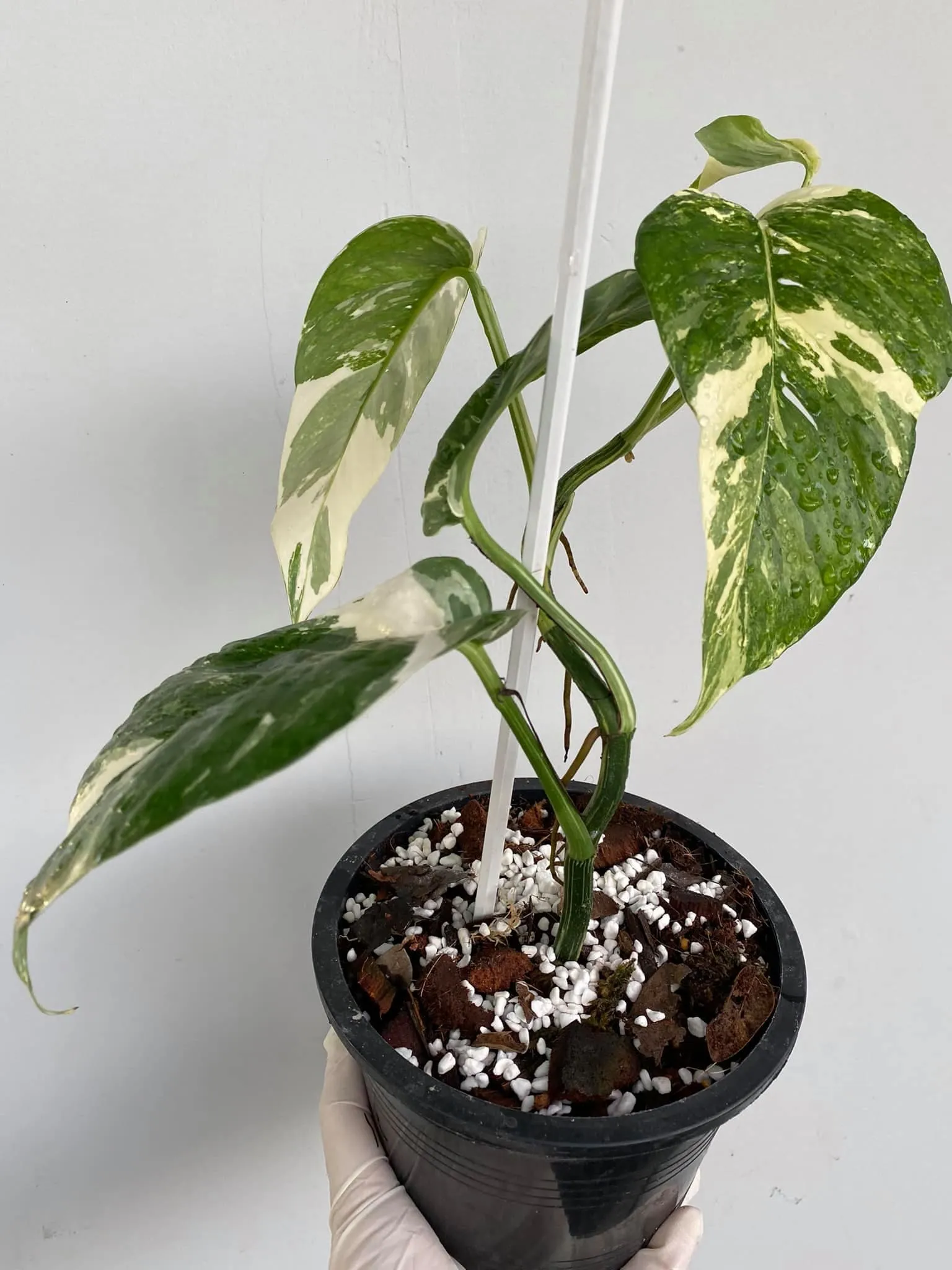
E. pinnatum is a root climber in nature. Indoors, guide the stem upward on a stake, plank, trellis, or moistable pole and secure it loosely without crushing the petioles. Aerial roots that engage with a surface help the vine maintain vertical growth.
Climbing does not produce mature leaves overnight. Look for a sequence: shorter internodes, a thicker stem, increasing leaf size, then progressively deeper divisions. A trailing basket can keep the plant attractive, but it is less likely to display the dramatic mature form many collectors expect.
How to propagate Epipremnum pinnatum Albo
A propagation cutting needs a node—the point on the stem where a leaf and aerial root or bud emerge. A detached leaf and petiole without stem tissue may remain green for a time but cannot make a new vine.
- Choose a healthy section with at least one clear node and, ideally, one leaf.
- Use a clean, sharp blade and cut between nodes. Keep track of which end is the base.
- Root the node in water, lightly moist sphagnum, perlite, or a similarly airy medium. Do not bury the leaf or keep the node waterlogged.
- Give it warmth, filtered light, and gentle airflow. Watch the cutting itself rather than following a fixed rooting deadline.
- Move it to an airy potting mix after it has developed a small, branching root system, then keep conditions stable while it adjusts.
Variegation on the parent leaf does not guarantee the pattern on every future leaf. Preserve a sensible amount of green tissue and avoid repeatedly cutting a weak plant merely to chase a whiter shoot.
Troubleshooting by symptom
Check the whole symptom pattern before changing several variables.
| What you see | Check first | Safer next step |
|---|---|---|
| Yellow leaves, heavy wet pot | Drainage, core moisture, roots and light | Inspect roots before watering or feeding again |
| Brown white sectors | Abrupt sun, hard dry-down, roots and salts | Correct measured stress; damaged tissue will not refill |
| Long internodes, small leaves | Usable light, support contact, roots and nutrition | Increase light gradually and rebuild the climb |
| Mostly green new leaves | Several nodes, stem pattern, light and roots | Stabilize care; do not cut from one leaf alone |
| Fine stippling/distortion | Mites, thrips, scale or mealybugs | Isolate, identify and use a treatment labeled for the site |
After shipping: acclimate before making major changes
Transit can temporarily soften leaves, dry aerial roots, or interrupt growth. Unpack promptly, photograph the plant and packaging, and inspect the roots and stem. If the medium is sound and the roots are stable, avoid combining repotting, fertilizing, very bright light, and a sudden humidity change on the first day.
Start with warm, filtered light and a protected place away from your established collection. Adjust one factor at a time and watch the newest growth. Review Greenboog’s shipping information before ordering so you understand preparation, documentation, and what evidence to keep if a parcel arrives with a problem.
Pet and child safety
NC State Extension classifies Epipremnum pinnatum as harmful if ingested and identifies calcium oxalate crystals as the toxic principle. Keep cuttings, fallen leaves, and the growing plant away from pets and children. If a pet chews the plant, contact a veterinarian promptly; the ASPCA Poison Control guidance describes oral irritation, drooling, vomiting, and difficulty swallowing associated with insoluble calcium oxalates.
Frequently asked questions
Can Epipremnum pinnatum Albo grow in low light?
It may persist in lower light, but growth can become sparse and small, and a heavily variegated plant has less chlorophyll available than an all-green one. Bright filtered light is the more reliable position.
Why are only the white parts turning brown?
White tissue is more delicate. Direct sun, a strong dry-down, root stress, or excess salts may show there first. Check the pattern and recent care change before assuming humidity is the only cause.
Will a moss pole make the leaves split?
A suitable climbing surface supports the plant’s mature growth habit, but it is not an instant switch. Consistent light, healthy roots, active attachment, and time are also required.
Should I cut off an all-green leaf?
Not automatically. One greener leaf can help power the plant. Watch several nodes and the active growth point before pruning, and avoid removing so much green tissue that the remaining vine cannot sustain itself.
Is Epipremnum pinnatum Albo the same as a Marble Queen pothos?
No. Marble Queen is a cultivar of Epipremnum aureum; Albo-Variegata belongs to Epipremnum pinnatum. Their juvenile foliage and variegation can look similar in listings, so confirm the botanical name and compare mature traits.
Sources and review note
Taxonomy and morphology were checked against Kew Plants of the World Online. Cultivar, care, propagation, pest, and toxicity details were checked against NC State Extension. Pet poison-control context was checked against the ASPCA. This article was reviewed and updated on August 16, 2026; care should still be adjusted to the plant, pot, and room in front of you.
