
Greenboog taxonomy guide
A practical map for reading Colocasia names without confusing accepted taxonomy, horticultural selections and commercial labels.
Three kinds of names, three kinds of evidence
| Name type | What it can support | What it cannot prove |
|---|---|---|
| Accepted botanical name | A taxonomic treatment such as Kew POWO’s accepted genus/species record. | That a particular unlabeled plant, photo or retail item has that identity. |
| Cultivar name | A selected cultivated clone or horticultural line when documented by its originator or authoritative register. | A different plant’s parentage, food use or current inventory. |
| Trade or seller label | How that seller describes a listing at a point in time. | Accepted taxonomy, origin, rarity, legality or availability elsewhere. |
Use Kew POWO for accepted taxonomy
Kew’s Plants of the World Online treats Colocasia Schott as an accepted genus and provides its current accepted-species list. Kew’s record for Colocasia esculenta is the appropriate starting point for the plant commonly called taro in many contexts.
Taxonomy can change as evidence changes. A current accepted database is stronger than an old care article, marketplace copy or social-media post. If a familiar name is listed as a synonym, report it as a synonym rather than presenting it as another accepted species. For example, Kew’s treatment matters more than a nursery name when comparing historical combinations.
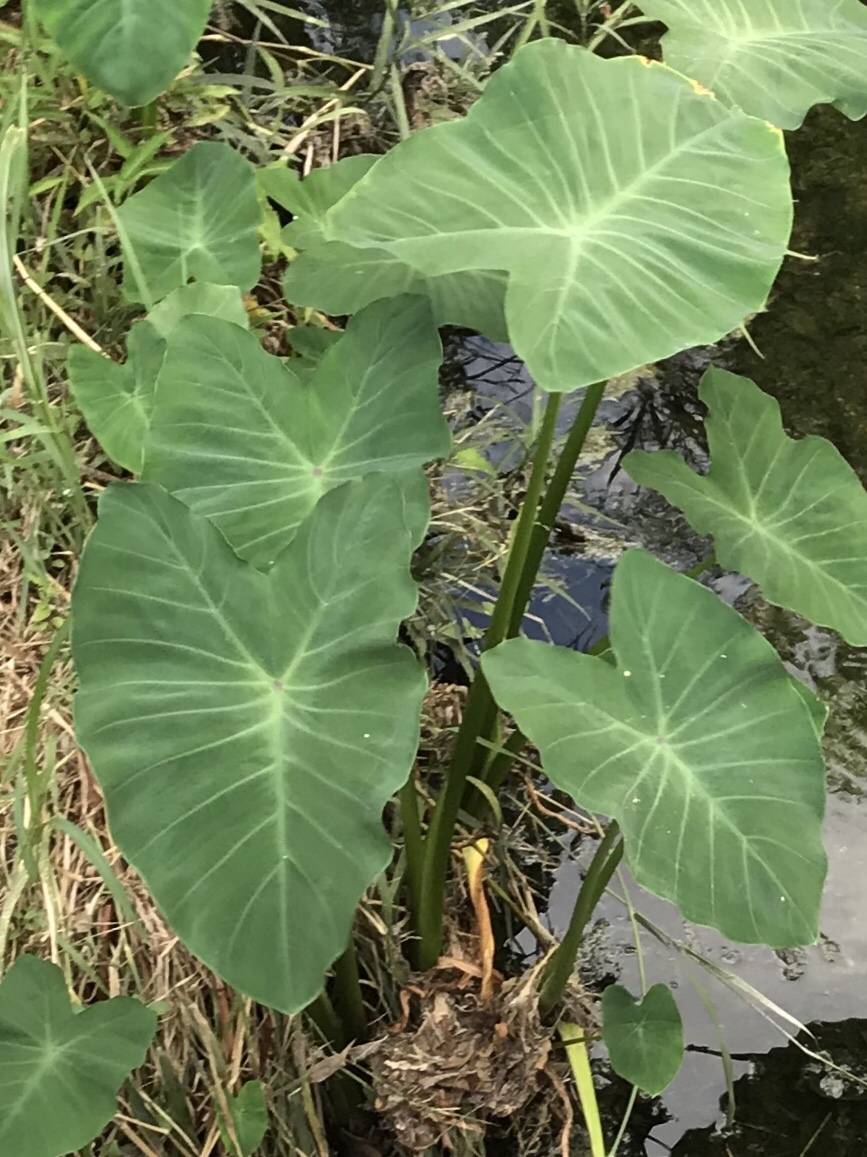
A common name or leaf photo is not a taxonomic determination. Closely related aroids and ornamental selections can overlap in appearance. Keep the plant label, whole-plant observations and provenance with the record you are comparing; do not use taxonomy as a shortcut to food suitability or commerce claims.
Species, cultivars and food names
A species name is not a menu instruction, and a food name is not a cultivar register. The Pacific Food Guide from the University of Hawaiʻi describes multiple taro crops used in Pacific food contexts. Those crop and culinary terms need their own place-specific sources. Use the taro preparation guide only for documented food material and established methods; do not infer edibility from a genus or ornamental label.
Likewise, a cultivar name can be useful for comparison but should remain inside its evidence boundary. A name may be missing, misspelled, applied inconsistently, or used as marketing copy. When the identity affects quarantine, invasive-plant, food or collection decisions, pause and obtain a source that addresses the exact plant and location.
How to verify a Colocasia label
- Record the label exactly, including punctuation and any cultivar quotation marks.
- Separate the genus/species portion from a cultivar or seller description.
- Check current accepted taxonomy in Kew POWO.
- Compare whole-plant traits and provenance; do not rely on one edited photo.
- Keep food use, plant care, local rules and purchase availability as separate questions.
FAQ
How many Colocasia species are accepted?
Kew POWO provides the current accepted list. Use its live record rather than repeating a fixed count, because taxonomic treatments can be updated.
Is a cultivar the same as a species?
No. A cultivar is a cultivated selection; it is not automatically a separate botanical species.
Can a trade label confirm that a plant is edible?
No. Food suitability needs identified food-use material and an appropriate preparation source, not a seller label.
Sources used: Kew Plants of the World Online for current Colocasia and C. esculenta taxonomy; University of Hawaiʻi CTAHR Pacific Food Guide for food-context boundaries. Accessed 2026-08-27.

2 thoughts on “Colocasia Species and Cultivars: A Name-Reading Guide”