
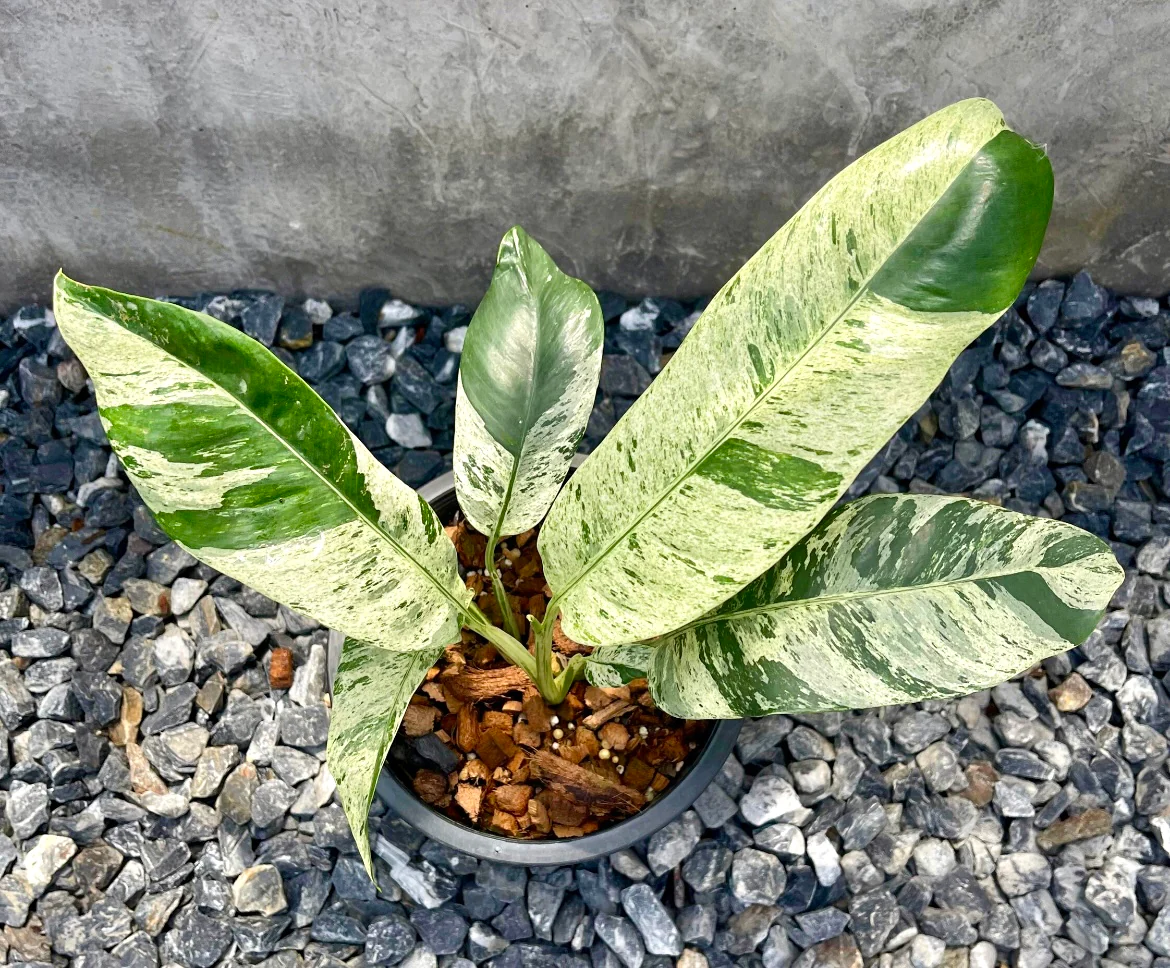
Greenboog giant Epipremnum field guide
This guide is for collectors and buyers who need to separate botanical identity from trade labels, keep variegated tissue healthy and choose between an established potted plant and a much younger tissue-culture plantlet.
Start here, then adjust to root volume, light, temperature and growth stage.
| Decision | Practical starting point | Adjust when |
|---|---|---|
| Light | Bright, indirect or filtered light | Internodes stretch or pale sectors heat and crisp |
| Water | Soak fully after the upper rooted mix dries and the pot lightens | Roots, season, light or container depth change dry-down |
| Root zone | Aerated aroid mix in a freely draining pot | The mix stays wet too long or dries before roots can use it |
| Support | Rigid plank, pole or trellis installed early | Stem and leaves outgrow the original anchor |
| Sale format | Match care to established plant or acclimating plantlet | Roots and normal-room growth become established |
What is Epipremnum giganteum?
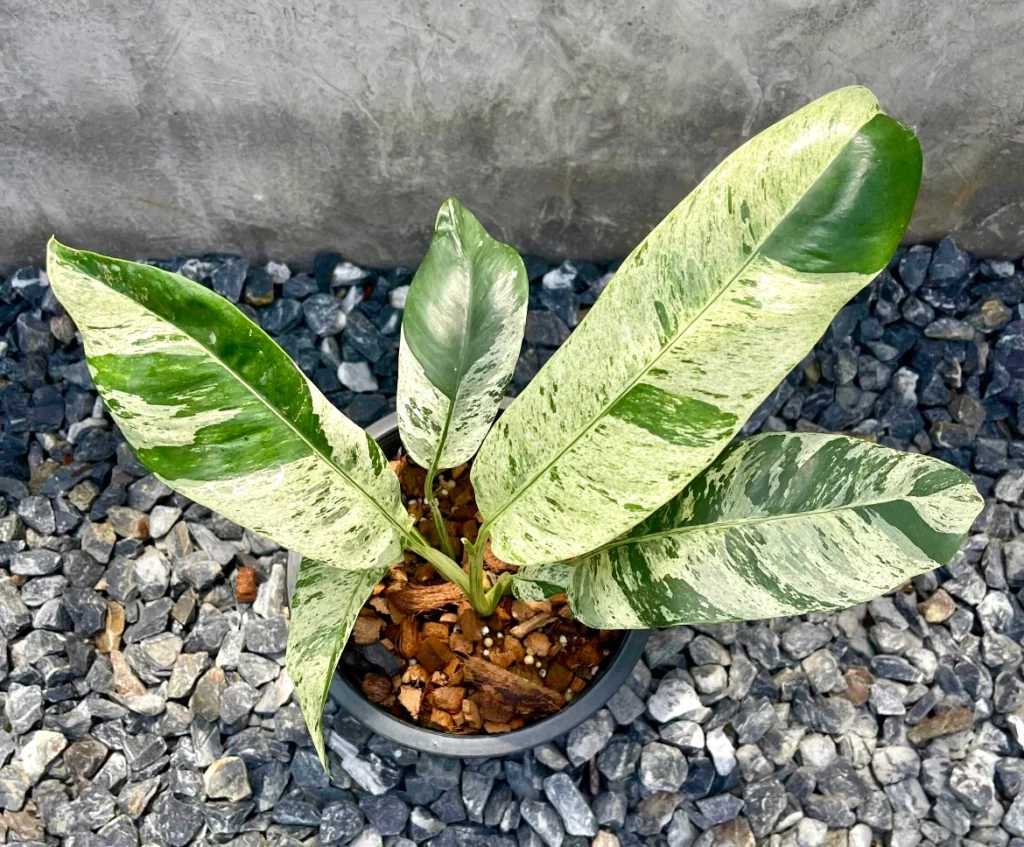
Epipremnum giganteum is an accepted species in the Araceae family. Kew records its native range from Indo-China to Malaya and describes it as a wet-tropical climber. Singapore’s NParks Flora & Fauna Web describes a root climber with a thick stem and large, leathery, elliptic-to-lanceolate leaves with an undulating margin.
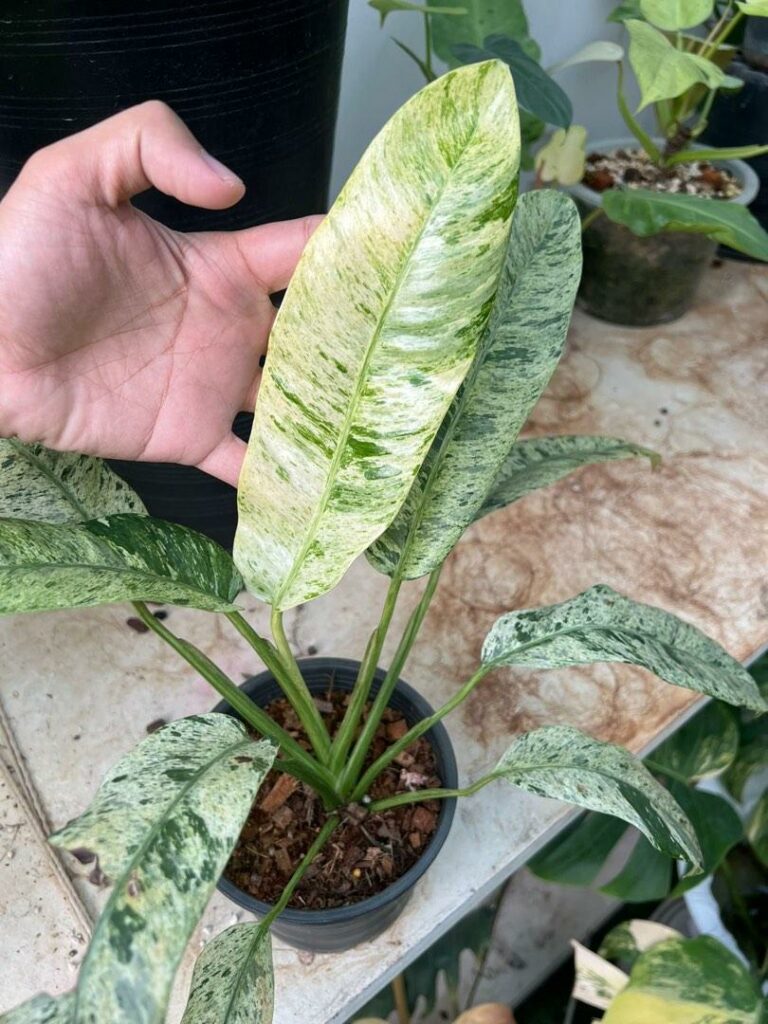
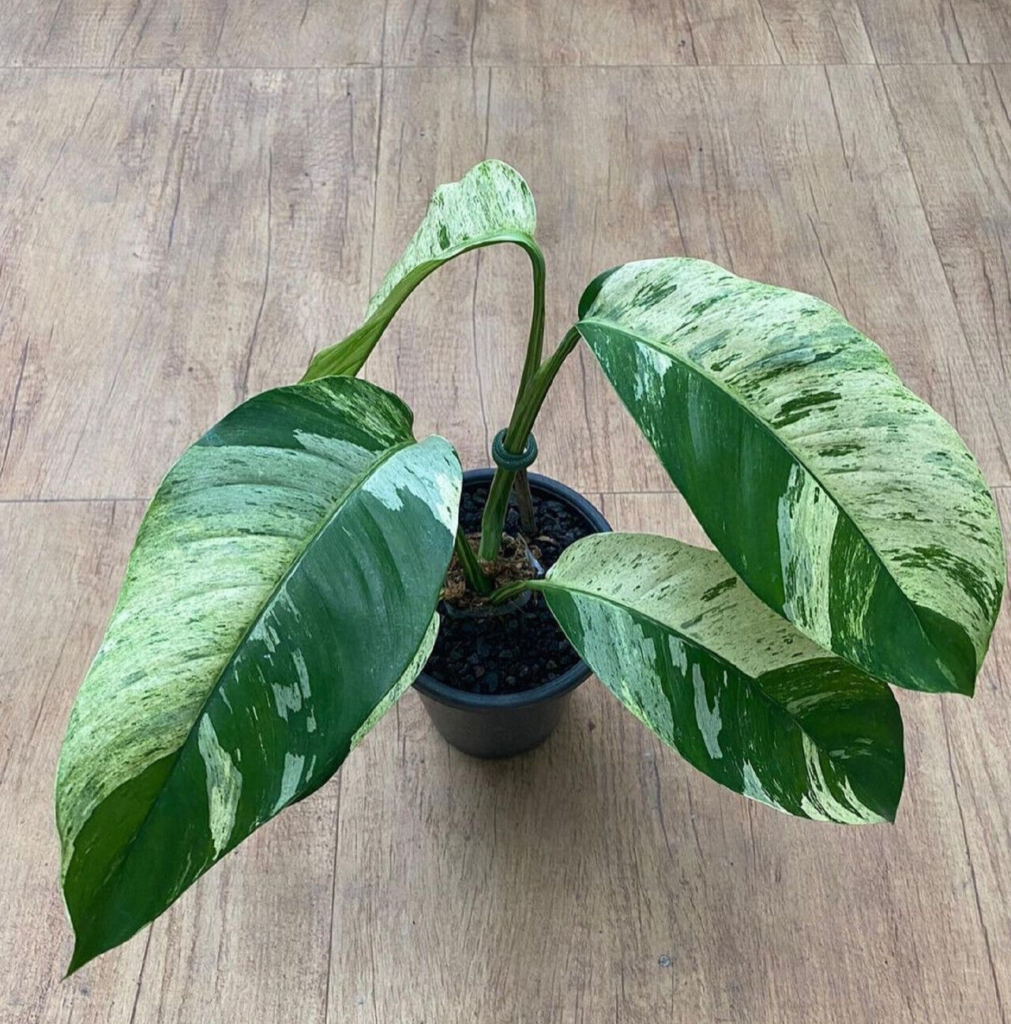
The green species is the botanical baseline. Variegated plants in cultivation carry areas with less chlorophyll, which may appear cream, yellow, pale green, or white depending on the clone and leaf. The pattern can change from one node to the next. Judge identity from the whole plant—stem, petiole, leaf shape, venation, growth point, and several consecutive leaves—not from a single dramatic sector.
Epipremnum giganteum vs Philodendron giganteum
These are different accepted species in different genera. Epipremnum giganteum is native to Southeast Asia and forms an aerial-rooted climber with elongated, leathery blades. Philodendron giganteum is native from the Caribbean to northern South America and has much broader cordate-ovate leaves with a pronounced basal sinus.
A marketplace label such as “giganteum variegated” is incomplete. Confirm the genus, botanical name, format, and photos before comparing prices or care advice. If a listing shows only a close crop of one leaf, ask for the stem and growth point as well.
What variegation labels do—and do not—tell you
- Marble: usually describes mottling distributed across the blade.
- Half-moon: describes a leaf with a large pale sector on roughly one side; it does not promise that the next leaf will repeat the division.
- Tricolor: usually points to three visible tones, such as dark green, pale green or yellow, and cream.
- Albo: is commonly used for white or cream variegation, but usage is not perfectly standardized between sellers.
For a plant intended to grow long term, a balanced amount of green tissue is more useful than maximum white on one leaf. Ask whether the listing photo is the exact plant, a representative example, or a batch. Then check rootedness, active growth, and the pattern visible on the stem near the growth point.
Light: enough energy without bleaching the pale tissue
Start with bright, indirect light. Gentle morning sun may work after gradual acclimation, while concentrated midday sun through glass can overheat pale sections. If an imported or shipped plant has spent days in a box, increase light in stages instead of moving it immediately to the brightest position.
Light supports growth; it does not manufacture a particular variegation pattern. Long internodes, smaller new leaves, and weak orientation toward a window can indicate too little usable light. Tan, crisp patches limited to pale sectors—especially on the window-facing side—suggest excess heat or light. The UF/IFAS Epipremnum guide similarly notes that low light can reduce leaf size and variegation in cultivated Epipremnum, while excessive light or heat can burn variegated tissue.
Why fixed care ranges can mislead
Translate broad advice into an observable decision.
| Common advice | Useful core | Safer adjustment |
|---|---|---|
| Dry the top few centimeters | Avoid continuous saturation | Check pot weight and moisture through the rooted zone; the same depth means different things in shallow and deep pots |
| Keep 18–27°C | Protect a tropical climber from cold stress | Prioritize stable warmth and observe slower water use whenever temperature and light fall |
| Raise humidity | Tender new leaves can open better in stable air | Do not use humidity to compensate for cold, failed roots, stagnant air or a saturated mix |
| Add a moss pole | A root climber benefits from vertical contact | Choose any rigid scalable support; support helps maturity but does not guarantee a leaf size or pattern |
Water by root-zone condition, not by weekday
- Feel below the dry surface and lift the pot to judge how much water remains.
- Check the newest growth and root condition rather than reacting to one old yellow leaf.
- When the upper portion has dried and the pot is lighter, water thoroughly until excess drains.
- Empty the saucer or cachepot; do not leave the nursery pot standing in runoff.
A warm, well-rooted plant in strong filtered light can use water quickly. A newly imported specimen in a large, dense pot may stay wet far longer. Yellow leaves can result from both prolonged saturation and a severe dry-down, so inspect the root zone before changing the routine.
Substrate, pot, and repotting
Use a mix that holds some moisture but still contains large air spaces. A practical base can combine indoor potting medium or coco-based substrate with coarse bark and pumice or perlite. Adjust the ratio to the room and container: increase coarse material when the mix dries slowly; retain a little more moisture when heat and airflow are high.
Choose a pot with open drainage only modestly larger than the root mass. A huge volume of wet substrate around a small root system increases the risk of oxygen loss. Repot when roots, drainage, or decomposed mix justify it—not because a fixed number of months has passed.
Temperature, humidity, airflow, and feeding
Keep the plant warm and avoid air-conditioning discharge, cold glass, heater exhaust, and abrupt environmental changes. Moderate humidity helps tender new leaves open, but high humidity without airflow can leave the plant and substrate wet for too long. Misting changes humidity only briefly and is not a substitute for managing the room.
Feed only a healthy, actively growing plant. Use a complete fertilizer according to its label and start conservatively after shipping, repotting, or root disturbance. More fertilizer will not correct cold roots, low light, or rot, and excess salts can damage pale tissue and stressed roots.
Support and space for mature growth
This species is a substantial root climber, not a compact tabletop pothos. Provide a support early and secure the stem loosely, leaving petioles free to move. A plank, rigid pole, or strong trellis is easier to scale than a thin stake once the stem and leaves gain weight.
Expect increasing leaf size, stronger texture, more prominent venation, and a thicker stem as the plant establishes. Unlike E. pinnatum, deep split leaves are not the main identification goal for E. giganteum; its large, entire, often undulating blades are the defining display.
How to propagate Epipremnum giganteum Variegated
Every cutting needs a viable node. A leaf and petiole without stem tissue may remain alive temporarily but cannot produce a new vine.
- Select a healthy stem section with a visible node, growth eye, and preferably one leaf.
- Cut between nodes with a clean, sharp blade and mark the basal end.
- Root the node in water, lightly moist sphagnum, perlite, or another airy medium. Keep the node moist, not buried in stagnant water.
- Provide warmth, filtered light, and airflow. Inspect for rot instead of following a guaranteed rooting deadline.
- Transfer after a small branching root system develops, then stabilize light and moisture while the cutting adjusts.
A variegated parent can still produce leaves with more or less color. Preserve enough green tissue to support the cutting, and do not repeatedly cut a weak plant just to chase a whiter growth point.
Troubleshooting by symptom
| Pattern | Check first | Next action |
|---|---|---|
| Yellow leaf + heavy pot | Drainage, mix density and dark or soft roots | Pause routine watering and restore root-zone oxygen after diagnosing the cause |
| Crisp pale sectors | Recent sun, hot glass, dry-down and fertilizer salts | Prevent the next injury; damaged tissue will not recolor |
| Small leaves + long internodes | Usable light and stem contact with support | Increase filtered light gradually and stabilize the climb |
| Scarred new growth | Thrips, mites, scale or mealybugs around the unfurling leaf | Isolate, identify and use a treatment labeled for the confirmed pest |
| One greener leaf | Several nodes and overall plant energy | Observe before cutting; a green leaf can help a highly variegated plant recover |
Potted plant or tissue culture?
A rooted potted plant is the simpler option for a collector who wants established foliage and a shorter acclimation path. A tissue-culture plantlet can be an efficient way to obtain a clone, but it arrives at a much earlier stage and needs a controlled transition from sterile, humid culture to an aerated substrate and normal room conditions.
Do not apply mature-plant care to a fresh plantlet. Prepare the container, clean tools, substrate, light, and humidity transition before opening it. Whichever format you choose, review the shipping information, photograph the parcel on arrival, and avoid stacking repotting, strong fertilizer, intense light, and a sudden humidity drop on the same day. The broader Epipremnum collection lets you compare other species and formats.
Choose the format that matches your acclimation experience and timeline.
| Format | Best for | Main constraint |
|---|---|---|
| Rooted potted plant | Collectors wanting established foliage and a shorter acclimation path | Shipping stress still changes light and water use; inspect before repotting |
| Tissue-culture plantlet | Growers prepared for a staged humidity, light and substrate transition | Juvenile roots and leaves cannot follow mature-plant care on day one |
Safety around pets and children
Treat Epipremnum foliage as unsafe to chew or swallow and keep plants, cuttings, and fallen leaves away from pets and young children. Species-specific veterinary guidance for E. giganteum is limited, so this is a precaution rather than a diagnosis. If exposure occurs, contact a veterinarian or local poison service and provide the botanical name and a photo of the plant.
Frequently asked questions
Is Epipremnum giganteum Variegated a Philodendron?
No. Epipremnum giganteum and Philodendron giganteum are separate accepted species in different genera and from different native regions.
Will every new leaf have the same variegation?
No. Pattern and color can vary by node and leaf. Light supports the green tissue but does not guarantee a half-moon, marble, or tricolor pattern.
Can I grow it in low light?
A green plant may tolerate lower light, but a variegated specimen has less photosynthetic tissue. In weak light, growth and leaf size can decline. Bright filtered light is a more reliable target.
Why is my plant not producing giant leaves?
Check whether it is actively climbing, receiving enough usable light, and maintaining healthy roots. Leaf size develops over a sequence of growth; a recently propagated or shipped plant needs time to establish.
Should I repot immediately after delivery?
Not if the roots and medium are stable. Inspect first, then change only what is necessary. Repot promptly only when the medium is failing, drainage is blocked, or roots are clearly compromised.
Sources and review note
Taxonomy and native range were checked against Kew Plants of the World Online. Exact-species morphology and cultivation context were checked against NParks Singapore. General Epipremnum propagation, media, shipping, and symptom guidance was checked against UF/IFAS and applied cautiously because that publication focuses on cultivated E. aureum. This article was reviewed and updated on August 23, 2026.
