
Epipremnum collector guide
Yellow Flame is bought for its yellow-green marbling and the promise of a bolder climbing leaf form. The useful question is not whether every leaf matches a perfect photo—it is whether the plant’s identity, growth point, roots and current pattern match the evidence you are buying.
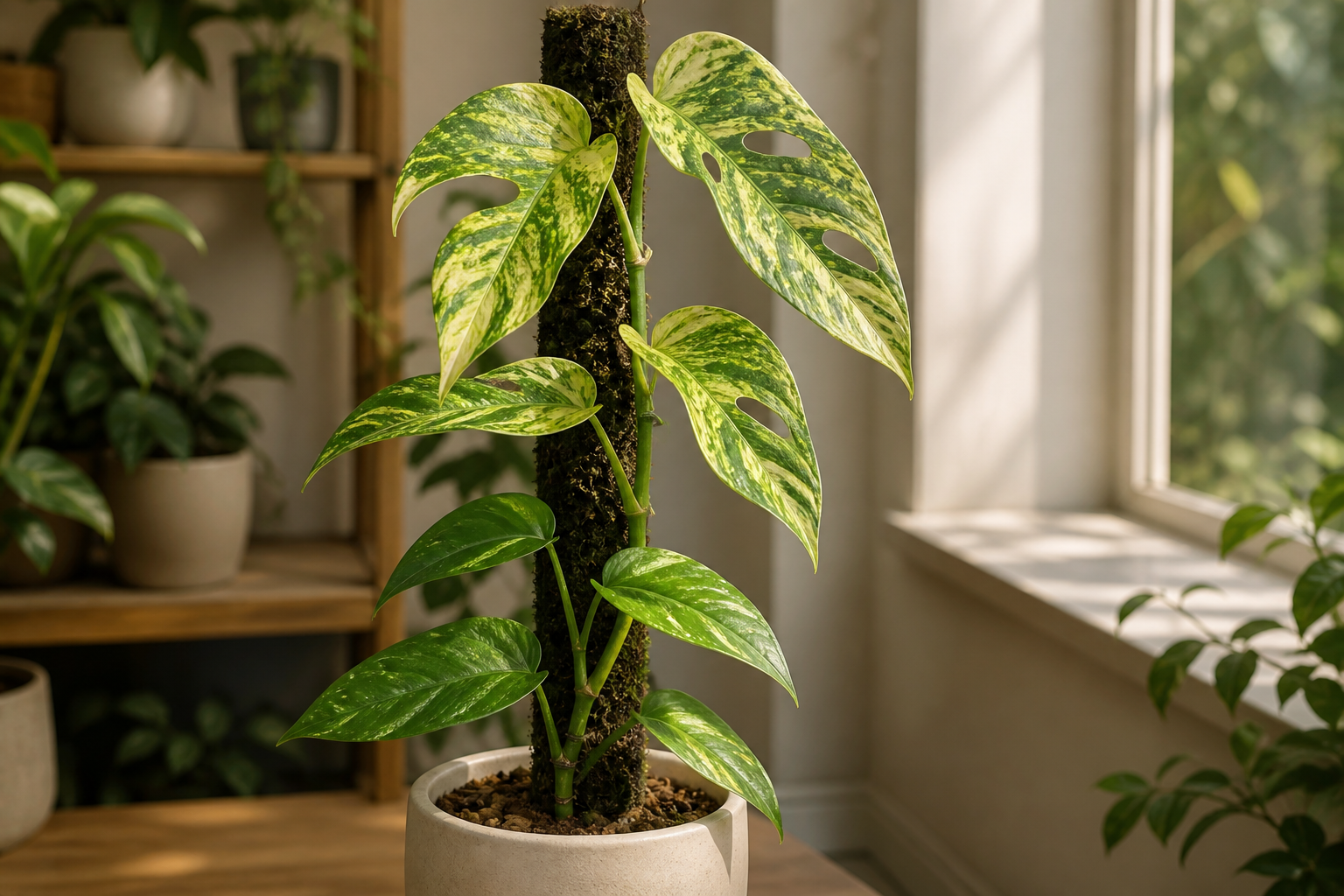
- Epipremnum is the genus of climbing aroids.
- Epipremnum pinnatum is the accepted species; Kew records a broad native range from tropical and subtropical Asia into the Pacific.
- Yellow Flame is the commercial selection name. “Golden Flame” also appears in trade, but a seller’s label is not a formal proof that every line sold under both names has identical provenance.
Yellow Flame, Golden Flame and Golden Pothos are not the same label
Common names are useful for shopping and unreliable for taxonomy. “Pothos” is applied broadly in horticulture, while “golden” and “flame” describe appearance. That creates a predictable mix-up between Yellow Flame and the much more familiar Golden Pothos.
| Listing name | What it usually indicates | What still needs proof |
|---|---|---|
| Yellow Flame | A yellow-variegated E. pinnatum selection. | Actual plant, roots, current pattern, size and seller lineage. |
| Golden Flame | A trade-name variant sometimes used for Yellow Flame material. | Whether a specific seller treats the names as the same line. |
| Golden Pothos | Epipremnum aureum, a different accepted species. | Cultivar and grade, especially in mixed or juvenile lots. |
| Monstera | A separate aroid genus that can also produce fenestrated leaves. | Genus-level identity; a split leaf alone is not diagnostic. |
What a photographed Yellow Flame can show
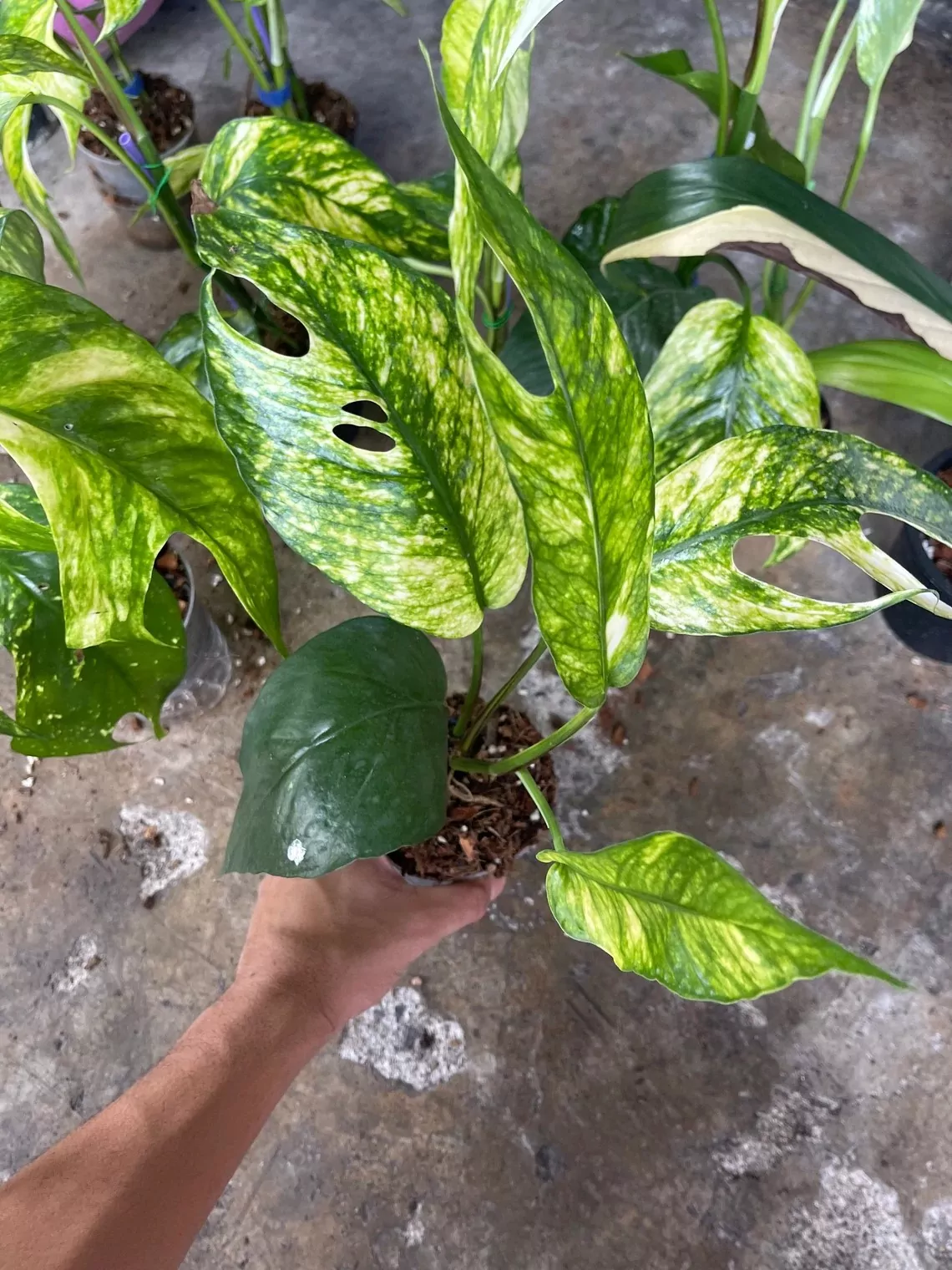
The authentic Greenboog nursery photograph below shows the traits a buyer can inspect: an elongated climbing leaf, irregular yellow-to-lime marbling, green tissue, nodes and more mature fenestration. It documents one plant at one time. It cannot guarantee that another plant will carry the same yellow ratio or reach the same leaf shape on a schedule.
Juvenile leaves do not predict a fixed maturation date
A young E. pinnatum may have entire, narrower leaves. As a healthy shoot climbs and establishes against a support, successive leaves can become larger and may develop splits or fenestrations. Age alone is not the switch: support contact, root capacity, light, temperature and uninterrupted growth all influence the result.
A moss pole is a growth tool, not decoration. Secure the stem without crushing the petiole, keep the active growth point facing the support and guide aerial roots toward a surface they can contact. A vine trailing away from support may remain healthy while producing smaller, less mature-looking foliage.
| Current evidence | Reasonable interpretation | Useful next step |
|---|---|---|
| Small entire leaves | Juvenile or recently reset growth; not proof of a different plant. | Confirm stem/node traits and give the vine stable support. |
| Larger leaves, no splits yet | The shoot may be building capacity but has not expressed mature form. | Keep conditions steady; do not force growth with excess feed. |
| Fenestrated upper leaves | A more mature climbing expression on that shoot. | Preserve support contact and avoid cutting back solely for propagation. |
| New leaf mostly green | One green-dominant leaf is a pattern observation, not a genetic diagnosis. | Photograph the stem and several sequential leaves before acting. |
Buyer checklist: judge the plant, not the best photograph
- Botanical label: look for Epipremnum pinnatum, not only a common name.
- Photo scope: ask whether the image is the exact plant, a representative lot or a mature reference.
- Viable structure: confirm a stem with at least one healthy node and growth point; a leaf alone cannot make a new vine.
- Root condition: firm active roots matter more than a dramatic single leaf.
- Current pattern: inspect several leaves and the stem rather than asking for a guaranteed percentage of yellow.
- Format and support: pot size, rooted cutting versus established vine, and current support change the value and recovery time.
- Arrival evidence: photograph the unopened package, roots, leaves and label before trimming transit damage.
For the exact item Greenboog currently offers, use the live Epipremnum Yellow Flame product page. Its images, size statement, price and stock should take priority over an evergreen care article.
Care follows the root zone and growth signal
Light and pattern visibility
Use bright filtered light and avoid an abrupt move into direct sun. Light can affect leaf size, internode length and how strongly a pattern appears, but it does not let you read or rewrite the plant’s genotype. Pale yellow tissue often has less photosynthetic capacity and can be less forgiving of heat or light shock.
Water and substrate
Choose a substrate that holds usable moisture while leaving air around the roots. Water thoroughly, allow drainage and recheck the root zone rather than following a fixed weekday. A small cutting in a large wet pot, or compact media that stays saturated, creates a different risk from an established vine using water quickly.
Temperature, humidity and support
Keep temperature and airflow stable enough that the root system can replace water lost by the leaves. Higher humidity can slow water loss, but it does not repair oxygen-poor media or eliminate bacterial and fungal risk. Support the climbing shoot early so it does not need a disruptive reset after the stem hardens.
Feeding
Feed only when the plant is rooted and producing active growth. Begin with a label-compliant conservative concentration suitable for young container plants, then watch new leaves, root tips and media salt buildup. More fertilizer cannot compensate for weak roots, insufficient light or chronically wet substrate.
Use symptoms to choose the next check
| Symptom | Check first | Avoid |
|---|---|---|
| Long internodes, smaller new leaves | Light at leaf level, support contact, root capacity and recent disturbance. | Treating fertilizer as the only solution. |
| Brown cream/yellow margin | Abrupt sun, heat, dry root zone, low humidity transition and salts. | Calling every brown edge fungal disease. |
| Whole leaf yellowing | Leaf age, root oxygen, watering history, temperature and pests. | Watering again before checking the root zone. |
| Wilt while media is wet | Root firmness, odor, pot drainage and stem base. | Adding fertilizer to a compromised root system. |
| Water-soaked or expanding spots | Isolation, leaf wetness, airflow, transit injury and lesion spread. | Diagnosing from color alone or misting more. |
Choose the correct Greenboog route
This guide answers identity and care questions. For current price, format and availability, return to the Yellow Flame listing. To compare related vines, browse the Epipremnum collection. If the concern is whether a pale or green-dominant leaf represents a trend, use the variegation evidence guide and apply its multi-leaf record method.
Sources and evidence boundaries
- Kew Plants of the World Online: Epipremnum pinnatum — accepted species, climbing habit and native range.
- UF/IFAS: Pothos Production Guide — container-production principles for E. aureum, not a Yellow Flame cultivar protocol.
- UF/IFAS: Pothos Diseases — differential-diagnosis principles for E. aureum, not an individual diagnosis.
Evidence limit: no authoritative cultivar registration or breeder record was located for Yellow Flame. Species-level distribution and general Epipremnum production guidance cannot establish cultivar lineage, guarantee variegation or predict when one plant will fenestrate.
