
Greenboog trade-label comparison
This page owns the label comparison and purchase checks. The separate species guide owns general A. veitchii identity and care.
The accepted species boundary
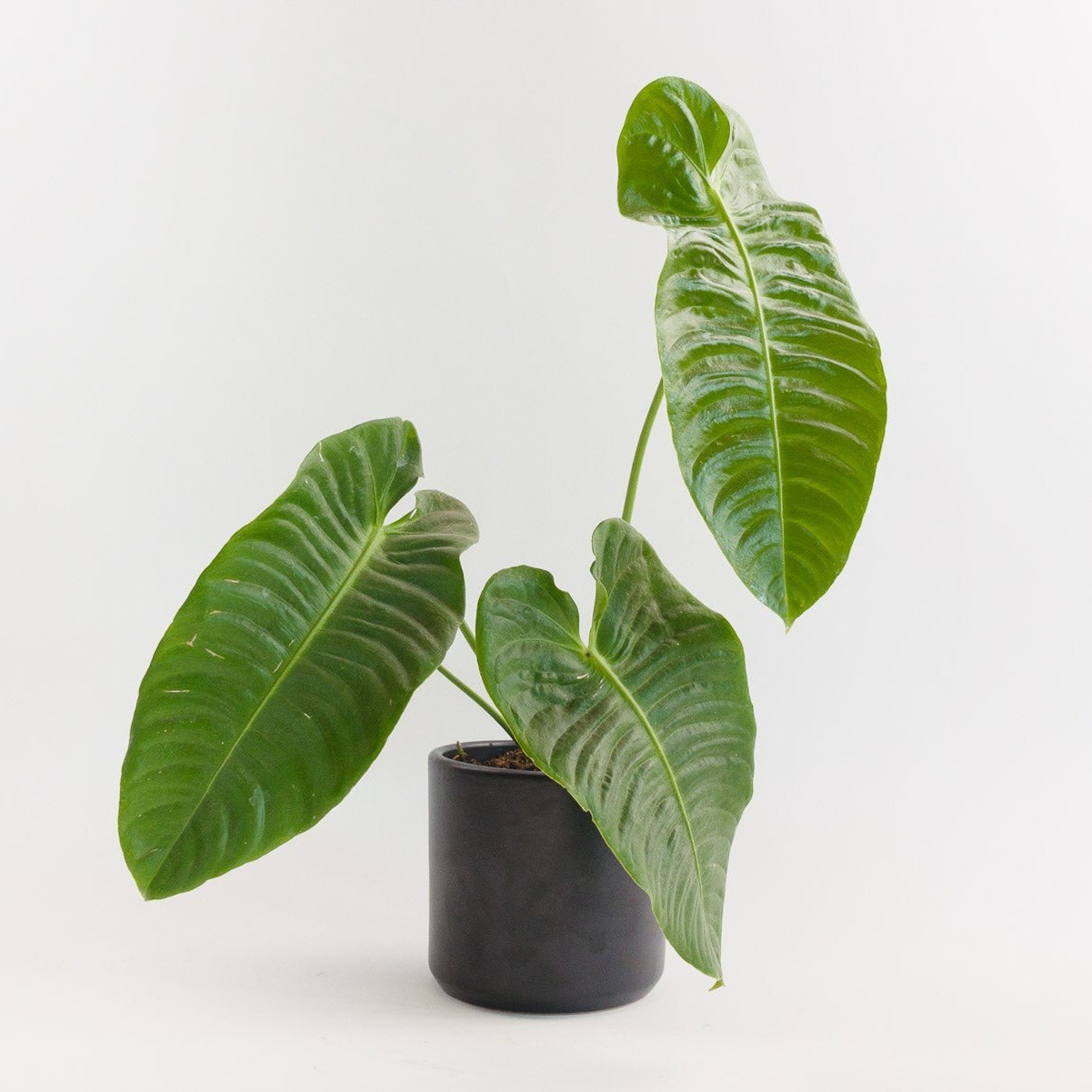
Anthurium veitchii Mast. is an accepted Colombian species in Araceae, recorded from Antioquia and Chocó as a wet-tropical epiphyte. Botanical descriptions emphasize a short stem, terete petiole, elongate-oblong blade, many primary lateral veins and a strongly structured surface.
Kew treats the historical name A. veitchii var. acuminatum as a synonym, not a current accepted variety. Exact searches do not establish Queen or King as botanical ranks. Those labels may still be useful within a seller’s inventory—but only when tied to current photographs and measurements.
| Label | Useful meaning | Verify before buying |
|---|---|---|
| A. veitchii | Accepted species identity | Corrugation, whole plant and provenance |
| Queen | Seller’s horticultural descriptor | Exact photo, blade length/width and source clone |
| King / wide form | Seller’s comparative form descriptor | Same measurements at comparable maturity |
| 8-inch pot | Current container format | Plant dimensions, roots and whether photo is exact |
Compare proportions at the same stage
A juvenile leaf and a mature leaf can differ substantially. Compare leaves of similar maturity, and request actual length and width rather than judging a cropped photo. Background, camera angle and perspective can make a blade appear narrower or wider than it is.
Use several successive leaves. A single narrow blade does not prove a stable Queen form, and a single broad blade does not prove a wide clone. Provenance matters most when a seller claims a specific clonal line.
Space and root-zone checks
Long corrugated blades need unobstructed expansion space. Keep new growth away from walls, shelves and strong fans. The species is epiphytic, so use an aerated, structurally stable root zone matched to the active roots—not an oversized pot chosen for several years of imagined growth.
Water when pot weight, depth moisture, drainage behavior and root activity agree, then drain. A top-inch or weekly rule ignores container depth, warmth and root mass. Feed only a rooted plant in stable growth, using the product label and accounting for water/substrate mineral load.
Inflorescence and display expectations
The old page invented large red flamingo-like spathes. CATE morphology describes an ivory-white spathe and whitish-rose spadix. Buy this species for leaf architecture; an inflorescence is not evidence of a Queen label and lack of flowering is not automatically a care failure.
Troubleshoot from combined evidence
| Pattern | Check first | Response |
|---|---|---|
| New leaf creases | Contact, fan, pests and dry-down during expansion | Protect the next leaf; old creases remain |
| Yellowing + heavy pot | Depth moisture, cold, odor and roots | Restore warmth/air; inspect if decline spreads |
| Weak corrugation | Leaf stage, genetics, roots, light and camera angle | Compare the next hardened leaf before relabeling |
| Label does not match photo | Exact vs representative image and seller provenance | Request clarification before purchase |
Propagation does not create a formal form
Vegetative division can preserve a clone’s genetics when the section retains viable growth tissue and preferably roots. A leaf alone cannot regenerate a complete Anthurium. Seedlings can vary and should not inherit a Queen or wide-form promise without selection and evidence. Use the Anthurium propagation guide for method boundaries.
Buying checklist
- Accepted identity: confirm Anthurium veitchii, not a velvet look-alike.
- Label source: ask what Queen means for this seller or clone.
- Photo type: exact item, representative batch or mother plant.
- Measurements: current blade length and width at a stated stage.
- Roots and pot: current medium, establishment and actual container.
Use the accepted-species Veitchii guide for morphology and general care, the rare Anthurium buying guide for verification and the Anthurium collection for live stock. Compare the current Queen listing with the King listing using the same evidence.
Veitchii Queen FAQ
Is Queen a separate Anthurium species?
No. Current Kew taxonomy accepts Anthurium veitchii; Queen is a horticultural descriptor, not an accepted species or infraspecific rank.
Is Queen always narrower than King?
Do not treat that as a universal botanical rule. Compare seller-defined material using actual measurements, maturity and provenance.
Does it produce red flamingo flowers?
No. The species description gives an ivory-white spathe and whitish-rose spadix; corrugated foliage is the main display.
Can seed reproduce the Queen label?
Seedlings can vary. A label tied to a clone or selected form needs provenance and current-plant evidence.
