
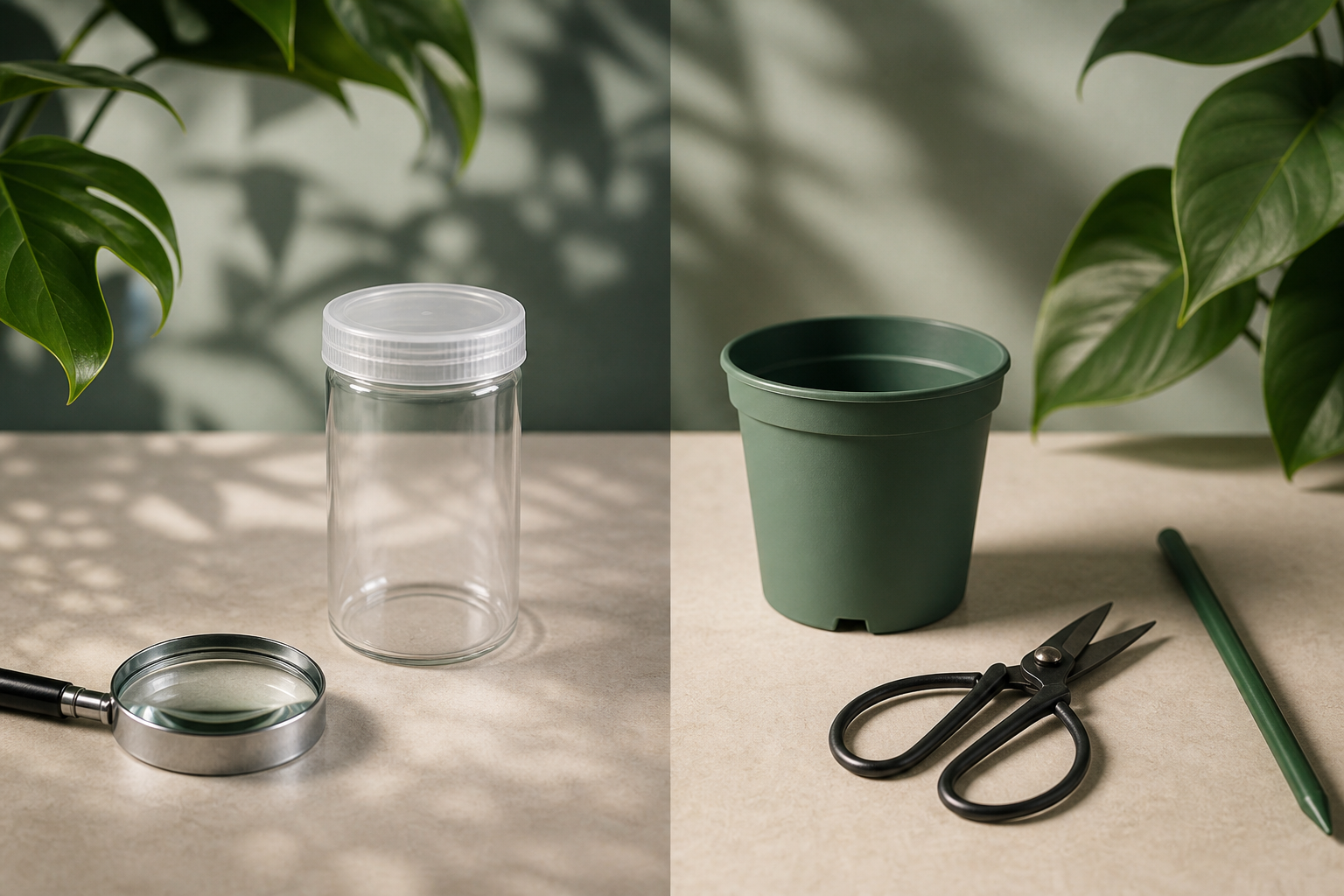
Tissue culture and home propagation solve different starting problems. One is a commercial in-vitro production format; the other begins with plant material you already have. Compare the starting point before comparing outcomes.
Choose the method by the material in front of you
| Method | Starting point | Reader decision |
|---|---|---|
| Tissue culture | A plantlet or vessel produced through a controlled commercial lab process. | Decide whether the current format and transition needs suit your setup. |
| Node or cutting propagation at home | Existing viable plant material with the relevant structure already present. | Use a species-specific home-propagation guide for the material you can observe. |
| Division or offsets | A plant that naturally presents a separable growth point or offset. | Confirm that the plant’s structure supports this method before attempting it. |
Tissue culture is not a home recipe and home propagation is not a way to recreate commercial in-vitro culture. Neither label alone proves genetic identity, mature traits, health, readiness or a guaranteed result. The live listing and visible material remain evidence for the decision in front of you.
Compare the starting evidence: a culture-format listing needs a transition plan, while home propagation starts with a node, cutting or division that you can inspect directly.
Follow the appropriate next guide
If you are choosing a tissue-culture format, start with format selection for tissue-culture plants. If you have an established plant, use the relevant home-propagation owner, such as Scindapsus propagation or Alocasia propagation, rather than borrowing a tissue-culture protocol.
This comparison stops at method choice. It does not provide a sterile-culture protocol, a claim about cloned outcomes or a universal propagation schedule.
