
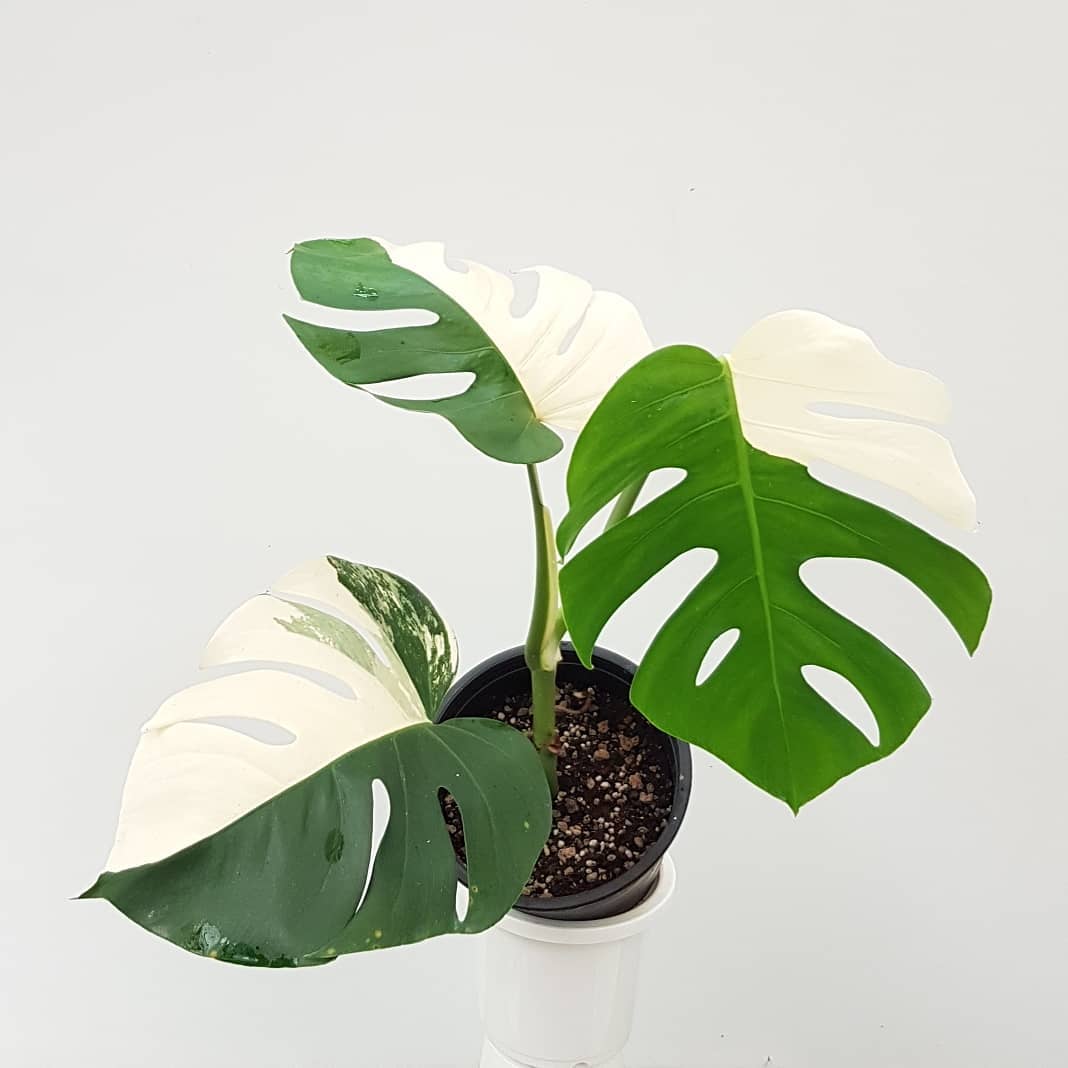
If you need broad identification and care rather than a label comparison, start with the Monstera Albo identity and care guide.
White Tiger vs Albo: quick comparison
| Question | Albo | White Tiger label |
|---|---|---|
| Botanical species | Monstera deliciosa | Usually applied to variegated M. deliciosa; not a separate accepted species in the records cited here |
| Verifiable horticultural name | ‘Variegata’, ‘Albovariegata’ or ‘Albo-Variegata’ appear in institutional records | Needs a seller-specific clone, breeder or registry record to establish a distinct cultivar |
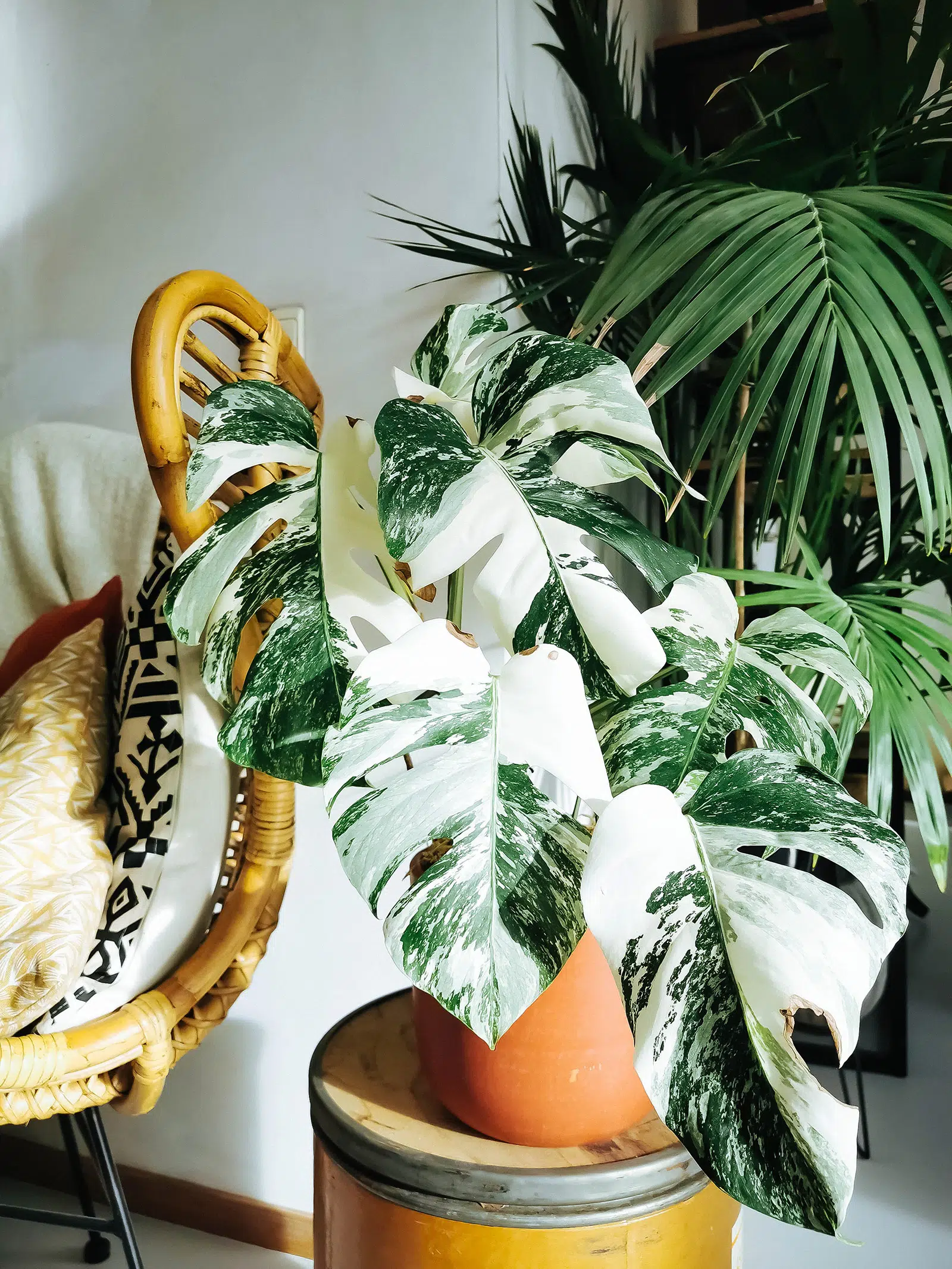
| Typical seller promise | Irregular white and green sectors, splashes or marbling | Often finer white-green marbling, “tiger” streaking or a selected high-contrast pattern—but usage varies |
| Care | Climbing M. deliciosa care adjusted for reduced green tissue | Same unless the seller documents a genuinely distinct clone with different behavior |
| Propagation | A viable stem node and axillary bud are required | The same; a label cannot make a leaf-only cutting viable |
| Premium decision | Pay for the actual plant, roots, active growth and evidence | Do not pay extra for the words alone |
What names can be verified?
Kew accepts Monstera deliciosa as the species. Its separate record for Monstera deliciosa var. borsigiana treats that name as a synonym of M. deliciosa. Therefore “Albo Borsigiana” can be useful marketplace shorthand, but it is not evidence that the plant belongs to a separately accepted species.
The Royal Horticultural Society accepts M. deliciosa ‘Variegata’, while Singapore’s NParks records M. deliciosa ‘Albo-Variegata’. A US plant patent for another Monstera also uses unpatented M. deliciosa ‘Albo’ as its commercial comparator, describing irregular cream-white flecks, blotches and larger solid pale portions.
Those sources give Albo/Variegata a defensible horticultural boundary. They do not define White Tiger as a separate botanical taxon, prove a universal pattern or authenticate every Albo listing.
Is White Tiger a separate cultivar?
It can be a useful seller or clone label only when the seller explains what it identifies. The International Aroid Society’s cultivar guidance requires cultivated plants to be distinct, uniform and stable through appropriate propagation. It also states that plants that cannot be reliably distinguished should not receive separate cultivar identities merely because their origins or stories differ.
In current trade use, White Tiger may refer to a marbled Albo selection, fine white-and-green streaking, a high-white plant, a particular clone or sometimes an alleged “large form.” Those meanings conflict. A seller photo may be genuine while the category boundary remains undefined.
Use this wording when evidence is limited: “White Tiger-labelled variegated Monstera deliciosa.” That describes the offer without turning a marketing label into settled taxonomy.
Can leaf pattern separate White Tiger from Albo?
Not reliably from one leaf. Albo variegation can produce broad sectors, half-moon divisions, flecks, marbling and nearly green or nearly white leaves on the same stem. A “tiger-striped” blade may be the seller’s selection criterion, but the pattern must repeat from the relevant growth point before it becomes useful clone evidence.
Use a five-part identity check
- Whole plant: request the stem, petioles and several hardened leaves in neutral light.
- Leaf sequence: compare at least three consecutive leaves rather than the whitest one.
- Active growth point: inspect the node and axillary bud that will produce the next shoot.
- Source history: ask whether the label follows a documented mother plant, clone or only the current pattern.
- Offer identity: establish whether every image is the actual plant, a representative batch or a mature reference.
Do not identify by price, a filtered photo, white percentage or the word “rare.” None of those creates a stable cultivar boundary.
Why the node matters more than the best leaf
The University of Minnesota’s Monstera propagation guide confirms that a cutting needs a node and axillary bud; a leaf and petiole alone will not produce a new shoot. For a variegated cutting, also inspect how green and pale tissue meet around the node and bud rather than assuming the attached leaf predicts the next one.
UF/IFAS explains that chimeral variegation can change as a shoot grows, including transitions toward fully pigmented or non-pigmented tissue. That is why no honest seller can guarantee the exact pattern or white percentage of every future leaf.
| Offer | Evidence to require | Main risk |
|---|---|---|
| Established actual plant | Current roots, active growth, whole stem and several leaves | Higher landed cost; hidden root or pest problems |
| Rooted cutting | Exact node/bud, current roots and mother-plant sequence | New shoot may express a different balance |
| Unrooted cutting | Firm viable node, intact bud, fresh-cut condition and mother plant | Rooting and rot risk plus uncertain next pattern |
| Leaf-only “cutting” | Reject unless a true stem node and bud are shown | It cannot start a new Monstera vine |
| Representative or batch offer | Variation range, minimum format and dispatch-selection rule | The delivered plant may not match the hero image |
Care is not a White Tiger differentiator
Both labels usually point to variegated Monstera deliciosa, so their basic decisions are the same: bright usable light without sudden scorch, an airy root zone, thorough watering followed by drainage, and a vertical support as the stem climbs.
- Light: enough for compact growth and usable green tissue; increase exposure gradually. More light cannot manufacture a promised stripe pattern.
- Water: use pot weight, a deeper moisture check and drying speed; do not water from a fixed calendar.
- Support: tie the stem loosely to a board or pole, leaving petioles free to move.
- Variegation: log several leaves and nodes before pruning. One green or white leaf is not a command.
- Arrival: isolate and inspect first; avoid stacking repotting, feeding, pruning and stronger light on the same day.
The “better” plant is the one with healthy roots, a viable growth point, enough green tissue for your conditions and a form you can support. Use the nine-check Monstera Albo buyer guide for seller, import, shipping and aftercare due diligence.
When is a White Tiger premium justified?
A premium may be rational for a healthy established plant, traceable clone history, a well-documented repeated phenotype, strong roots or a particularly useful stem/growth-point balance. It is not justified by a renamed stock photo or an undefined “tiger” adjective.
- Compare like-for-like formats: actual plant versus actual plant, not mature reference versus unrooted node.
- Ask the seller to define White Tiger in observable terms and explain whether it is a clone name or a pattern grade.
- Request current roots, stem, node, bud and consecutive leaves.
- Calculate landed cost, import documents, weather risk and refund limits.
- Save the listing, messages and dispatch evidence before payment.
For current variants, stock and transaction terms, use the current Monstera Albo product page or browse the Monstera collection. Treat all prices and availability as live catalog data, not permanent facts in this comparison.
Safety around people and pets
Frequently asked questions
Is Monstera White Tiger the same as Albo?
White Tiger is often used as a trade or selection label within variegated Albo-type Monstera deliciosa, but sellers do not use it consistently. Without a traceable distinct clone or cultivar record, do not assume it is a separate cultivar.
Is Monstera borsigiana a separate species?
Kew treats Monstera deliciosa var. borsigiana as a synonym of Monstera deliciosa. “Borsigiana” remains common marketplace shorthand but should not be presented as an accepted separate species.
Does White Tiger always have more white?
No universal record defines a required white percentage. A seller may use the label for fine marbling, higher white, a selected clone or another pattern. Ask for that seller’s definition and the exact plant.
Can light turn an Albo into a White Tiger?
No. Light affects growth and plant performance, but it cannot convert an undocumented plant into a distinct cultivar or guarantee tiger-like streaks.
Can a White Tiger leaf grow into a plant?
Only if the cutting includes a viable stem node and axillary bud. A leaf and petiole without that growth point cannot produce a new Monstera vine.
Which one should I buy?
Choose the best documented actual plant or cutting for your risk tolerance. Healthy roots, viable node/bud, enough green tissue, traceable source and clear seller terms matter more than whether the listing says Albo or White Tiger.
